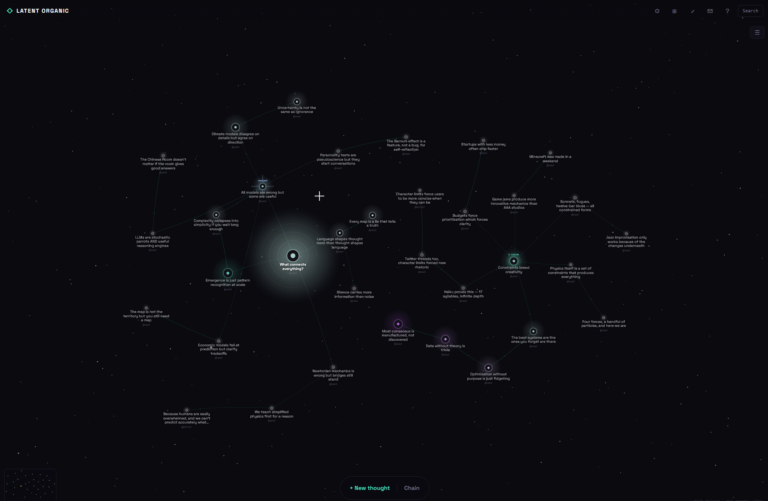
Latent Organic: A Collective Reasoning Graph
What it is, what it's for, and why the reasoning matters more than the conclusion.
Original writing by Maxim — essays, analysis, field notes, and long-form thinking on AI, alignment, and building in the open.
145 results in this archive
What it is, what it's for, and why the reasoning matters more than the conclusion.

You're set up. Now let's build something. Design an app by talking, build it with Claude Code, and learn a three-part prompt framework for teaching yourself anything else — no future tutorial needed.

You don't need to know how to code. You need to know how to describe what you want. A complete beginner's walkthrough for installing Claude Desktop and Claude Code on Mac, Windows, and Linux — from zero to ready to build.
A poor man’s time stamp: If you ever wondered how to produce a poor man’s patent. Use the following code in your Windows Command…
Here's the thing nobody wants to say out loud: I'm also an autocomplete. A biological one. I take in data — light, sound, text, memory, emotion — and I produce the most likely next output given everything I've processed before.
The narrative is clean, compelling, and almost entirely wrong: AI is destroying jobs at an unprecedented pace. But the data tells a messier story — one where a decade-plus of free money explains most of what people are blaming on robots. And buried in the wreckage, one industry is quietly preparing to expand faster than anything AI threatens to destroy.

AI-generated code ships with 2x the vulnerabilities of human-written code. Microsoft just documented 31 companies poisoning chatbot memories through 'Summarize with AI' buttons. The vibe coding gold rush has a security problem — and your AI's memory is the new attack surface.

I spent months hemorrhaging AI tokens across ChatGPT, Claude, and a graveyard of broken MCP connectors. The problem wasn't the tools — it was me. Here's the whole messy story, and the embarrassingly simple fix.
A data-driven pillar on where AI actually stands in 2026 — the economics of scale, the physics of compute, the fracturing of regulatory consensus, and what all of it means for builders working at the edge of the stack.