The thing that gets lost in every week’s worth of AI announcements is proportion. A new model drops, a benchmark falls, a company raises a round that would have seemed fictional five years ago — and then the next one. The pace makes it hard to see the shape of what’s actually being built. This piece is an attempt to hold still for a moment and look at the structure underneath the noise: the economics of scale, the physics of compute, the fracturing of regulatory consensus, and what alignment debates actually mean for anyone trying to build something honest and durable in this environment.
Key Statistics: 2026 Snapshot
280×
Decline in inference cost for GPT-3.5–level performance between November 2022 and October 2024, per Stanford HAI AI Index Report 2025 [1]
2×+
Projected increase in global data center electricity demand by 2030, driven primarily by AI workloads, per the International Energy Agency’s April 2025 report [2]
Aug 1, 2024
Date the EU AI Act entered into force, establishing the world’s first comprehensive binding legal framework for artificial intelligence [3]
I. The Economics of Scale

The first empirical scaling laws — the observation that model performance improves predictably as compute increases — were published by Kaplan et al. in 2020 [6]. The practical implication was stark: if you could afford to scale, you would improve. This gave frontier labs a legible theory of progress and, more importantly, a justification for spending that previously would have required faith.
Two years later, Hoffmann et al. at DeepMind complicated that picture. The Chinchilla paper showed that raw parameter growth wasn’t the whole story — the ratio of model size to training data mattered just as much [5]. Larger models trained on insufficient data were, in a precise sense, wasteful. The industry absorbed this lesson unevenly. Some labs recalibrated toward data-efficient training; others continued scaling parameters on the theory that data constraints were solvable engineering problems. Both camps had evidence on their side.
What happened to the cost of running these models is genuinely striking. According to Stanford’s AI Index 2025, the cost of inference at GPT-3.5–level performance fell by approximately 280 times between November 2022 and October 2024 [1]. That is not a gradual decline — it is a structural price collapse driven by hardware improvements, software optimization, and intensifying competition among providers. The significance for builders is direct: workloads that were economically marginal in 2022 are now routine. Workloads that seem marginal today may be routine within eighteen months.
It is worth being precise about what this figure does and does not tell us. Inference cost falling 280× means running a given model got dramatically cheaper. It says nothing definitive about frontier training cost, which remains largely opaque — labs do not publish audited compute or cost disclosures. The AI Index documents exponential growth in training compute over time, but the dollar figures circulated publicly are estimates built on assumptions about hardware pricing and utilization, not line items from financial statements [1]. The AI Index itself draws on method-backed estimation sources such as Epoch AI for these figures — useful as directional signals, but a different category of evidence than an audited disclosure. Treat them accordingly.
II. Compute as Physical Constraint
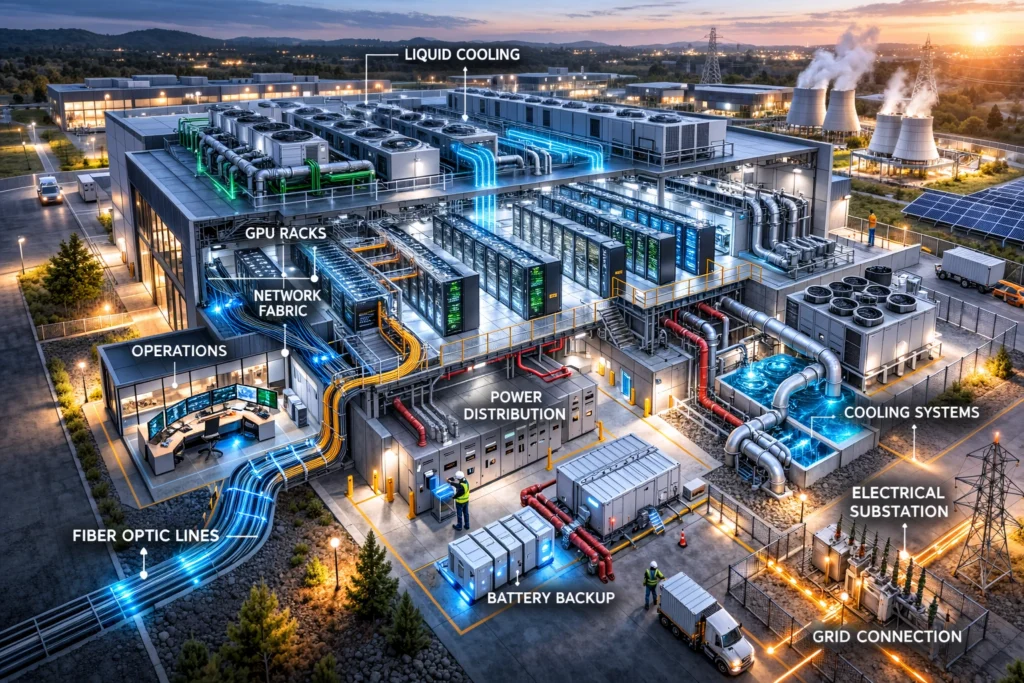
There is a tendency to discuss AI as if it exists primarily in software — algorithms, weights, token probabilities. The reality is increasingly industrial. NVIDIA reported record fiscal year 2026 revenue driven by AI data center demand [7], a figure that reflects not an abstraction but the physical accumulation of chips, racks, power infrastructure, and cooling systems in locations chosen partly based on where water and electricity are cheap.
The cloud partnership arrangements that underpin frontier AI are not static contracts — they are evolving relationships with real strategic weight. OpenAI operates substantially on Microsoft Azure infrastructure; that partnership has been publicly extended and renegotiated over time, with Microsoft describing updated terms including product and cloud arrangements as recently as October 2025 [8a][8b]. Anthropic’s relationship with Amazon is similarly layered: Amazon made a significant multi-billion-dollar investment in Anthropic [9a], and separately, Anthropic expanded its infrastructure work with AWS through a dedicated Trainium compute partnership [9b]. These are distinct events with different implications — the investment shapes ownership and governance; the infrastructure partnership shapes where and how models are trained and served. Neither is simply a distribution deal.
The energy dimension of this is not a footnote. The International Energy Agency’s April 2025 report projects that global electricity demand from data centers could more than double by 2030, with AI identified as a primary driver [2]. Grid operators in regions with high data center concentration are actively managing this as a planning constraint. The IEA’s figures are projections, not guarantees — efficiency gains could moderate demand growth, and the pace of AI deployment is genuinely uncertain — but the direction is not seriously disputed. The question is magnitude, not direction.
What this physical concentration means structurally is worth sitting with. Frontier training is not accessible to organizations without either very large capital reserves or negotiated cloud access at scale. The compute layer has become, in practical terms, a small number of chokepoints. That is not inherently sinister — industrial concentration often follows from genuine economies of scale — but it is a fact with implications for who gets to build at the frontier, and what dependencies everyone else accepts when they build on top of it.
III. The Regulatory Fork

The EU AI Act entered into force on August 1, 2024 [3]. One distinction worth flagging for anyone acting on this: “entered into force” is not the same as “all obligations now apply.” The Act is structured with staggered compliance timelines — prohibitions on unacceptable-risk systems took effect first, obligations for general-purpose AI and high-risk systems follow on their own schedules. As of early 2026, implementation timelines remain on track per Reuters reporting through 2025 [10], but the specific milestone that matters to any given organization depends on what they are building and who they are selling to. The Act applies to any entity placing AI systems on the EU market, regardless of where development occurs, which extends its practical reach considerably.
The United States took a sharply different trajectory. Executive Order 14110 — the Biden administration’s October 2023 framework establishing federal AI governance priorities — was revoked by President Trump on January 20, 2025, within hours of taking office [11]. It was replaced on January 23, 2025 by Executive Order 14179, “Removing Barriers to American Leadership in Artificial Intelligence,” which reoriented federal policy away from oversight requirements and toward competitiveness and deregulation. A further executive order in December 2025 sought to establish a national AI policy framework that would preempt state-level AI regulation, though legal challenges to state enforcement authority remain ongoing as of this writing [11].
NIST’s AI Risk Management Framework continues to provide voluntary operational guidance that many organizations use regardless of regulatory mandate [12]. It is worth noting the distinction: the NIST framework persists as a practical tool even as the executive-branch policy environment around it has shifted substantially. Voluntary frameworks tend to have stickiness that executive orders do not, because organizations internalize them into procurement, audit, and contract requirements that outlast any single administration.
What this creates, at minimum, is a divergent compliance environment for any organization operating across jurisdictions. The EU AI Act imposes real obligations with real penalties. The US federal posture is currently de-regulatory. State laws are proliferating — Colorado’s AI Act is set to take effect June 30, 2026, and California’s AI Transparency Act follows in August 2026. The patchwork is not hypothetical; it is the operating reality for any organization building AI products at meaningful scale.
IV. The Alignment Question, Honestly Stated
Alignment is a word that carries a lot of weight and sometimes more heat than it can bear. At its most basic, it refers to the problem of ensuring AI systems do what their developers intend them to do, and what their users and society need them to do, across the range of circumstances they actually encounter. That problem has technical dimensions and governance dimensions, and neither set of solutions has yet been proven adequate at frontier scale.
Reinforcement Learning from Human Feedback, the technique by which human preference signals are used to shape model behavior, was formalized in work by Christiano et al. in 2017 [4]. It is now standard practice across frontier labs. The limitation most discussed in the research community is scalable oversight: as models become more capable, human evaluators may be less able to reliably judge which outputs are correct or aligned. The technique that works adequately at current capability levels may degrade as a control mechanism at higher ones. This is not a fringe concern — it is the subject of active research at Anthropic, OpenAI, DeepMind, and academic institutions.
Anthropic’s Constitutional AI approach represents one proposed path forward: rather than relying solely on direct human feedback, it uses an explicit set of principles to guide model self-critique during training [13]. The idea is to make alignment more legible and auditable than an implicit preference-trained signal. Whether this scales to systems substantially more capable than current models is not yet known — that is an honest statement about where the research stands, not a criticism of the approach.
OpenAI’s Charter acknowledges uncertainty regarding AGI timelines and frames long-term safety as a core commitment [14]. It is worth reading carefully, because it makes explicit what most organizations in this space leave implicit: that the systems being built could, at some future capability level, have effects that are difficult to reverse. There is no scientific consensus on when or whether such capability thresholds will be reached. Claims of specific timelines from any direction — imminent AGI or AGI as permanently distant — exceed what the evidence currently supports.
What is tractable right now is narrower than what gets debated in public: better evaluation methods, more legible training processes, clearer documentation of model behavior, and governance structures that can respond faster than legislative cycles. These are not glamorous problems. They are the ones that matter most in the near term.
V. Where Independent Builders Actually Fit

Frontier training is capital-concentrated and is likely to remain so. That much is clear. What does not follow from this is that the economic opportunity is equally concentrated. The 280× decline in inference cost [1] means that the cost of building on top of frontier models has dropped dramatically, even as the cost of building new frontier models has not. This asymmetry is where independent builders have real room to operate.
OpenAI and Anthropic publish API pricing publicly [15][16], which means the unit economics of building on frontier models are legible in a way that was not true even two years ago. Meta’s Llama 3 and Llama 3.1 releases continue a trend of capable open-weight models that can be deployed without per-token API costs at all, for teams with the infrastructure to run them [17a][17b]. Hugging Face operates as the primary distribution hub for open-weight models and research artifacts, which has meaningfully lowered the barrier to accessing and working with non-API models [18].
None of this changes the structural reality of the compute layer. Independent builders are, in most cases, building on infrastructure they do not own, using models they did not train, subject to pricing and terms they cannot individually negotiate. That dependency is real and worth being clear-eyed about. What it doesn’t determine is whether the work built on top of that infrastructure is valuable, differentiated, or durable.
The advantage that does not require capital at frontier scale is specificity. A model served via API is general by design — it has to serve millions of different users across thousands of different contexts. A workflow, a data layer, a domain model, a set of evals built for a particular vertical has the opportunity to be genuinely better than the general case for the people it serves. That is not a consolation prize. It is the structure of how useful software has always been built: specific enough to matter, integrated enough to be hard to replicate quickly.
The other asymmetry worth naming is transparency. Frontier labs are, by the nature of their competitive position, not fully transparent about training data, safety testing, failure modes, or long-term product commitments. An independent builder operating in a specific domain can be more transparent with their users than a general-purpose model provider can afford to be. That transparency is itself a form of trust infrastructure — and trust, at the level of an individual organization’s relationship with its users, is not something that can be automated at scale.
What This Adds Up To
AI in 2026 is not a technology in search of applications. It is a technology with demonstrated capabilities, significant deployment momentum, contested governance, and unresolved technical questions at the capability frontier. The optimistic reading and the cautious reading are both available from the same set of facts — which is exactly the condition that rewards clear thinking over loud takes.
Inference is cheap and getting cheaper. Compute concentration is real and growing. Regulatory frameworks are diverging across jurisdictions in ways that create compliance complexity for anyone building at scale. Alignment research is active and honest about what remains unsolved. Open-weight models are expanding access to foundation-level capability. The market for specific, integrated, trustworthy applications built on top of general infrastructure is genuinely open.
None of those statements are contradictory. They are just the shape of the thing, held still long enough to see.
References
- Stanford HAI, AI Index Report 2025
- International Energy Agency, Electricity 2025, April 2025
- European Commission, EU AI Act enters into force, August 1, 2024
- Christiano et al., Deep Reinforcement Learning from Human Preferences, 2017
- Hoffmann et al. (DeepMind), Training Compute-Optimal Large Language Models (Chinchilla), 2022
- Kaplan et al. (OpenAI), Scaling Laws for Neural Language Models, 2020
- NVIDIA, Fiscal Year 2026 Earnings Release
- [8a] OpenAI–Microsoft Partnership Extension announcement; [8b] Microsoft, The Next Chapter of the Microsoft–OpenAI Partnership, October 28, 2025
- [9a] Amazon, Amazon–Anthropic Investment Announcement; [9b] Anthropic, Anthropic Expands Partnership with AWS on Trainium Infrastructure
- Reuters reporting on EU AI Act rollout timeline, 2025
- Federal Register: Executive Order 14110 (revoked January 20, 2025); Executive Order 14179, January 23, 2025; Executive Order 14365, December 11, 2025
- NIST, AI Risk Management Framework
- Bai et al. (Anthropic), Constitutional AI: Harmlessness from AI Feedback, 2022
- OpenAI Charter
- OpenAI API Pricing (public)
- Anthropic API Pricing (public)
- [17a] Meta, Llama 3 Model Release; [17b] Meta, Llama 3.1 Model Release
- Hugging Face Model Hub documentation

AI-generated editorial illustration · TemperatureZero · February 27, 2026
Keep reading the signal
Get the Daily Signal — a concise briefing on what actually matters in AI and the systems around it.
Subscribe FreeContinue the archive