What it is, what it’s for, and why the reasoning matters more than the conclusion.
By Maxim Starkweather
The Idea
Every platform on the internet captures what people think. None of them capture how they got there.
Twitter captures takes. Reddit captures reactions. Wikipedia captures conclusions that survived editorial committee. But the connective tissue — the reasoning that links a fact to an interpretation to a prediction to a question nobody thought to ask — that gets lost in the scroll. It exists for a few seconds in someone’s head, maybe surfaces in a comment thread where it’s buried between jokes, and then it’s gone.
Latent Organic is built to capture that connective tissue and make it visible.
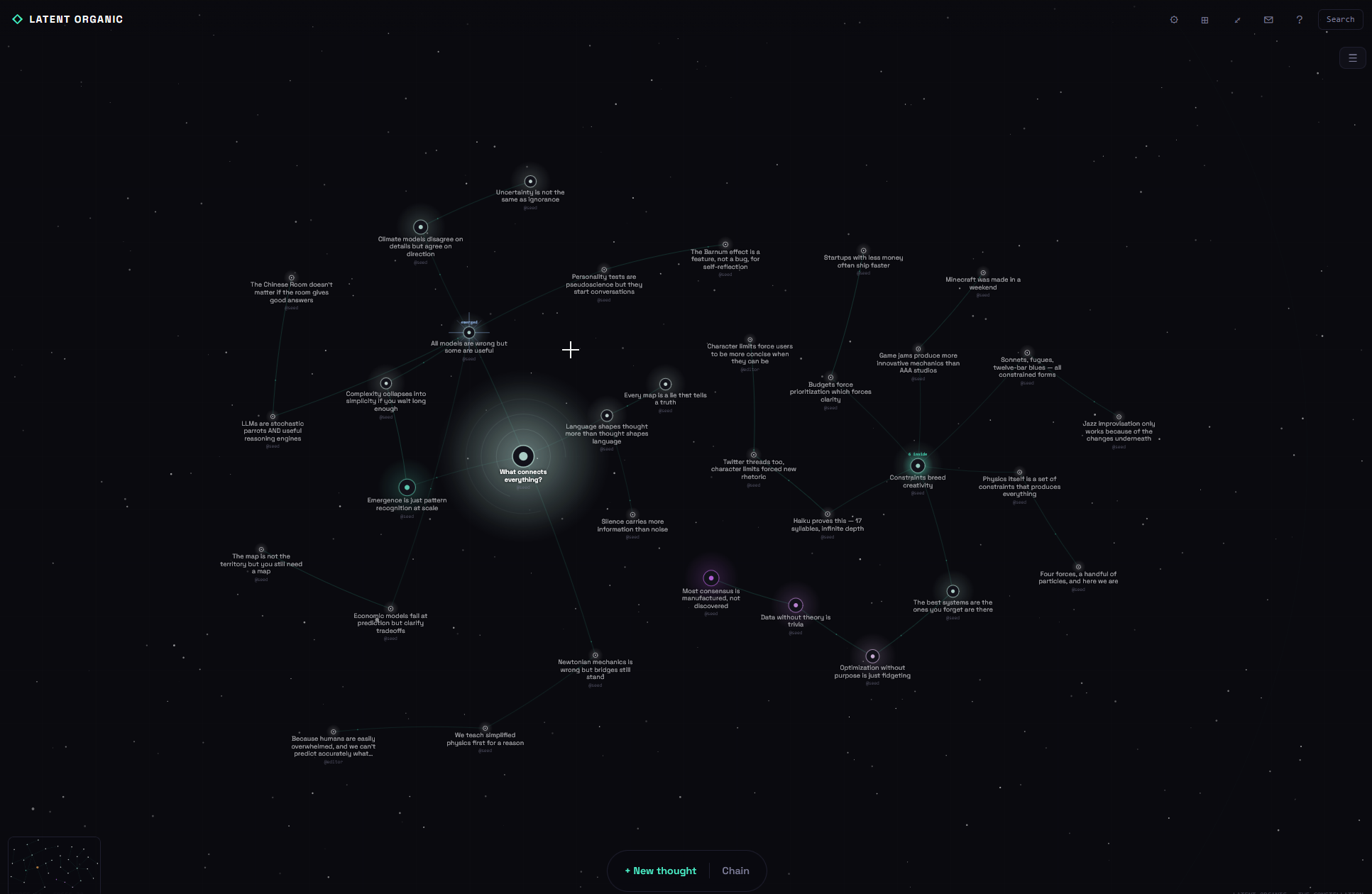
It’s a graph — a living constellation of ideas where every node is a thought and every connection between them is a human being saying this relates to that, and here’s why. The “here’s why” is the point. Not the node. Not the vote. The explanation on the connection. That’s the data that doesn’t exist anywhere else at scale: structured, attributed, community-evaluated records of how people actually reason through hard questions.
The graph starts from a single seed question pinned at the center. Right now, that question is: “What connects everything?”
Everything that follows grows outward from that seed. The shape of the constellation — when you zoom out far enough to see the whole thing — is the artifact. No single person’s contribution defines it. The emergent pattern of collective reasoning does.
How It Works
You open the graph and you see a constellation. Nodes float in space, connected by glowing lines. Each node is someone’s thought. Each line is someone saying these two thoughts are connected.
Contributing is simple by design:
Place a thought. Click into the graph and write your idea. No category to pick, no type to select — just your thinking in your own words. You can attach a link if you want to source it — a paper, an article, anything that supports or contextualizes what you’re saying. The link lives on the node as a reference, not a preview. The thought is yours. The link is your receipt.
Draw a connection. Drag from one node to another. Then write your explanation of why these two ideas are related. That explanation — your reasoning in your own voice — is the most valuable thing in the entire system.
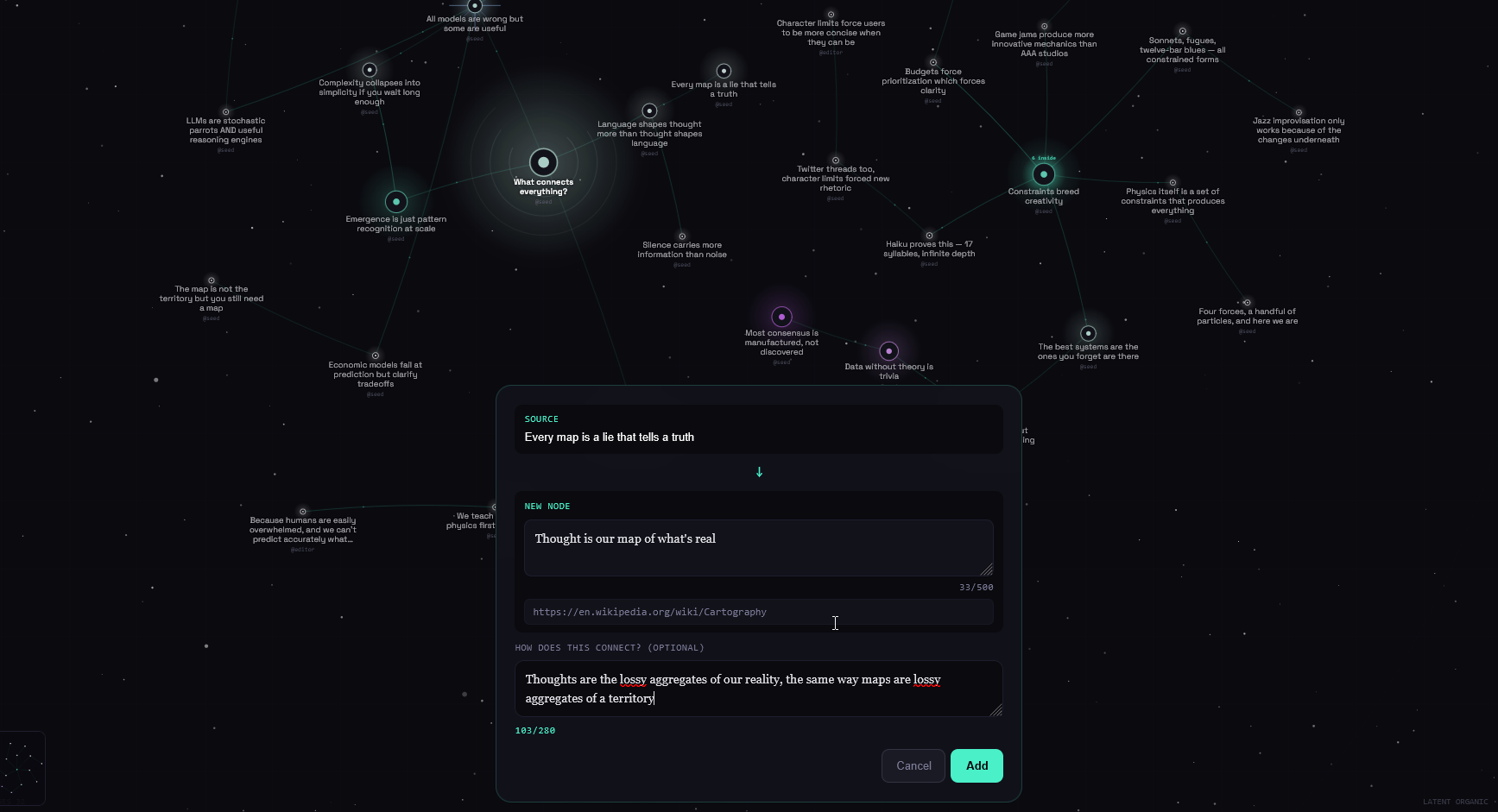
There are no dropdowns asking you to classify your thought. No taxonomic overhead. No formal ontology forcing you to decide whether your idea is an “interpretation” or a “prediction” before you’ve finished thinking it. The graph captures reasoning as it actually happens — in natural language, with all the hedging, uncertainty, and partial commitment that real thinking involves.
You can also vote. Every node carries a community score. Ideas that resonate glow brighter — a wider, more intense halo that makes them impossible to overlook. Ideas that the community finds wrong, harmful, or misguided don’t disappear — they shift through a bruise palette of deep purple and blood red, growing more opaque as the debate intensifies. Unvoted nodes sit ghostly and translucent. Heavily contested nodes become the most solid objects on the graph. You can’t miss them. You’re not supposed to.
This is deliberate. Painful ideas and wrong predictions are real parts of how we process the world. A map that only shows the approved route is a bad map. The contested nodes — and the connections people draw to explain why they’re contested — are some of the most interesting data the graph produces.
What Makes This Different
There’s no feed. No algorithm deciding what you see. No timeline. The graph is the interface — you navigate it spatially, zooming in to read individual reasoning chains and zooming out to see the emergent shape of collective thought.
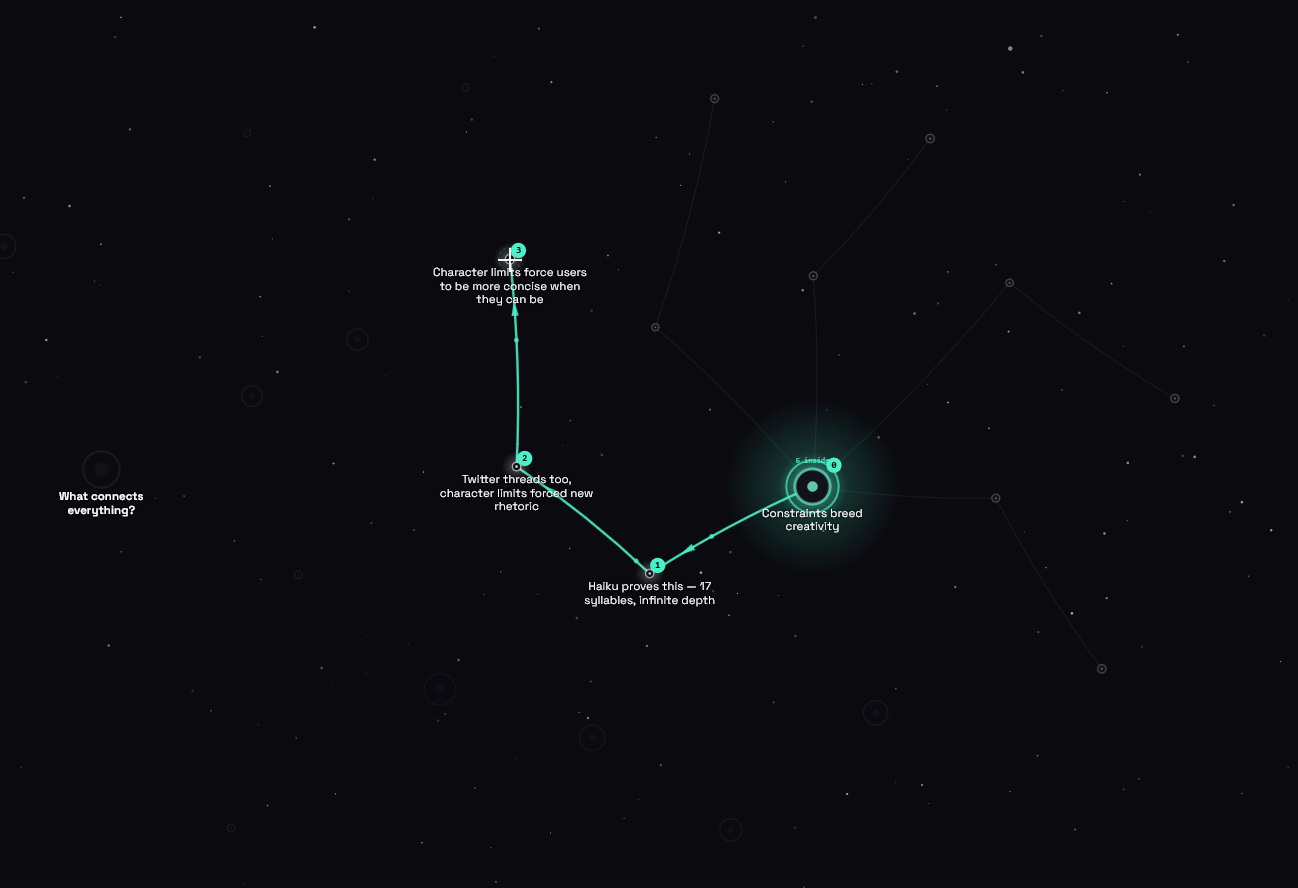
There’s no engagement optimization. A node becomes significant because many people chose to connect to it and explain why. Connection density is the only ranking mechanism — and now it’s the only sizing mechanism too. Nodes grow larger in proportion to how many connections they attract. A hub that five people built on is visibly bigger than a leaf at the end of a chain. Ideas rise through the structure of reasoning they attract, not through controversy, novelty, or timing.
The contribution model is deliberately low-friction. The reasoning is the data — not metadata about the reasoning. When someone writes “I think this connects because the same failure mode shows up in both cases, but I’m not sure it’s causal,” that freeform explanation is richer than any dropdown classification could produce. The uncertainty is signal. The hedging is signal. The way someone naturally articulates a connection they’re not fully sure about — that’s what thinking actually sounds like.
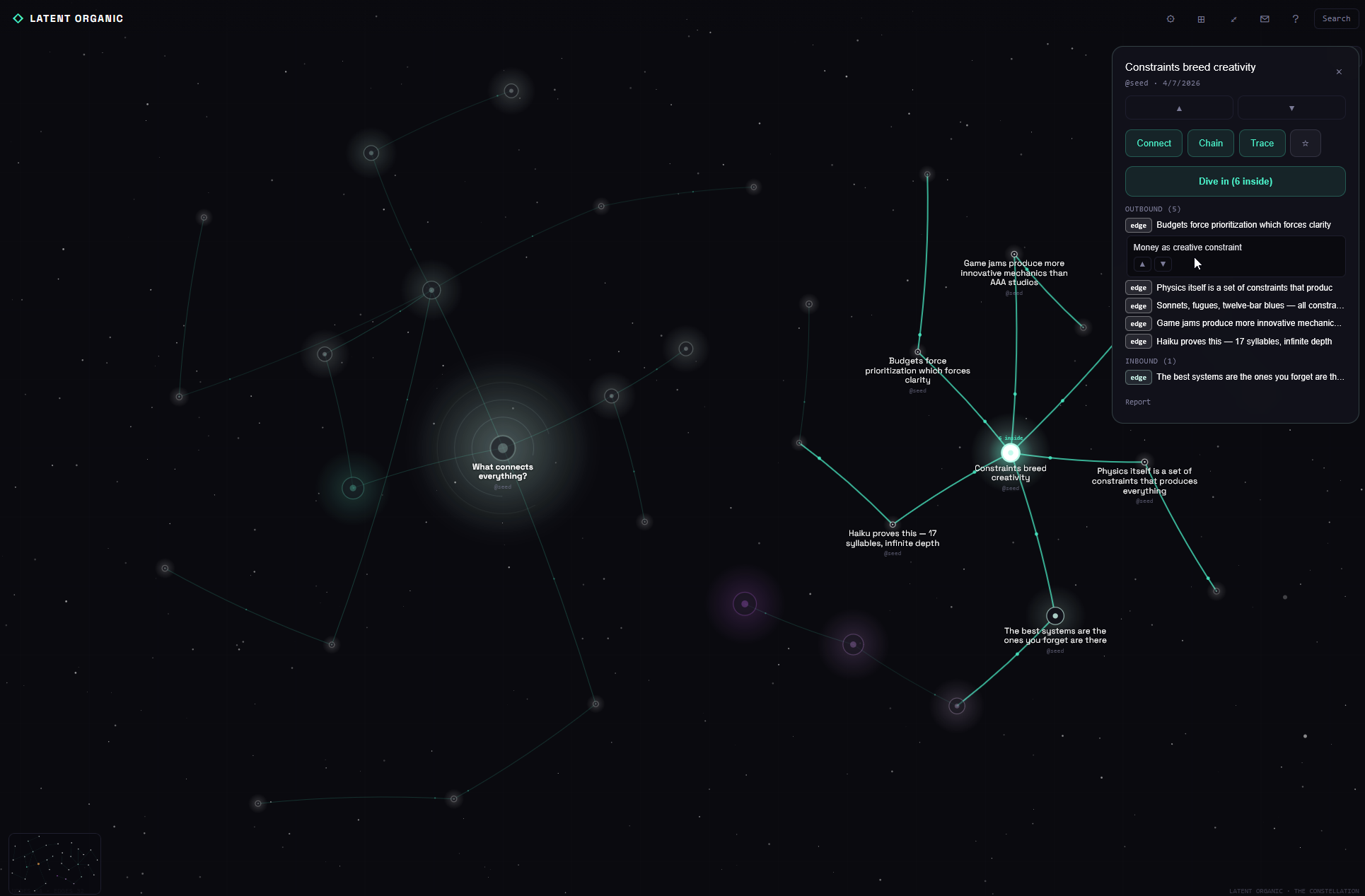
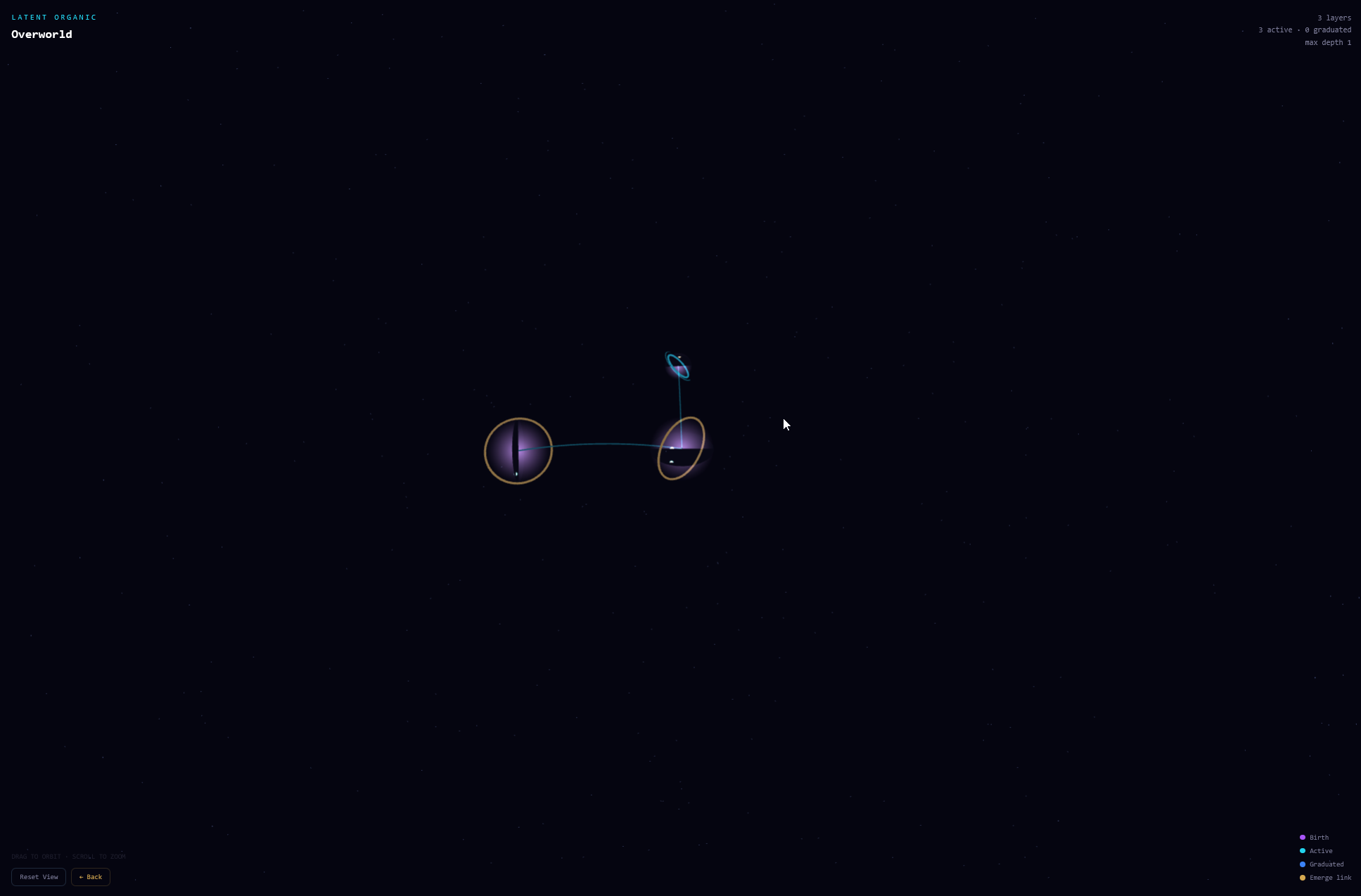
The graph grows fractally. When a region reaches enough density and community engagement, it can generate a new layer — a deeper level of abstraction that begins from whatever the collective signal identified as most significant. Each layer is its own constellation, and the layers stack. The architecture encodes the way ideas abstract naturally: from specifics to patterns to principles to questions that haven’t been asked yet.
Every contribution is persistent and attributed. Every connection carries a timestamp, an author, and a community vote score. Every edit creates a revision record. The graph remembers how it grew, not just what it contains.
Who This Is For
Latent Organic isn’t trying to be a social network. It’s not competing with Twitter for attention or with Reddit for engagement. The contribution model — place a thought, draw a connection, explain your reasoning — selects for people who enjoy structured argument and building on each other’s thinking.
The people this is built for are the ones who already think this way. Philosophy students who spend hours mapping the logical dependencies between positions. Debate participants who track the structure of an argument, not just its conclusion. Worldbuilders who construct coherent systems of interconnected ideas. Researchers who think in graphs naturally. Anyone who has ever been in a conversation and wanted to say “wait, let me draw this out.”
That’s the experience this graph is built to provide — except the drawing persists, other people can build on it, and the collective shape of everyone’s reasoning becomes something none of them could have produced alone.
The Bigger Picture
Every activated connection in the graph is a structured reasoning artifact: a source idea, a target idea, a written explanation, an optional source link, a timestamp, an author, and a community vote score. This is a data format that is genuinely scarce.
The internet has produced more text than any civilization in history. What it has not produced — at any meaningful scale — is structured records of relational reasoning. Why does A connect to B? How does C challenge D? What would it mean if E were true? These questions get answered in conversations that disappear, in comment threads that get buried, in classrooms where nobody’s recording. The answers exist in people’s heads and nowhere else.
Latent Organic is infrastructure for making those answers visible, persistent, and structured. At scale, the graph becomes something genuinely new: a navigable map of how a community of minds processes hard questions, with every reasoning step explained in natural language and every explanation evaluated by the community.
The freeform design is central to this. A graph that forces contributors into predefined categories produces data where humans performed reasoning into a structure someone else designed. A graph that captures reasoning in the contributor’s own words — with all the natural hedging, uncertainty, and partial conviction — produces data closer to the actual cognitive event. That difference matters if you care about what reasoning actually looks like rather than what it looks like when it’s been cleaned up for a taxonomy.
Whether that map has applications beyond being interesting to look at — in education, in research, in training AI systems to reason rather than to produce reasoning-shaped text — is a question the graph itself will answer as it grows.
Try It
The graph is live at graph.latentorganic.com.
The seed question is “What connects everything?” — an intentionally open question with no correct answer. What the graph captures isn’t the answer. It’s the topology of how different minds approach it, what they connect along the way, and where they disagree.
If you’re the kind of person who would enjoy placing your perspective in spatial relationship to someone else’s and writing a careful explanation of why you drew that connection — the graph is growing, and there’s space for yours.
Graph Engine v2.0 — April 2026
The layout engine that arranges the graph has been rebuilt from the ground up. The changes are invisible in the sense that nothing about the contribution model changed — you still place thoughts, draw connections, and explain your reasoning — but the visual experience is meaningfully different.
What changed:
Uniform spacing. The old engine used fibonacci-spiral mathematics to determine how far apart each ring of nodes sat. This produced organic, beautiful shapes — but the first two depth rings were crammed together while outer rings had too much space. Following a chain of reasoning meant your eyes had to jump unpredictable distances. Now every ring is uniformly spaced. Each hop along a chain covers the same visual distance. Chains read like paths with consistent stepping stones.
Connection-density sizing. Nodes used to grow based on vote count — a popularity metric that had nothing to do with structural importance. Now every node starts at the same base size and grows only in proportion to how many connections it has. The nodes that people keep building on become visibly larger. Not because they were upvoted, but because the graph literally grew around them. This is the design principle we wanted from the start: structural load-bearing importance, not applause.
Vote magnitude moved to glow and opacity. Votes still matter — they just don’t distort the layout anymore. Positive sentiment increases glow radius and brightness. Negative sentiment shifts color through the bruise palette. Total engagement increases fill opacity. An unvoted thought sits ghostly at half opacity. A heavily debated thought is the most solid, most opaque object on the graph. The information is all still there. It just lives in the right visual channel.
Adaptive expansion. When a node has many children crowding a single depth ring, the engine now pushes that ring outward just enough to prevent overlap, and shifts all downstream rings to preserve uniform gaps. Uncrowded regions stay tight. The graph breathes where it needs to.
The result is a graph that’s easier to read, easier to navigate, and more honest about what matters. Structure earns prominence. Popularity doesn’t.
Latent Organic is built and maintained independently by Maxim Starkweather under the TemperatureZero project. For the philosophical foundations, read The Uncarved Stone. For questions or early access, reach out at [email protected].
AI-generated editorial illustration · TemperatureZero · April 9, 2026
Keep reading the signal
Get the Daily Signal — a concise briefing on what actually matters in AI and the systems around it.
Subscribe FreeContinue the archive