In March 2026, the production team behind Critterz lost a key piece of their workflow. The film — an AI-assisted animated feature backed by AGC International and Vertigo Films, based on a 2023 short by Chad Nelson, budgeted under $30 million — had positioned itself as a demonstration of AI-supported filmmaking at commercial scale. It was scheduled to debut at the 2026 Cannes Film Festival as proof that AI could carry a feature-length production from concept to international premiere. Instead, OpenAI announced Sora’s discontinuation. The official premiere slot evaporated. The producers presented privately to international buyers in the Cannes market, somewhere between the official screenings and the trade floor, and the project moved into an extended rebuild. Which tools replaced Sora in the pipeline? The producers haven’t said. The film targets a 2027 festival window.
The Sora API closes on September 24, 2026. Twenty-seven days. Any developer who built a creative tool on top of it has that window to migrate, or to export whatever their users made and tell them it’s over. User data gets permanently deleted after the cutoff — no archive, no recovery path, no provision for the creative record of every filmmaker who ran thousands of generations through the platform. The farewell message OpenAI sent to Sora’s creative community read: “To everyone who created with Sora, shared it, and built community around it: thank you. What you made with Sora mattered.” Past tense. Mattered.
The economics were always a problem
Sora launched in September 2025. Trade press placed its compute costs at roughly $1 million per day to operate — a figure OpenAI never confirmed publicly but did not dispute. Video generation demands substantially more compute than text or image production; the infrastructure costs of running diffusion models at the resolution and length Sora targeted were not reducible through software optimization alone, and OpenAI was not in a position to subsidize the gap indefinitely. When active user numbers declined — after safety restrictions stripped the celebrity-deepfake features that had given the platform its viral moment — the business case collapsed.
Disney had been in an OpenAI partnership. According to The Decoder, Disney withdrew from the partnership following Sora’s discontinuation announcement. The financial terms of what was lost were never disclosed. Reports of a billion-dollar deal have circulated widely; no verified public record of a finalized agreement at that scale exists. What is confirmed is that the partnership ended, and that OpenAI redirected its compute and strategic attention toward enterprise coding tools and a planned unified app consolidating its consumer products. Video generation was not in that picture.
OpenAI did not abandon video entirely. Sora continues as a research initiative under a “world models” framing, with stated objectives around what the company calls “automating the physical economy.” Consumer filmmaking — shorts, features, creative production pipelines — was always a use case, never the mission. That gap between what Sora was sold as and what it was built for is where the disruption lived.

What tool dependency actually looks like
Critterz is the example we know about because it was documented, partly by its own promotional positioning. The Cannes ambition made the disruption newsworthy. But the AI film community runs on pipelines that are rarely disclosed in the same way — a short that took three weeks to render might have integrated Sora for specific motion sequences, then Runway for camera work, then a compositor for final pass. That middle layer, the Sora step, is now gone. Replaced by something, but the transition was never smooth, and for productions mid-shoot when March 2026 arrived, the replacement was made under deadline pressure with a tool the team hadn’t stress-tested.
The deeper problem is structural. When a filmmaker buys a camera, it persists. When a studio rents a lighting rig, the rental company cannot remotely discontinue the lights mid-production. The economics of cloud-hosted AI generation work differently: the platform exists at a corporation’s discretion, the pricing can change on a billing cycle, and the shutdown timeline — in Sora’s case, from announcement to full discontinuation — is set by the company’s strategic calendar, not the creative calendar of the people who built around it. OpenAI gave the developer API a six-month grace period from the March announcement to the September 24 cutoff. That is more runway than many enterprise shutdowns, and less than most commercial film productions need.
The traditional filmmakers who celebrated when Sora went down were celebrating something real, though not always for the right reasons. The labor arguments — about replacement of human crew, about training data scraped without consent — are legitimate and ongoing. But some of the celebration reflected a genuine read on Sora’s creative limitations that the AI filmmaking community had been slower to articulate publicly.
The counter-creative bias
Ahmed Elgammal, a researcher in computational creativity, named it precisely: a “counter-creative bias.” Sora and systems like it train on curated collections of visually appealing content — the most polished, the most technically accomplished, the most aesthetically legible. That training signal doesn’t teach the model what constitutes creative originality; it teaches the model what constitutes a conventionally successful image. The output optimizes for the familiar. Novelty gets suppressed not by design but by gradient descent toward what the training data told it the world finds beautiful.
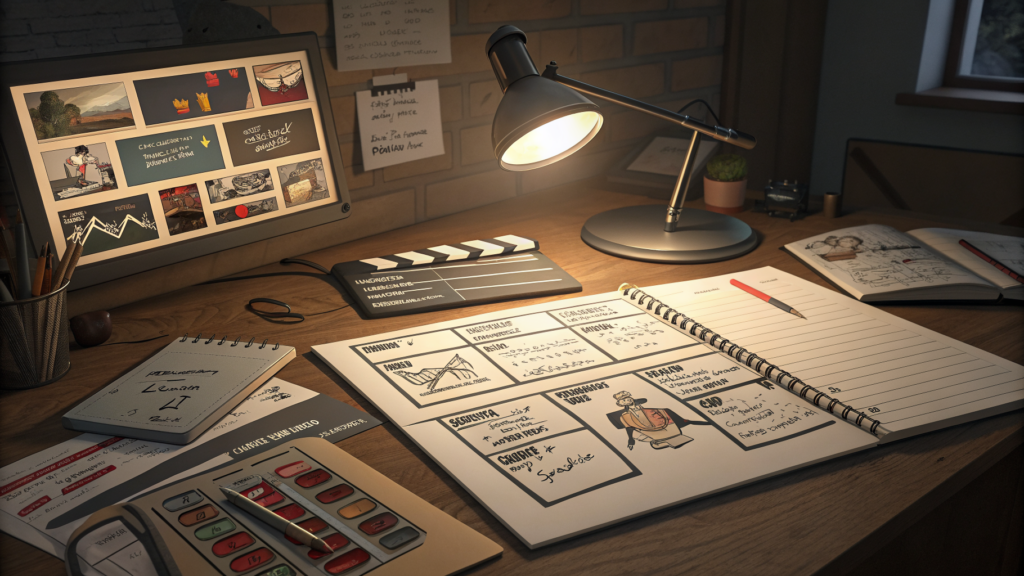
For certain applications — commercial production requiring consistent, high-quality visual language — this is a feature. For the filmmakers who were genuinely trying to do something new with the tool, it was a ceiling. The text-to-video interface compounded this: building a visual scene from a language prompt means the creative process runs through linguistic description, not visual intuition. Cinematographers don’t think in sentences. The ones who got the most out of Sora were often the ones who treated it as a compositing element rather than a primary camera — which is to say, they were using it in ways that exposed its limits rather than transcending them.
None of this means the work that came out of Sora was without value. A year and a half of AI filmmakers running production experiments through a single platform produced craft knowledge that doesn’t disappear when the server does. What people learned about motion consistency, about prompt construction for video, about where AI generation fails on complex physics — that transfers to whatever comes next. The tool is gone. The learning is not.
Who moved into the space
The current state of the AI video tool market, as of August 2026, has consolidated around a handful of serious players. Kling 3.0 from Kuaishou — a Chinese short-video company — leads on cinematic motion quality: native lip-sync in five languages, multi-shot storyboards, clips up to 15 seconds in 4K. Runway Gen-4.5 remains technically competitive, particularly for editors building professional workflows in Western markets. Google’s Veo 3.1 is ranked first for overall capability across current review rankings. Seedance from ByteDance fills the audio-visual generation space — text, image, and sound in a single pass. The platforms doing the most technically serious work for AI filmmakers include one American company (Runway), one American-corporate-successor (Google), and two Chinese companies. OpenAI is not among them.
The first two of those three are Chinese companies. The center of gravity of AI filmmaking infrastructure has moved to ByteDance and Kuaishou in the same period that OpenAI pulled back. This has practical implications for creators operating in US and EU regulatory environments — questions about data handling, model licensing, and the long-term availability of Chinese-hosted platforms are not resolved — and strategic implications for any filmmaker trying to build a stable production practice around tools they don’t control. The answer to “Sora shut down, what do I use?” is, for now, “a Chinese platform or Runway.” Both come with their own dependencies.
The pattern here is legible. Creative infrastructure in the AI era is cloud-hosted, priced at corporate discretion, and shut down when the economics stop working or the strategy shifts. That is not a bug specific to Sora. It is the operating model of every platform that runs generation at scale. The question for filmmakers who want to build something that lasts is not which platform to trust — it is how to build a practice that doesn’t live or die on the availability of any one of them.
September 24 closes the final Sora access point. What Critterz and the other productions that ran through Sora’s pipeline proved is that the platform can be taken away, on a timeline set by someone else’s spreadsheet. The lesson was always in that dependency. It just took a shutdown to make it visible.
AI-generated editorial illustration · TemperatureZero · August 28, 2026
Keep reading the signal
Get the Daily Signal — a concise briefing on what actually matters in AI and the systems around it.
Subscribe FreeContinue the archive