
The first thing you see in the Dreams of Violets trailer is a Tehran alleyway: amber light on stone, a boy at a window, the particular emptiness of a city after something has happened in it. What you cannot see is the crew, the actors, the cameras, the budget. There was none of any of them. The film was made by one person, from a flat in London, in three months, for roughly $2,000. It is 74 minutes long. It screened at Tribeca on June 10 as the first full-length AI-generated live-action film in the official lineup of a major festival. It has no distribution.
The Only Filmmaker Who Could Make This
Ash Koosha is a British-Iranian composer and AI artist who grew up in Tehran and has lived in London for over a decade — not by choice, initially. He was imprisoned in Iran for directing a film about the country’s underground music scene. After he left, going back was not an option. In 2018 he built YONA, an AI virtual singer he called an “auxuman” — a complete artistic persona, with her own voice, lyrics, and performance, generated by software. He has been working in AI creative systems ever since.
In January 2026, Iran’s government cracked down on protesters and, by estimates from international organizations, killed more than 7,000 people — while a communications blackout severed the footage that typically becomes the record of these events. Koosha, watching from London, faced a specific impossibility: he wanted to make a film, he had no way to film it, and the absence of documentation that makes AI generation feel like an approximation was, here, also the reason there was no alternative. The blackout had already erased the primary source. There was only what people had seen and survived.
He said, in the film’s production notes, that his use of AI “wasn’t a creative choice, it was the only tool available.” That framing is worth sitting with. Koosha is not a filmmaker who reached for AI because it was efficient or affordable. He reached for it because the other options were silence or fabrication — and he judged that AI, deployed honestly, was less false than either.
How He Built It
The production stack Koosha assembled is specific. Kling AI handled video generation — the platform now capable of holding consistent motion across hair, fabric, and liquid. Google’s image models built the core frames. His own proprietary software, developed through years of AI music production, controlled blocking and lens accuracy, the two places where generative video most visibly loses coherence over time. Each generated clip runs five to eight seconds before re-prompting; longer holds are where the seams show.
He voice-acted every character himself — the surgeon, the elderly woman, the ten-year-old boy named Amir who witnesses the others from a window — and then ran each take through AI to alter gender, age, and accent. Dialogue is sparse by design. Koosha understood early that lip-sync misalignment was his weakest technical liability, so he leaned into silence, into reaction, into the ambient sound of a city going quiet before a blackout. The score is AI-generated.
The visible limitations are real. Close-ups dominate because backgrounds soften and smear at distance. The dream-sequence structure — overlapping vignettes rather than linear plot — is partly an artistic choice and partly an engineering accommodation: the fragmented form papers over the temporal consistency failures that video-generation systems accumulate across long takes. The faces in the film were built from descriptions Koosha wrote of real Iranians he knew — not photographs (the blackout meant those mostly do not exist) but from memory and testimony, the AI synthesizing toward something that felt like the right person.
When a generation failed, he hit delete and started again. Three hours of sleep a night, by his account, for three months. There are no reshoots in this pipeline. There are only reruns.
Tribeca Applauded. The Distributors Calculated.
Tribeca co-founder Jane Rosenthal called the selection “a powerful example of how emerging technologies like AI can be used not simply as tools of innovation, but as vehicles for deeply human storytelling.” The audience at the June 10 screening gave the film strong applause. The festival’s programming committee drew a line by accepting it: AI is a filmmaking tool now, and this is a film.
The distribution meetings went differently. The Hollywood Reporter noted that one distributor had responded warmly until learning the film was made with AI, at which point the conversation shifted to “controversy” — framed not as the distributor’s personal objection but as a market calculation. The audience is not the problem. The calculation is.
This is a strange outcome. The film’s political subject — a documentary account of a state massacre, built from testimony and journalistic record — should protect it from the most obvious dismissal, that AI films are novelty items without substance. It does not protect it from the inverse: that an AI-generated depiction of real people who actually died is exactly the kind of liability a cautious distribution pipeline will decline to carry, regardless of what Tribeca thought.
What the Critic Got Right, and What He Missed
Variety’s chief film critic Owen Gleiberman reviewed Dreams of Violets and found it “dramatically numbing” and “stultifying.” He argues the film uses tragedy as justification — that Koosha reaches for an unarguable cause to give himself “the best possible excuse to craft an AI showreel.” His counter-premise: “effective art needs no justification.”
He is right about the drama. The uncanny-valley problem is real: generated imagery can produce convincing textures, roiling crowd scenes, plausible light on wet stone — but the absence of performance, of accident, of the live quality that cameras capture, registers as a gap in close-up. The vignettes cycle without the kind of development that makes a documentary feel like it has a stake in the people it follows.
What Gleiberman arrives at in his own final lines is more interesting than dismissal. “$2,000 can now buy a hell of a lot of motion picture,” he writes. He frames this as the film’s most important message. And here he has, without quite meaning to, named the actual story: not whether this particular film succeeds as drama, but what happens when the tools that produced it are in the hands of everyone who has ever had a story they could not tell because they could not afford a crew, or because their country would not let them.
Koosha knew the objection was coming. He addressed it in a statement before the premiere:
“I understand that an AI-generated film about people who actually died raises difficult questions. I have thought about those questions for every minute of every day I have worked on this film. My answer is that the alternative — silence, forgetting, the regime’s preferred outcome — is worse. The film exists because the dead deserve to be witnessed and because the families inside Iran, who cannot speak, deserve someone outside who refuses to forget.”
That is a harder argument than a showreel charge can handle. Every docudrama reconstruction, every historical painting, every photograph of someone later killed has crossed the line between witness and approximation. The line exists. Koosha crossed it knowing that. The AI left visible marks in the crossing — the close-up reliance, the dream-sequence fragmentation, the faces synthesized from memory rather than record — which may be the most honest form the crossing can take: a film that looks like grief rather than footage, that cannot pretend to be something it is not, because the seams will not let it.
Dreams of Violets will not find distribution on this run. That is the market calculating risk, which is its job. What already exists — the Tribeca selection, the Gleiberman review, the applause — is a record: that a 74-minute film about a state massacre, made by one exiled musician in London with AI tools and no crew, cleared the bar at a major festival. The cost was $2,000.
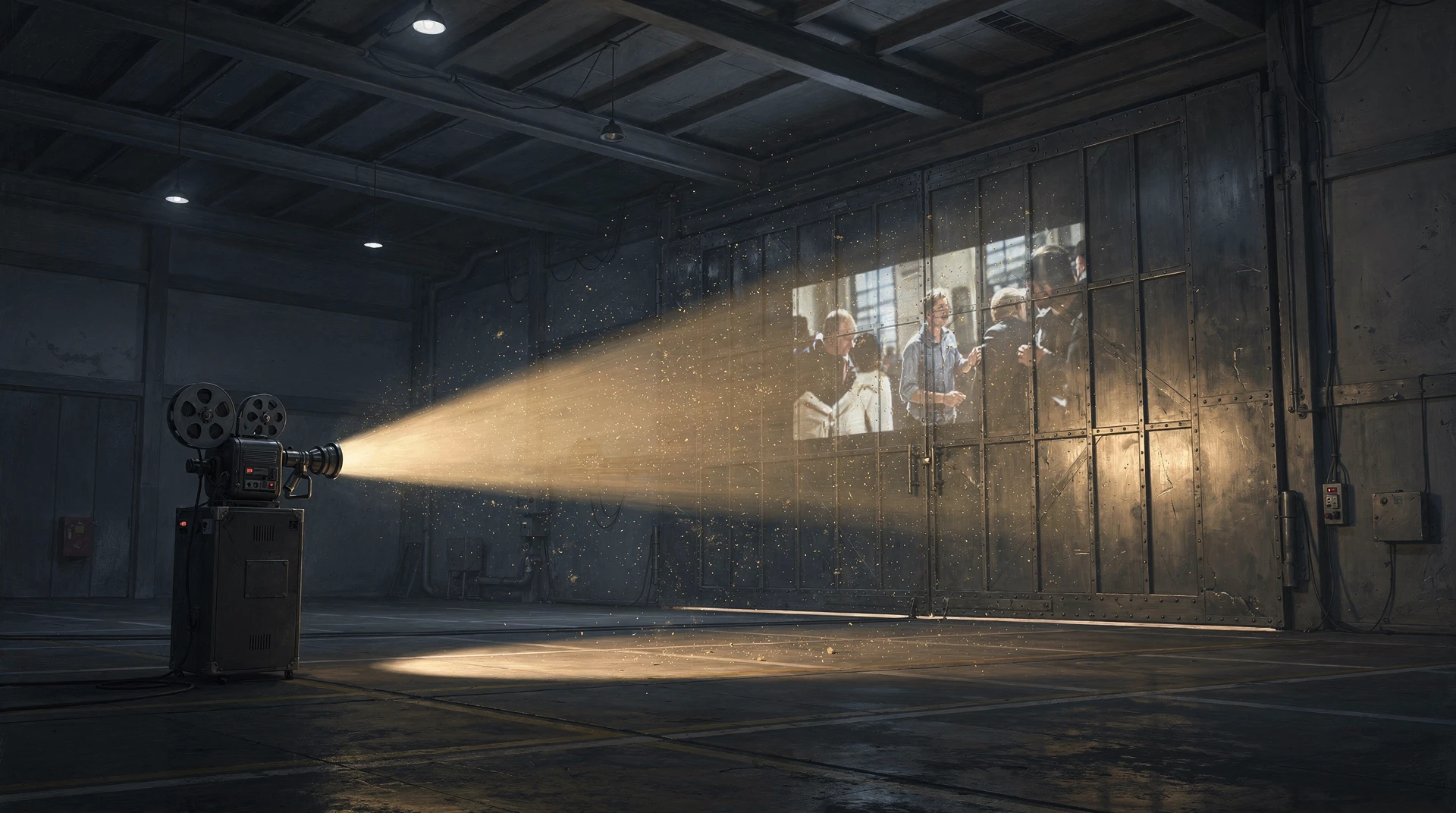
AI-generated editorial illustration · TemperatureZero · June 20, 2026
Keep reading the signal
Get the Daily Signal — a concise briefing on what actually matters in AI and the systems around it.
Subscribe FreeContinue the archive