Featured illustration generated with Nano Banana Pro (Gemini 3 Pro Image).
Prompt
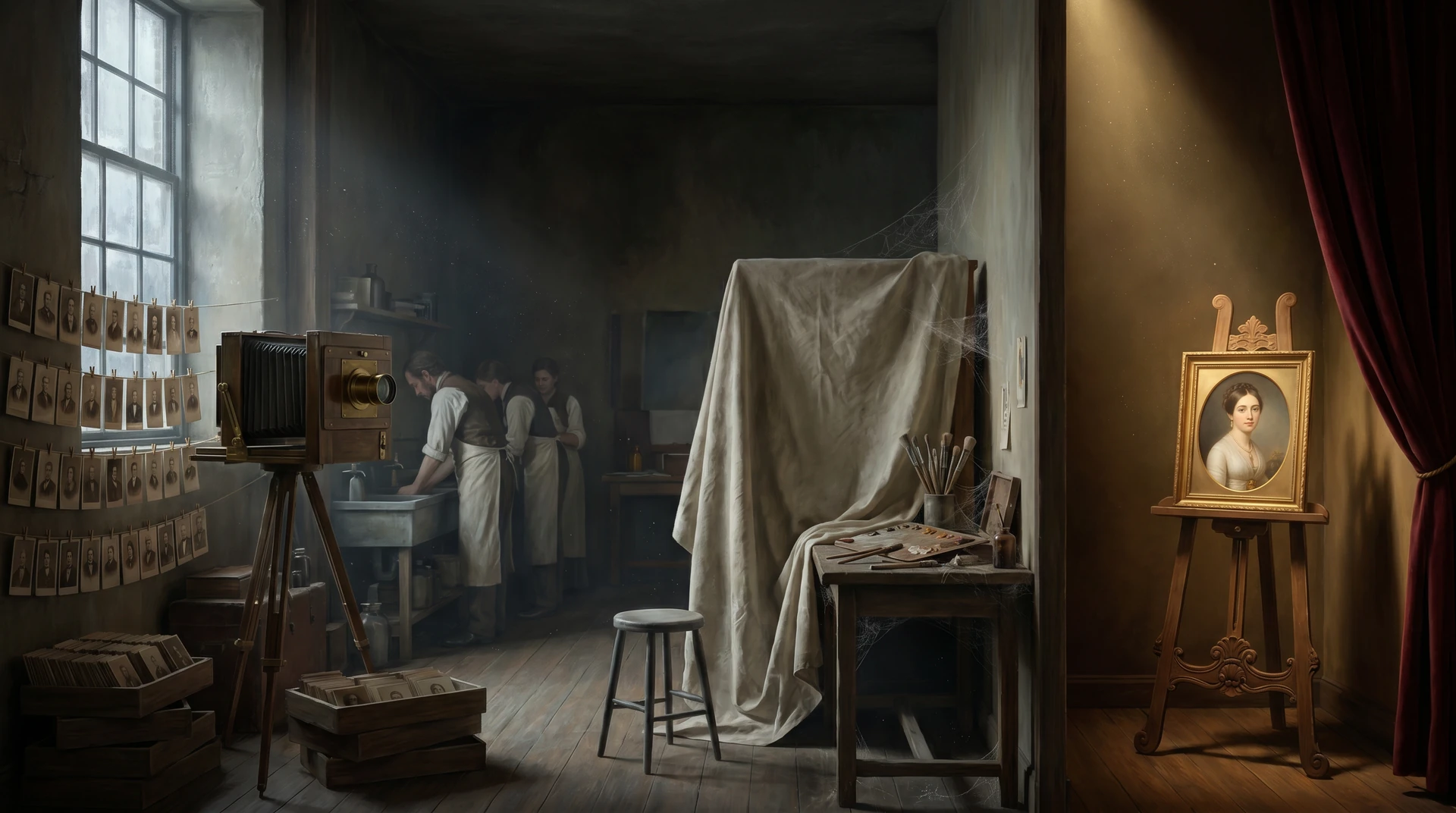
A cross-sectional view inside a mid-19th-century European portrait studio at the exact moment a trade splits in two, rendered in the rich tonal realism of early photographic-era genre oil painting. On the left third: a cramped production line of a brass daguerreotype camera and rows of dozens of near-identical small sepia portrait cards drying on wires and stacked in trays, lit by flat, cold, north-facing window light. On the right third: a single ornate hand-painted ivory portrait miniature on a carved easel, isolated under a warm shaft of golden afternoon light and framed by deep velvet shadow, treated like a relic. In the center, between them: an abandoned painter's workbench under a grey dust sheet, brushes fossilized in a dried palette, cobwebbed and unused, the hollow middle of the trade. Wide-angle interior with deep one-point perspective, volumetric dust suspended in the light beams, museum oil-painting surface quality. Restrained period palette of umber, bone white, oxblood velvet, and cold window-grey. Historically accurate to the 1850s. No modern objects, no text, no signage, no sharply focused faces, no recognizable real people.
In 1839, Louis Daguerre announced the daguerreotype and set in motion a process that took about a generation to finish. The portrait-miniature industry, which had employed thousands of trained painters across Europe producing small, precious likenesses on ivory and vellum for the merchant and professional classes, did not collapse overnight. But it did not survive. By the 1870s the hand-painted portrait had split into two categories: the expensive and the expressive. Photography had compressed the commodity middle out of existence and left the tails intact, each stronger than before.
I’m a painter. I say that not as a credential but as a frame, because I have skin in this outcome and I’ve been watching what AI does to the creative economy with the attention of someone who builds AI systems and makes art in the same week. My read is simple, and I’ll state it at the top. AI is splitting the art market. It is lifting the ceiling of what individuals and small teams can make while pressing the floor of commodity production toward zero. The casualties are concentrated in the middle. The survivors are at the edges.
This is not a prediction. The data is already there.
The Ceiling Rises
Google’s Veo 3.1 generates 4K video with native synchronized audio, producing dialogue, ambient sound, and score in a single pass from a text prompt. Runway’s Gen-4.5, which the company calls “the world’s best video model,” provides camera control that rivals deliberate cinematography: dolly moves, motivated pans, reference-character consistency across cuts. Kling’s VIDEO 3.0 handles the motion that used to break these systems, the hair and fabric and liquids, and it does it at roughly a dime per second of output.¹ These are not prototypes. They are production tools available to anyone with a subscription.
Prompt
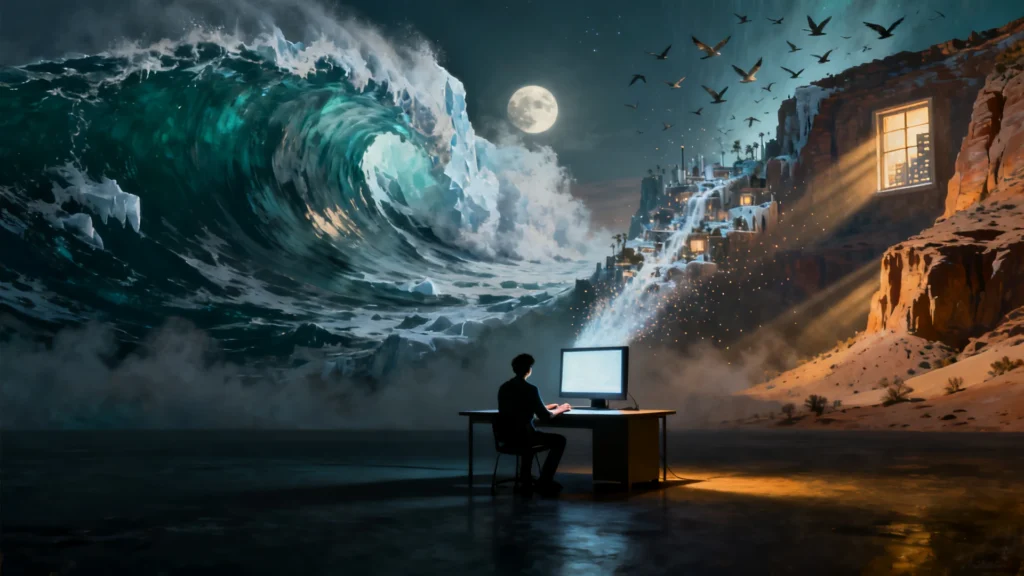
Cinematic wide establishing shot, painterly hyperreal, anamorphic feeling. A single small human silhouette sits at a plain, modest desk on a vast dark plane, a soft monitor glow lighting only their face and hands. Out of that small screen's light erupts an immense, impossible film set that dwarfs them: a towering ocean wave frozen mid-break, a moonlit desert canyon, a lone lit window in a night city, a wheeling flock of birds, all rendered as one continuous volumetric dreamscape pouring upward and outward from the desk, as though the entire output of a full production crew is flowing from one person. The subject is the scale contrast: tiny solitary maker, monumental made-world. Atmospheric haze, long god-rays, fine particulate drifting in the air, deep cinematic chiaroscuro of teal shadow and warm amber key light, shallow foreground focus on the figure with vast soft spectacle behind. Awe edged with solitude. No text, no logos, no readable screens, no recognizable faces.
What that means for a solo filmmaker or a two-person studio is hard to overstate. The production capabilities that once required a full department of concept art, previz, cinematography, and sound design are now reachable by individuals with taste and a clear vision. The ceiling of what is makeable has genuinely moved.
The counter-narrative matters, so let me give it room. Production value is no longer the binding constraint. Taste is. Distribution is. Attention is. The gap between a technically impressive eight-second clip and a twenty-minute film with a coherent emotional arc is still wide. Temporal consistency breaks under pressure. Physics simulation fails at the edges. The tools hand you cinematic imagery; they do not hand you the judgment to know when to cut, or why a scene needs to breathe.
That caveat has been true of every amplifying technology in the history of art. The camera did not make everyone a photographer. The DAW did not make everyone a musician. What both did was move where the serious work came from, and sharpen what separated the amateur from the professional. The ceiling has risen. Who clears it still depends on everything else.
The Floor Collapses
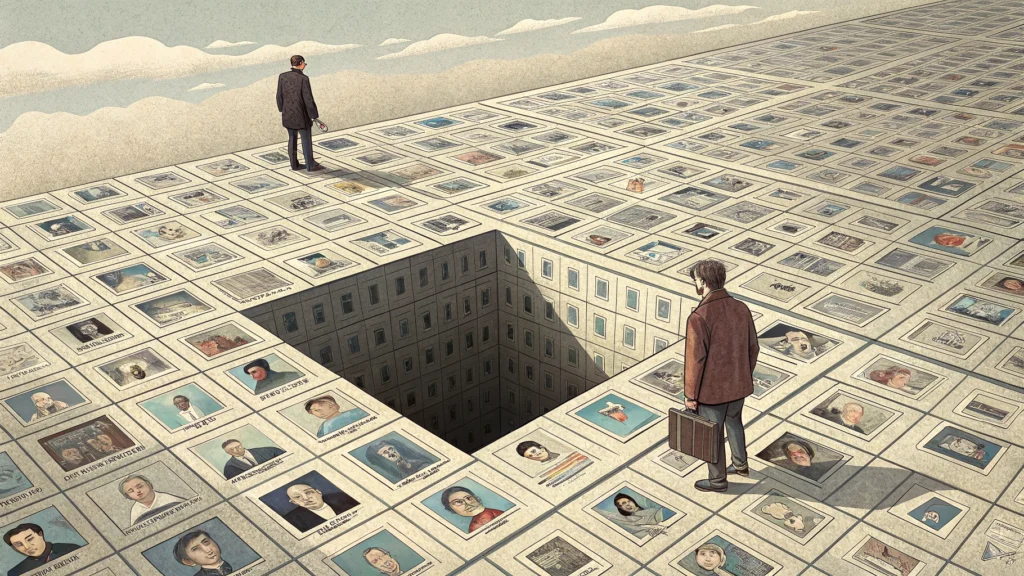
The industries built on commodity creative work are in visible financial stress. Shutterstock reported Q1 2026 revenue of $199.2 million, down 18% year over year from $242.6 million, with content licensing alone off 12%. Getty Images held steadier at $226.6 million, up 1.1%, but its creative licensing segment fell from $132.2 million to $126.2 million, and only a surge in sports and news editorial kept the headline number positive.² The structural story in both filings is the same. Creative licensing is under sustained compression.
Prompt
Conceptual editorial digital illustration, flat but dimensional with fine paper grain, graphic clarity over realism. An immense floor seen from a high tilted angle, tiled with thousands of identical small generic stock-style picture squares: bland icons, faceless avatar portraits, interchangeable little landscapes, receding to a far horizon. In the dead center the tiles dissolve downward into a dark void, pixelating into falling dust, a sinkhole of commodity images draining away. At the far left edge the tiles rise into a few large luminous framed works; at the far right they harden into solid carved three-dimensional objects. A handful of tiny human figures stand at the crumbling rim, looking in. Limited palette: slate blue-grey, paper white, one warning accent of ember orange at the dissolving edge. Strong silhouette reading, confident negative space, intelligent and conceptual. No text, no logos, no recognizable faces.
The individual-creator data is bleaker. A Society of Authors survey found that 26% of illustrators had already lost work to AI by early 2024, with 37% reporting reduced income. Concept artists who specialize in character and creature design describe a market gone bleak: fewer projects, compressed budgets, a larger pool of competitors chasing each remaining commission. The commercial illustration market for advertising and social work, the kind a client can now generate in minutes, has contracted hard.
The displacement follows exactly the pattern marginal-cost compression predicts. The exposed tiers are stock illustration and photography, where AI produces commercially acceptable replacements at near-zero cost; commission portraiture at the low end; logo and brand-identity work below a threshold of complexity; and pre-production concept art, where a studio can now generate fifty environment variants in the time one artist produces a single board. None of these are the highest-value creative practices. They are the most volume-sensitive, which is exactly why they go first.
What I find telling is that the market is already building its defense, and that the defense is itself a measure of how seriously the floor is moving. The Glaze Project at the University of Chicago has logged 8.5 million downloads of Glaze, which masks an artist’s style from AI style-mining, and 2.5 million of Nightshade, which poisons training data so that scraped images corrupt model outputs. Cara, the anti-AI platform founded by photographer Jingna Zhang, grew from 40,000 users to 650,000 in a single week after Meta announced it would train models on public Instagram content. SAG-AFTRA wrote consent into the 2025 Nickelodeon animation agreement, requiring a performer’s sign-off before their name can be used as a generative-AI prompt. None of these responses would exist at this scale if the floor were not actually moving.
Physical Appreciates
The Art Basel and UBS Global Art Market Report 2026 put total global art sales at $59.6 billion in 2025, a 4% rise after two consecutive years of decline. The number that matters for this argument sits underneath the headline. Online sales fell to $9.2 billion, their lowest since 2019, just 15% of the total against a pandemic peak of 25%. At the high end, collectors moved back to physical, in-person transactions, and public auction sales grew 9%.
Prompt
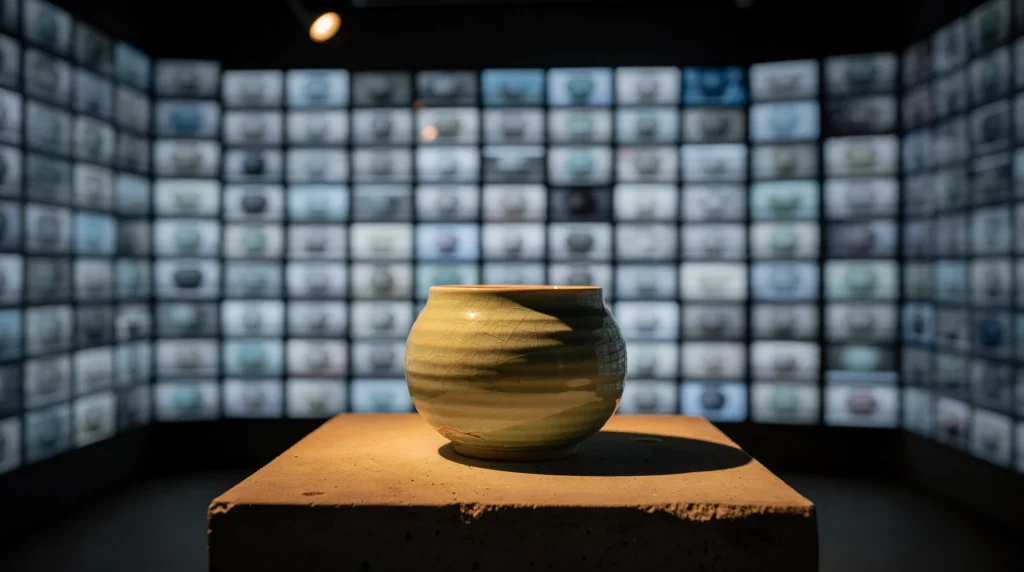
Photorealistic gallery still, museum lighting, extreme material fidelity and texture. A single hand-thrown ceramic vessel with visible finger ridges and a thick, crackled celadon glaze sits on a raw concrete plinth, side-lit by one warm focused gallery spotlight that rakes across its surface to reveal every imperfection, throwing-line, and tool-mark as evidence of the human hand. It holds a quiet, valuable presence. Behind and around it, receding into soft darkness, stands an infinite grid of thin, identical, flat glowing screens, every one displaying the same flattened photograph of that same vessel, their light cooling to dead grey static the further back they recede, endless cheap reproduction fading to nothing. Shallow depth of field: the real object tack-sharp and dimensional in front, the screen-field melting into soft bokeh behind. Palette: warm tungsten gold on the object, cold blue-grey across the screen field, deep gallery black surrounding. Reverent, still, faintly melancholy. No text, no UI elements, no readable screens, no logos, no faces.
This is Baumol’s cost disease running in reverse. When reproducible goods race toward zero marginal cost, the scarce and the live and the hand-made hold value precisely because they cannot be reproduced. Photography did not destroy the market for hand-painted portraits. It destroyed the commodity tier and made genuine hand-painted work more expensive. An archival print costs twenty dollars. The hand-painted portrait starts in the hundreds and climbs, because scarcity became the feature.
The skeptical read matters here and I won’t paper over it. “Physical appreciates” is mostly a story about the top of the market. Auction performance is dominated by works where provenance, blue-chip names, and institutional demand set the price, not by a broad premium on handmade objects. A mid-career painter whose canvases anchor between $2,000 and $8,000 is not necessarily lifted by the same tide that keeps the Christie’s floor active. The appreciation is real at the top. It does not distribute evenly below.
The direction still holds, and the direction is what matters over time. Reproducible compresses toward zero. Scarce holds or gains. The middle, work that is neither irreplaceable nor cheaply replaceable by a model, is where the sustained pressure falls.
The Pipeline Becomes the Medium
There is a fourth movement in this story, and it is the most interesting one.
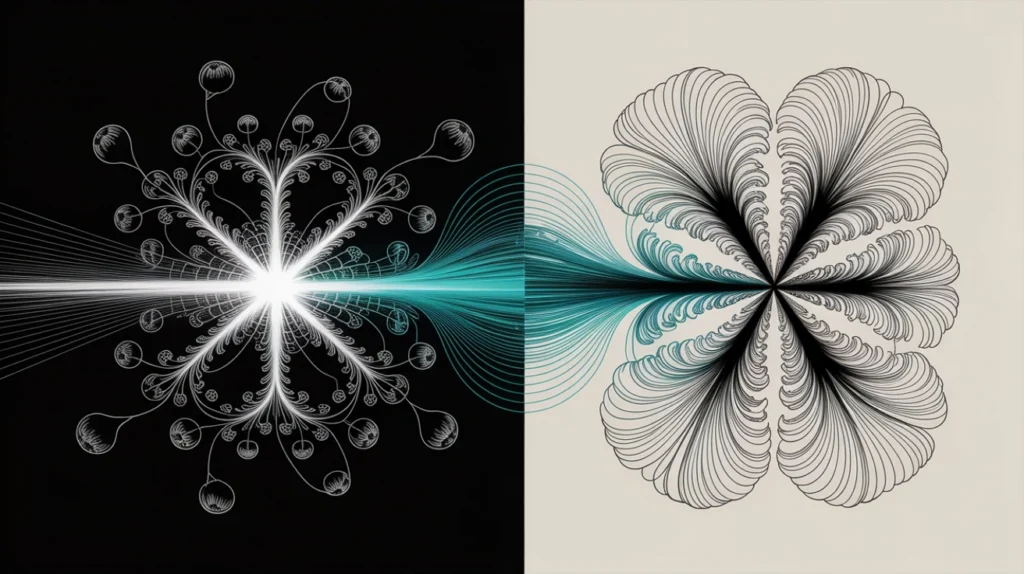
Prompt
A bold conceptual design composition: a generative-art system depicted as the artwork itself, reading clearly left to right. On the left, a luminous flowing diagram of connected nodes and branching signal-paths, raw and electric. Moving rightward, that system gradually organizes and resolves into an exquisite plotter-drawn generative bloom, dense looping algorithmic pen-line work in the spirit of code-art and vintage pen-plotter drawings, which finally hangs framed in elegant gilt on a clean gallery wall at the far right. The transformation from raw process to authored, exhibited object is the subject. Refined graphic-poster elegance, generous negative space, crisp clean edges, a disciplined limited palette of ink-black, warm cream paper, and a single electric cyan signal-accent. Modern, intelligent, museum-grade. No words, no text, no letters, no numbers, no logos, no faces.
When the Obvious collective sold Portrait of Edmond de Belamy at Christie’s in October 2018 for $432,500 against a presale estimate of $7,000 to $10,000, most of the room’s attention went to the attribution fight. The GAN code had been forked, with minimal change, from work by the then-19-year-old AI artist Robbie Barrat, whom Obvious did not initially credit. Mario Klingemann estimated that roughly 90% of the real work had been Barrat’s. That controversy deserved the attention it got.
What got less attention was the price signal. A sophisticated auction room bid a GAN-generated portrait to 43 times its high estimate. That room was not buying the image, a somewhat blurry face in a gilded frame. It was buying the marker: the first time a major auction house had offered AI-generated work as art. The bid was for the moment, but the moment pointed at a practice, one new enough that the vocabulary to judge it did not exist yet.
That practice is established now, if volatile. Art Blocks, where the algorithm is the authored object and the collector buys a specific seed run on a specific, publicly verifiable system, has cleared more than $1.4 billion in cumulative sales.³ Trading volume has fallen sharply from the 2021 peak. But the market has formed. The practice exists, and it sits in a lineage that runs back through Casey Reas and the Processing community, through the demoscene, through decades of plotter drawings and code art that preceded the blockchain by a generation.
The auteur-engineer who can hold both halves at once, who can write the system that generates the work and keep the editorial judgment to know which output is worth saving, is a genuinely distinct kind of artist. Not a substitute for a painter. Not a threat to one. A new mode of making that the old vocabulary does not quite fit. I find the serious work in this category more interesting than most of what gets written about it, which tends to settle for either unqualified enthusiasm or reflexive dismissal.
Who Wins, Who Loses
Here is my read. The people positioned well sit at both tails. There is the individual creator who uses AI as a force multiplier to reach production values that used to be out of reach. And there is the artist working in media that cannot be reproduced at all, the painter, the sculptor in bronze, the live performer, the potter at the wheel, whose work holds value because it cannot be replicated at scale. The people positioned poorly are in the middle: the commercial illustrator whose client can now generate a passable substitute, the junior concept artist whose workflow has been folded into a generation tool, the stock contributor competing against a model trained on billions of images that included work like theirs.
That compression is not conjecture. The income data, the platform financials, the scale of the defense infrastructure, and the auction trends all point the same way. What is genuinely uncertain is the pace, how fast the commodity layer fully collapses and how much time the middle has to adapt or exit.
My bet is that it goes faster than most people working in the middle expect, and slower than the loudest AI boosters claim. The photography transition took a generation. This one will take less, because the tools improve faster and the capital behind them is more concentrated. But it will outlast any news cycle. The portrait miniaturists who moved into reportage illustration found work for another decade, and a handful of them ended up defining a new visual practice entirely.
The bifurcation is real. The question for every working artist right now is not whether it is happening. It is. The question is which tail you are on, and what you are building there.
—
¹ Kling VIDEO 3.0 Omni pricing runs roughly $0.084–$0.112 per second of output at API rates. ² Shutterstock and Getty figures are from their Q1 2026 filings. ³ Cumulative Art Blocks sales per on-chain trackers. All market, pricing, and model-capability figures in this piece reflect publicly available data as of June 2026 and are subject to change.
AI-generated editorial illustration · TemperatureZero · June 19, 2026
Keep reading the signal
Get the Daily Signal — a concise briefing on what actually matters in AI and the systems around it.
Subscribe FreeContinue the archive