
On June 18, 2026, David Holz announced that Midjourney has built a full-body medical scanner. The device lowers you into water at 4 centimeters per second while sliding you through a 70-centimeter ring of 358,000 ultrasonic sensors, processing 17 gigabytes of raw sensor data per second to produce a tomographic map of your body’s interior. Holz told Bloomberg the company’s eventual goal is a billion full-body scans per month. The current prototype has scanned approximately twelve people.
That gap is not the interesting part. Every hardware company starts with a prototype, and twelve scans is twelve more than zero. What’s interesting is the specific structure of the bet Midjourney is making — what is real about what they’ve built, what isn’t yet, and where the distance between the launch announcement and the clinical promise actually lives.
The Machine in the Water Tank
The Midjourney Scanner uses 40 ultrasound-on-chip modules licensed from Butterfly Network, arranged in a ring. Each module contains 8,960 individual piezoelectric transducers, giving the system 358,000 total ultrasonic elements. Butterfly Network’s Ultrasound-on-Chip is the same semiconductor architecture inside their iQ3, which received FDA 510(k) clearance in January 2024 as a handheld point-of-care diagnostic system. Midjourney didn’t improvise the sensor technology. They licensed it exclusively in November 2025 under a deal worth up to $74 million over five years — $15 million upfront, $10 million per year, with milestone payments in addition.
Ahmad Abbas leads the consumer hardware build. His prior work was on Apple’s Vision Pro hardware team — a relevant background for anyone building a multi-sensor spatial imaging ring at medical resolution. The technology itself is ultrasonic CT: using dense arrays of ultrasound transmitters and receivers to reconstruct three-dimensional tomographic images through inversion of acoustic wave data. It is a real research area, distinct from conventional ultrasound, which uses a single probe and produces two-dimensional slices in real time. Whole-body ultrasonic CT has been explored in academic settings for years, most successfully in limited applications like breast imaging, where the geometry is simpler. What Midjourney is attempting — full-body reconstruction from a ring scanner — is the harder version, and Holz’s claim that “no such device has ever been built until now” is accurate.

The reason nobody built it before is partly hardware cost — the Butterfly Network chips make dense sensor arrays economically feasible for the first time — and partly that the reconstruction algorithms required for diagnostically useful images at whole-body scale remain unproven. The prototype’s current scan time is approximately 20 minutes, against a stated target of 60 seconds. The images shown in Midjourney’s launch materials do not yet use AI reconstruction — the technical breakdown notes explicitly that the AI processing pipeline is still in development. The reconstruction compute Midjourney claims — 21 servers at 2 petaflops — reflects where they expect to land, not where they are.
The Wellness Exemption and What It Costs
Midjourney Medical’s launch strategy is built around the FDA’s 2016 General Wellness Policy, which gives the agency enforcement discretion over products intended for general health promotion — fitness trackers, sleep monitors, body composition tools — that don’t make disease-specific claims. Prenuvo and Ezra, the two most prominent whole-body MRI scan companies, have operated under this framework for years: full-body MRI marketed as preventive health screening, no diagnostic claims, no 510(k) filing. Midjourney explicitly names them as comparators and is following the identical path: start by offering only “body composition maps,” hold the diagnostic claims, stay under the wellness threshold.
This is a rational regulatory strategy, not a shortcut. FDA clearance for a novel diagnostic imaging device requires a 510(k) premarket notification demonstrating substantial equivalence to a legally marketed predicate device. There is no predicate for whole-body ultrasonic CT. The alternative is the De Novo pathway, which applies to genuinely novel devices and typically requires two to four years of review after submission, preceded by substantial clinical evidence generation. “Start as wellness” is how a company buys the time to build the evidence that a De Novo requires. Midjourney has set a 2028 FDA approval target. The math works out: launch the spa in late 2027, collect data for several months, submit De Novo in early 2028.
The wellness exemption has a specific breaking point, though, and Midjourney’s launch materials push against it. The FDA guidance is unambiguous: the moment a device is marketed to detect, diagnose, treat, cure, or prevent a specific disease, it crosses into medical device territory and the wellness exemption disappears. Midjourney’s announcement framing lives in the adjacent zone. Holz’s claim that early imaging could “avoid 30 percent of all deaths and 50 percent of all healthcare costs” is not a body composition statement. It describes preventive diagnosis. The legal documents are the product labeling and marketing materials at actual launch — those can be drafted carefully. The launch video is a different matter, and what customers internalize from a launch video is the number that drives expectations, not the fine print on the regulatory strategy slide.

Prenuvo has navigated this tension for years, with a pattern that has become familiar to emergency physicians: patients presenting scan findings from whole-body MRI wellness sessions that their primary care physicians have no validated protocol to evaluate. At Prenuvo’s scale, this is a managed customer-service challenge. At the scale Midjourney is describing — fifty thousand scanners, a billion scans per month — the unsupervised findings become a population-level clinical burden, generated by a device operating under wellness exemption specifically because it can’t yet make diagnostic claims.
The Reconstruction Problem
The chips are the solvable part. The reconstruction algorithms are not yet solved, and the physics of why matters.
MRI reconstruction is computationally demanding but the underlying physics is well-characterized: nuclear magnetic resonance produces signals that follow predictable spatial encoding, and the reconstruction math has been refined over fifty years of clinical use. X-ray CT reconstruction is similarly mature. Ultrasonic CT reconstruction at whole-body scale is neither. Sound waves in tissue refract at tissue boundaries, reflect off interfaces between materials with different acoustic impedance, and travel at speeds that vary significantly across fat, muscle, bone, and organ. A reconstruction algorithm that doesn’t model these effects accurately produces images with artifacts that look like anatomy but aren’t. The challenge isn’t compute — it’s training data. A deep learning model that learns to reconstruct these images accurately from raw sensor data needs ground-truth paired scans: matched ultrasonic CT and validated reference imaging for the same anatomy. That dataset starts at twelve people and needs to be orders of magnitude larger before it produces clinically reliable reconstruction.
Midjourney’s answer is the same answer the company applies to every hard problem: generate enough data, and the model will learn. Their stated compute target is 21 servers at 2 petaflops of reconstruction capacity per scanner ring. This is a serious number, and the bet is coherent in principle — diffusion models learned to produce photorealistic images without anyone writing explicit rules about optics. A model trained on sufficient paired ground-truth scans might achieve whole-body reconstruction quality that analytical methods can’t reach. The catch is that the training data doesn’t exist yet, and building it requires exactly the clinical validation infrastructure that the wellness exemption pathway is designed to defer.
What the Butterfly Network Deal Actually Proves
Butterfly Network is not a healthy company going into this partnership. Their stock had declined approximately 20% in the week preceding the November 2025 announcement, with a beta of 2.36 and Q3 2025 EPS coming in at a loss of $0.13 per share. The $74 million in expected payments from Midjourney over five years is a material revenue stream for a company that earns roughly $21 million per quarter. The deal makes business sense for Butterfly Network for reasons that have nothing to do with whether Midjourney’s medical scanner becomes a clinical success.
The deal also doesn’t transfer Butterfly Network’s FDA clearances to Midjourney’s application. The 8-K describes an exclusive license within a “specified field of use” — the field is not named in the public filing, but it is constrained. Butterfly Network’s 510(k) clearances cover their handheld iQ3 for point-of-care diagnostic use. A ring scanner performing whole-body tomographic reconstruction uses the same semiconductor chip in a fundamentally different clinical context. FDA clearance doesn’t port between applications. Midjourney will need its own De Novo submission based on its own clinical evidence. The Butterfly Network relationship proves they can build the sensor hardware at commercial scale. It doesn’t prove the imaging system works clinically, and it doesn’t accelerate the regulatory timeline.
What the partnership does establish is that the chip component of the problem is solved. That matters. The reason nobody built whole-body ultrasonic CT before was partly the economic infeasibility of 358,000 medical-grade transducers and partly the reconstruction challenge. Butterfly Network’s semiconductor manufacturing has answered the first part. The reconstruction is still open.
The Distance
The last new whole-body imaging modality was MRI. From Paul Lauterbur’s laboratory demonstration in 1971 to the first clinical installation at Hammersmith Hospital in 1980 was roughly eight years. From first clinical installation to widespread diagnostic deployment took another fifteen. MRI arrived with decades of nuclear magnetic resonance physics research behind it, in an era when the FDA clearance process was slower but the clinical evidence requirements were real.
Midjourney’s timeline is compressed: a wellness spa by end of 2027, a De Novo FDA submission in 2028, fifty thousand scanners by 2031. This is the software company’s timeline applied to medical device development — and software timelines have a specific relationship to the parts of product development that require external validation. You can ship software to production at a cadence that medical devices do not permit. The FDA’s review timeline is not a queue you can optimize. The clinical evidence required for a De Novo is not a sprint.
Midjourney has built real hardware, signed a real chip deal, and hired someone who built serious sensors before. The company has a coherent theory of how to move from wellness scan to diagnostic device through the wellness exemption pathway. That theory is the same one Prenuvo and Ezra are executing on, except with a novel modality instead of an established one, on a timeline that would require the reconstruction problem to be solved on data that doesn’t exist yet. The San Francisco spa opens in eighteen months. The De Novo submission is two regulatory cycles after that. The billion monthly scans are a vision document entry.
The distance between “no such device has ever been built” and “30 percent of deaths prevented” is not hardware. It is clinical validation, and clinical validation does not move at the speed of a launch announcement.
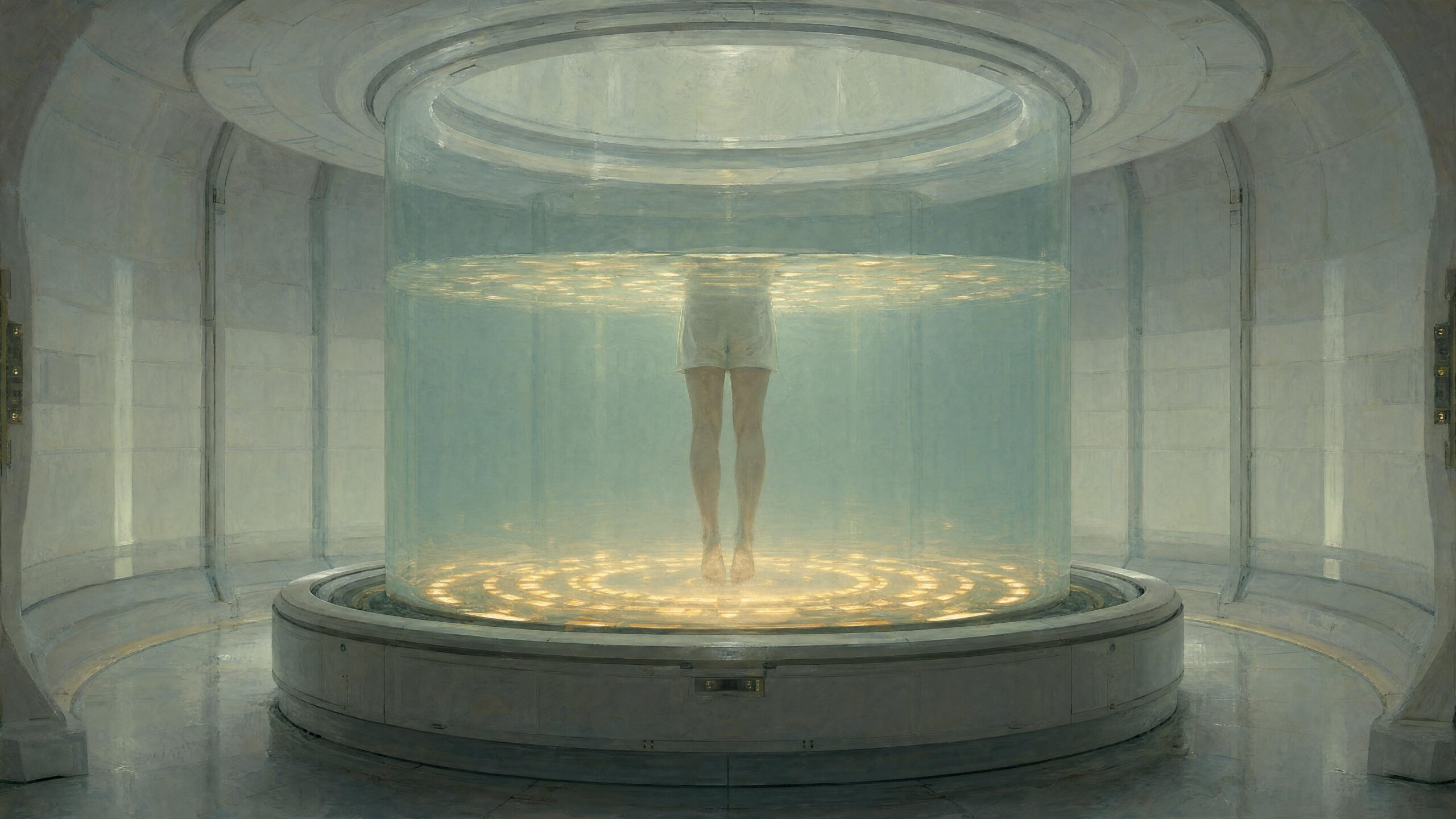
AI-generated editorial illustration · TemperatureZero · June 18, 2026
Keep reading the signal
Get the Daily Signal — a concise briefing on what actually matters in AI and the systems around it.
Subscribe FreeContinue the archive