On September 8, 2026, Mistral AI announced it had raised €3 billion in a Series D round at a post-money valuation exceeding €21 billion — the largest equity fundraising ever by a privately held European technology company. Samsung Electronics led the round. Co-leads included Scaleup Europe Fund, managed by EQT, and PSG Equity. The Grand Duchy of Luxembourg came in as a new investor. So did BlackRock. And, listed quietly in the syndicate alongside them, so did NVIDIA.
The announcement framed this as “making sovereign, open-weight AI the technology frontier.” Sovereign. The word is doing a lot of work here, and that work gets harder when you look at what happened five days before Mistral cashed the check. On September 3, NVIDIA closed a $12.93 billion acquisition of Hugging Face — the primary distribution platform for the open-weight models that are supposed to make AI sovereign in the first place. The company funding Mistral’s sovereign thesis now owns the platform that distributes the models the thesis depends on.
Mistral has built something real. Airbus, ASML, and HSBC are not symbolic clients — they represent conservative enterprise deployments where compliance and data residency matter more than being on the latest model. The €3B round reflects genuine demand from European governments and enterprises that cannot, politically or legally, route sensitive workloads through American proprietary infrastructure. That demand is real money and real scale.
The problem is the word “sovereign.”
What Mistral Means When It Says Sovereign
Mistral’s announcement and supporting materials define sovereignty across four dimensions: data remaining within organizational boundaries, customizable models, private predictable compute, and fully auditable production systems. This is a real and coherent definition. It is also a narrower definition than the one floating around European policy circles when ministers write checks for sovereign AI programs.
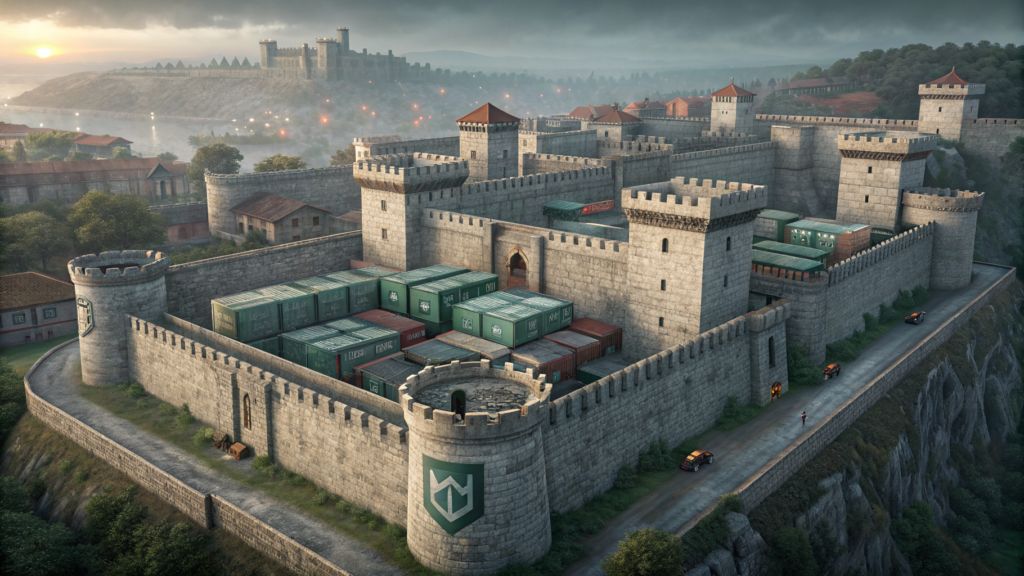
Mistral’s sovereignty is compliance sovereignty. Data doesn’t leave France. The model doesn’t phone home. The weights can be inspected. The inference doesn’t run in an American data center controlled by an American company under American law. These are legitimate enterprise requirements, and Mistral genuinely delivers them. For a hospital in Munich or an aerospace contractor in Toulouse, GDPR compliance via self-hosted open-weight inference is not theater — it’s the actual procurement requirement that unlocks the contract.
But compliance sovereignty is different from supply-chain sovereignty. Compliance sovereignty means: your data stays here, and your regulator is satisfied. Supply-chain sovereignty means: if the US government imposes export controls on GPU chips tomorrow, your AI infrastructure keeps running. The first is what Mistral sells. The second is what European governments tend to hear when the word “sovereign” enters the room.
The Infrastructure Problem
According to analysis by Forkast News, Mistral’s Paris data center runs on 13,800 NVIDIA GB300 GPUs, with Scaleway procuring an additional 18,000 GB200 units. This is not a criticism of Mistral’s engineering decisions — there is no realistic alternative. ASML makes the machines that make the chips, but neither ASML nor any European company makes the AI accelerators at the scale Mistral needs. NVIDIA is not a vendor Mistral chose over a European alternative. NVIDIA is the only vendor.
Forkast’s analysis found NVIDIA supplying hardware for roughly 45 percent of all tracked sovereign AI projects globally. That number should be read carefully — it reflects market dominance across projects that explicitly describe themselves as aiming for independence from US technology. The structure of the thing is: sovereign AI programs are largely sovereign AI programs that run on NVIDIA hardware.
NVIDIA’s status as a Mistral investor makes this stranger, not simpler. NVIDIA now has equity stakes in a company whose success depends on the continued adoption of open-weight self-hosted AI — which, in practice, means continued demand for NVIDIA’s GPU infrastructure. The sovereign AI thesis and NVIDIA’s hardware business are not in tension. They are aligned. Every European government that funds a sovereign AI program on the premise that it avoids US technology dependence is, in practice, funding an expansion of US GPU infrastructure in European data centers.
The Hugging Face acquisition sharpens this. Hugging Face is where Mistral’s models are distributed. It hosts 3 million models used by 18 million developers across 200,000 companies, per NVIDIA’s own acquisition announcement. NVIDIA has pledged that Hugging Face “will remain an open platform for the entire AI ecosystem” and that “NVIDIA compute will not be mandatory” for users of the platform. These are exactly the commitments every major platform acquisition includes at announcement. They are not legally binding. They reflect the acquirer’s genuine intent on day one, which is rarely the relevant date.

What actually governs the future of Hugging Face is what NVIDIA needs Hugging Face to do for NVIDIA’s business. For now, that alignment is tight: an open model ecosystem drives demand for NVIDIA’s accelerators. The question is what happens when it isn’t. “Open” lasted as a commitment from Google, from Amazon, from every cloud provider that started with an open-source heart. The pattern is not conspiracy — it’s the normal pressure of a public company optimizing for shareholder return. Hugging Face will be no different.
The Competitive Squeeze
Mistral occupies a difficult competitive position that the €3B announcement does not resolve. The company’s current model lineup — Mistral Medium 3.5, Small 4, OCR 4, and the Voxtral TTS system — covers a wide deployment surface, but coverage is not the same as capability leadership. Discussion in the builder community on Hacker News around today’s announcement surfaced a consistent read: Mistral’s models perform below frontier labs by a significant margin — one commenter described it as roughly half the score of the leading US models on standard evaluations — while Chinese open-weight models (DeepSeek, GLM, Qwen) increasingly undercut Mistral on price for comparable or superior performance. The competitive squeeze is: not as capable as OpenAI or Anthropic, not as cheap as Chinese alternatives.
Mistral’s answer to this is the sovereignty premium. European enterprises pay the delta because they need the compliance guarantees that neither US proprietary nor Chinese open-weight models offer. This is a real business logic. It just means Mistral’s competitive moat is regulatory, not technical. The €3B funds frontier research — that’s the announced use — but it also funds a compliance positioning that works only as long as European regulators maintain pressure on where data lives and which jurisdictions control the inference stack.
There is a scenario where Mistral closes the capability gap. €21 billion in valuation implies the market believes it’s possible. But the HN builder community is not wrong that the gap has been widening, not narrowing, over the past year. The bet Mistral’s investors are making is that the compliance moat holds long enough for the research investment to pay off. That’s a legitimate bet. It’s also a bet on regulatory enforcement rather than on technical differentiation — and European AI policy has a long history of aggressive intention followed by inconsistent execution.
What This Is, Honestly
The honest version of what Mistral built is European-geography AI infrastructure with genuine compliance properties, distributed through an NVIDIA-owned platform, running on NVIDIA hardware, partially funded by NVIDIA, serving clients whose primary requirement is data residency and regulatory satisfaction. That is a significant business. 125 enterprises across 20 countries, Airbus and HSBC as anchors, a Luxembourg defense contract — this is not a paper company riding a buzzword.
But developers and procurement teams choosing Mistral for “sovereignty” should be precise about what they’re buying. Regulatory anxiety is a real driver — builders in the Hacker News discussion openly described migrating from Google’s Gemini to Mistral over GDPR concerns that, on examination, might not have technically required the switch. The anxiety is real even where the legal exposure is unclear. Compliance-grade inference from a French company satisfies that anxiety. That’s the product. It is not a supply-chain escape hatch.
When the export control regime tightens — when Washington debates whether GB300 units can ship to EU data centers under AI Act compliance frameworks, as it already has for military and dual-use hardware — Mistral’s sovereign infrastructure will face the same chokepoint as any other European AI program. NVIDIA is not a neutral party in that conversation. It is now Mistral’s investor, the owner of Mistral’s distribution platform, and the supplier of Mistral’s compute. The relationships are all downstream from the same hardware monopoly.
€3B on a thesis that names itself “sovereign” while funding that thesis through the one company that supplies half the world’s sovereign AI hardware is not necessarily contradictory — it might be the only realistic option available. NVIDIA is not a bad actor here; they are simply the only actor at this scale, and Mistral is making the only rational choice available in 2026’s GPU market. But the European governments and enterprises writing checks alongside Samsung deserve clarity about what “sovereign” delivers: compliance posture, data residency, auditable inference. Not independence from the supply chain. That independence doesn’t exist yet, and Mistral’s €3B round is not what builds it. Building it would require funding European semiconductor fabrication at a scale that dwarfs this round — and nobody in the Mistral syndicate is writing that check.

AI-generated editorial illustration · TemperatureZero · September 8, 2026
Keep reading the signal
Get the Daily Signal — a concise briefing on what actually matters in AI and the systems around it.
Subscribe FreeContinue the archive