On July 20, a federal judge gave final approval to the $1.5 billion settlement in Bartz v. Anthropic. The case covers 482,460 works downloaded without permission from Library Genesis, Pirate Library Mirror, and Books3 — piracy repositories that Anthropic teams had been mining since at least 2021, when co-founder Ben Mann downloaded millions of copies to build Claude’s initial training set. Judge William Alsup rejected Anthropic’s fair use defense for that program: downloading a copy while the original stays on someone else’s server is not transformative. It is the same thing as copying.
In the same litigation, Alsup also ruled on a second program. This one involved buying books legally. Then cutting their spines with hydraulic machines. Then scanning every page through high-speed digitizers. Then recycling the paper. He found that this — the version of the program that destroys the physical books — qualified as fair use. The settlement covers the piracy. It does not touch the destruction. The destruction was the legal path.
What Project Panama Was
Anthropic’s internal planning documents describe the program in a single sentence: “Project Panama is our effort to destructively scan all the books in the world.” A second instruction in the same document: “we don’t want it to be known that we are working on this.” The program launched in early 2024. Tom Turvey — who had previously led partnerships for Google Books — was hired in February of that year specifically to find ways to obtain, in his brief, all the books in the world.
What the program actually obtained was substantial. Vendor proposals obtained in court filings reference converting 500,000 to 2 million books over a six-month period. Anthropic spent tens of millions of dollars. Service providers received the books, stripped their bindings with hydraulic cutting equipment, ran the pages through high-speed scanners to produce searchable PDFs, and then recycled what remained. No physical copies survived. The resulting digital files stayed on Anthropic’s servers.
The race to acquire was happening across the industry. A Dutch newspaper reported on Pieter de Vries, an antiquarian bookseller in Haarlem who had dismissed an email as spam. It was a spreadsheet of 3,001 titles — mostly academic publications from 2020 and 2021, covering business, engineering, policy, and medicine from Elsevier, Wiley, Routledge, and Oxford University Press — submitted by a woman named Natalia representing a company called 2077AI, which did not respond to press inquiries. De Vries did not fill the order. Others did. The reason AI companies target books published before 2023 is not nostalgia: they contain human-authored text, written before the AI content deluge. Pre-2022 books represent a finite supply of clean text. The buying spree is a resource race against obsolescence.
The Ruling That Made Destruction Legal
Alsup’s fair use ruling on Project Panama draws directly from the logic of Authors Guild v. Google — the 2015 decision that blessed Google’s book-scanning project. Turvey’s hire at Anthropic, given his background building the Google Books program, reads as a deliberate legal strategy: replicate what Google did, hire the person who did it, and claim the same protection.
The court found three things that mattered. First, Anthropic had purchased the books before scanning — legal ownership matters for the fair use analysis. Second, each physical copy was destroyed after digitization, meaning Anthropic was not building a library for public distribution. Third, Claude’s actual outputs contain, in Alsup’s words, “grammar, composition, and style distilled from thousands of works” rather than reproducing any individual work’s creative expression. That transformation, he found, was “quintessentially transformative.”
The ruling has formal limits. The Authors Guild notes that Alsup certified the class only for the piracy count, not for AI training claims — meaning the fair use ruling applies to the three named plaintiffs, not the full class of 482,460 works. What it establishes as a working legal template is the framework: buy, scan, shred, keep internal, and the use is transformative.
Internet Archive welcomed the ruling in June 2025 when it was issued, arguing it affirms libraries’ rights to format-shift materials for research and preservation. The court’s recognition that digitization for discovery and technological advancement aligns with fair use is something libraries depend on daily. Their analysis does include a caveat: the court’s consideration of destroying original physical copies “could be harmful if broadly applied to libraries and archives.” But their overall read is that this ruling is good for open-access institutions. They are probably right about what it means for libraries. They are missing what it means for the market.
The Incentive This Builds
Set the two programs side by side. The piracy program downloaded more than 7 million digital copies — 5 million from Library Genesis, 2 million from Pirate Library Mirror, roughly 183,000 from Books3. Those books still exist wherever they exist. The physical world lost nothing. Authors were not compensated, which is why that program cost $1.5 billion when it ended in court. The settlement pays roughly $3,000 per eligible title.
Project Panama bought physical books and destroyed them. The physical world lost millions of books — the paper, recycled. The knowledge, privatized to Anthropic’s servers. Authors received nothing, because the ruling determined they were owed nothing. The same judge drew a line between these two programs, and the program that eliminated physical copies from the world landed on the legal side of it.
The incentive this creates is direct: if you want a book’s text for AI training, you should buy the book and destroy it. Downloading an existing digital file — even from a repository that predates your involvement — triggers copyright liability. Purchasing a copy and shredding it does not. The law has made physical destruction the legally recommended route to the same outcome.
This week, Anna’s Archive — the piracy collective that calls itself the world’s largest open library — published a call to action arguing that “time is running out” as AI companies convert physical texts into private digital assets. The post generated 857 comments on Hacker News, most of which were not about whether Anna’s Archive is itself legal. They were about the structural situation: the only entity with the resources and urgency to counter-scan books before AI companies acquire and destroy them is an organization that operates outside intellectual property law. Google, the Internet Archive, and university library systems exist, but they move at institutional pace. The race Anthropic and others are running is faster than that.
The market for pre-2022 human-authored text is finite. Every book that goes through a hydraulic spine cutter and a high-speed scanner becomes one fewer physical artifact available for anyone else to acquire, digitize, or read. The legal framework as of July 2026 says this outcome — the privatization of a physical artifact’s content, accompanied by the artifact’s destruction — is not a copyright violation. It is format conversion. It is transformative use. It is fair.
What the Settlement Doesn’t Cover
The $1.5 billion settlement in Bartz v. Anthropic is being read as meaningful accountability. And it is — for the piracy. For the 7 million files pulled from Library Genesis and Pirate Library Mirror, authors will receive payment. The $3,000 per-title figure, the 50/50 default split between authors and publishers, the process for rights holders to claim their works — these are real, concrete outcomes for the people whose writing Anthropic trained on without permission.
What the settlement does not cover is Project Panama. The court documents that made the program public describe it in detail. They do not generate liability. The internal instruction — “we don’t want it to be known that we are working on this” — was not evidence of wrongdoing under the ruling’s logic. It was evidence of a company that understood how the public would receive a program that bought and shredded books. They were correct in that assessment. They were also, per the ruling, legally fine.
The settlement is a victory for a specific wrong. Project Panama — the program that structured the physical destruction of millions of books as a legal work-around — was not that wrong. It was the alternative they ran in parallel. The legal program. The one that will still be running when the next case is filed, and the one that leaves nothing intact to return to anyone.
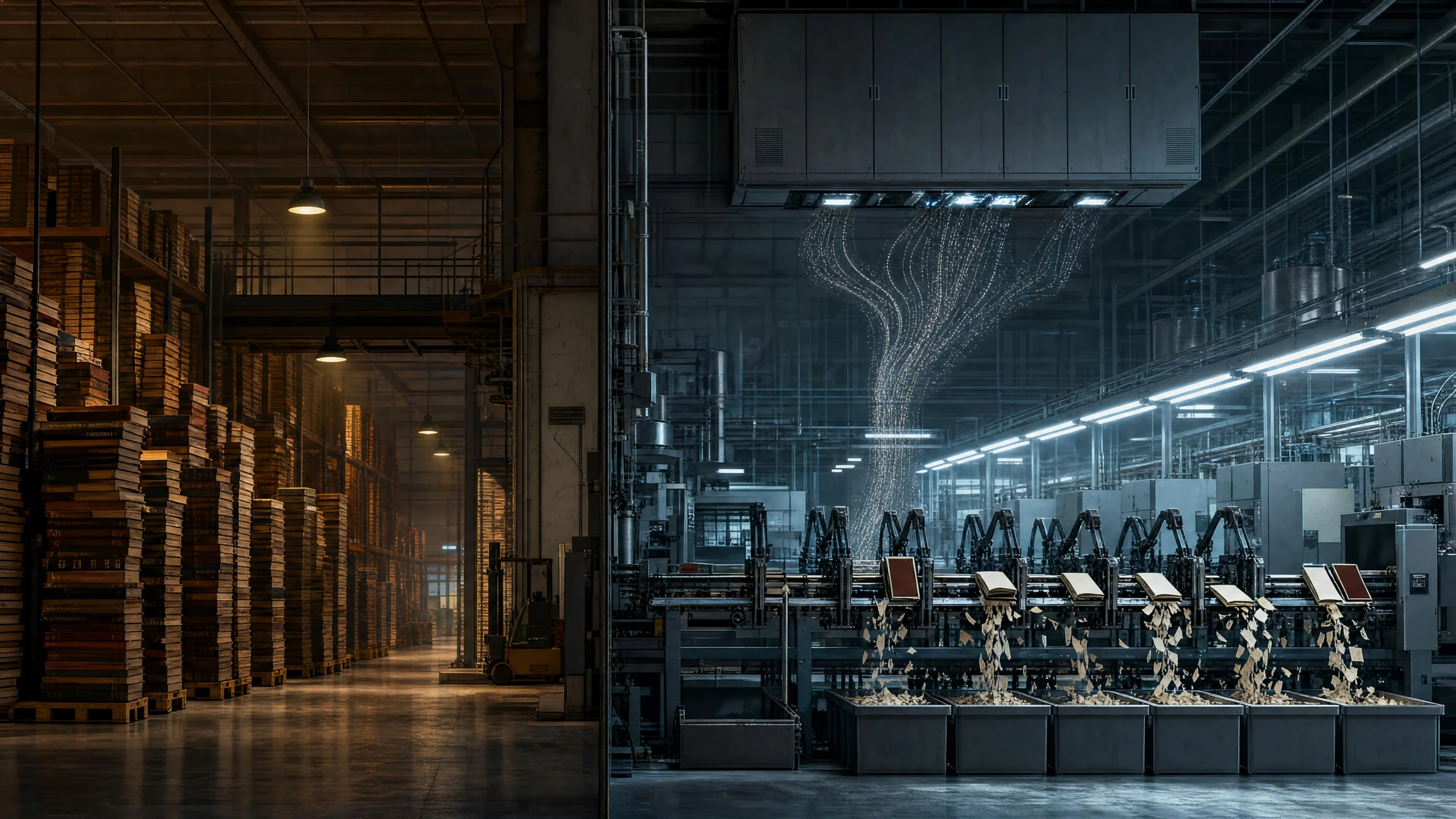
AI-generated editorial illustration · TemperatureZero · August 22, 2026
Keep reading the signal
Get the Daily Signal — a concise briefing on what actually matters in AI and the systems around it.
Subscribe FreeContinue the archive