
Cerebras launched the CS-4 today — three wafer-scale processors per rack, 750 petaflops of AI compute, 4,400 tokens per second per user on a 120-billion-parameter model. That last number is 30 times faster than GPU-based solutions on the same workload. The number that matters more is not any of those. It’s the 750 megawatts that OpenAI committed to before the CS-4 existed. OpenAI signed a multi-year agreement to build what Cerebras calls “the largest high-speed AI inference deployment in the world” on Cerebras hardware. The hardware came second. That order is the signal.
OpenAI’s CTO Sachin Katti framed the strategy precisely when the partnership was announced: “OpenAI’s compute strategy is to build a resilient portfolio that matches the right systems to the right workloads. Cerebras adds a dedicated low-latency inference solution to our platform.” Not a replacement for GPU. A dedicated layer for a specific class of workload. That framing is what makes today’s CS-4 launch more than a spec upgrade — it’s the hardware that executes a bet OpenAI already made about where the inference bottleneck actually lives.
The Memory Wall Is the Inference Wall
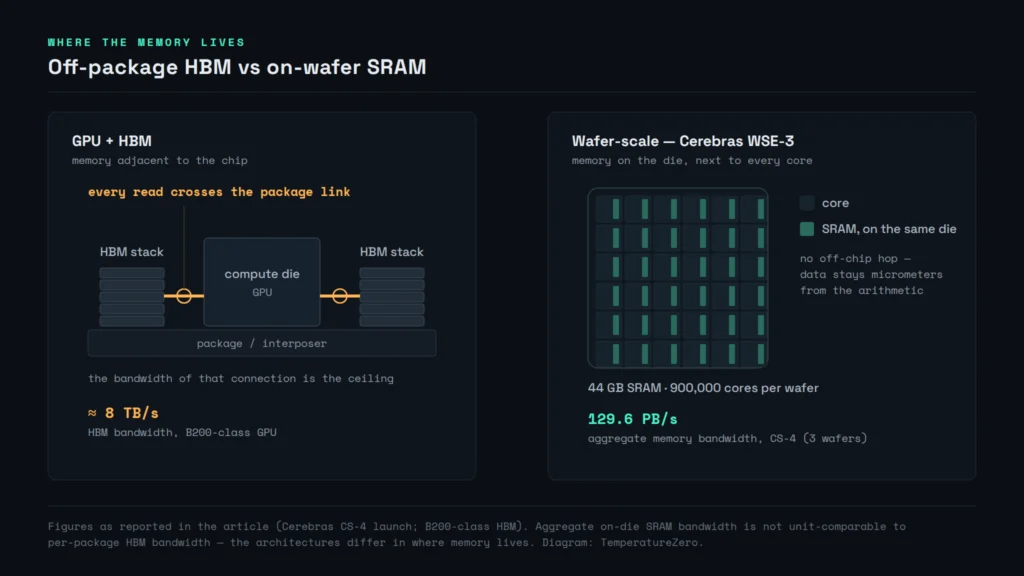
The standard comparison in AI hardware focuses on FLOPS — floating-point operations per second. For training, that’s the right axis. For inference, it’s the wrong one. A language model generates tokens one at a time. Each token generation requires loading the model’s weights — potentially hundreds of billions of parameters — from memory into the compute units on every step. The constraint is not how fast those units multiply matrices. It’s how fast the chip can read from memory.
GPU inference is bottlenecked at the interface between the processor and its memory. High-bandwidth memory (HBM) sits adjacent to the chip, connected by an external package, and the bandwidth of that connection is the ceiling. The WSE-3 processor inside the CS-4 takes a different path: 44 gigabytes of SRAM sits directly on the same die as 900,000 compute cores, within micrometers of the arithmetic. The CS-4 system, combining three WSE-3 Turbo wafers, delivers 129.6 petabytes per second of memory bandwidth. That figure is not comparable to HBM bandwidth in units — it’s in a different class of hardware architecture, because the data never travels between chips at all.
The implication for inference is direct. GPU vendors have improved HBM steadily across generations, but HBM is always off-chip. The traces from processor to memory package are a physics problem, not an engineering gap that iteration closes. Cerebras’s approach eliminates the bus rather than widening it. Andrew Feldman, Cerebras’s CEO, described the consequence in product terms: being 30 times faster “gives an agentic system room for more than an order of magnitude as much reasoning, verification, or tool use in the same wall-clock time.” That’s the argument — not a faster single response, but a qualitatively different capability envelope for inference-heavy workloads.
CS-4 and the Disaggregated Stack
The CS-4 is built from three WSE-3 Turbo processors. The WSE-3T maintains the same 900,000 cores, 44 gigabytes of SRAM, and 5nm TSMC process as the prior WSE-3, but runs at approximately twice the clock frequency — from 1.4 GHz to roughly 2.8 GHz. NextPlatform’s analysis notes the key enabling change: Cerebras moved power delivery to within 0.5 millimeters of the processor, compared to approximately 50 millimeters in conventional GPU board designs. The thermal and power infrastructure for this doubling “was not yet there” two years prior. Three WSE-3T units in a CS-4 rack yield 750 petaflops, 129.6 petabytes per second of memory bandwidth, 7.2 terabits per second of I/O (up from 1.2 Tbps on the CS-3), and wafer-to-wafer latency of 2 microseconds via Direct Wafer Links. The Nexus Platform that houses the system uses a modular “Wafer-Scale Backpack” design — 50% fewer components, 60% more automated manufacturing, and deployment measured in hours rather than days. On a per-watt basis, the CS-4 delivers 10 times the throughput of the CS-3.
The most structurally significant announcement alongside CS-4 is the disaggregated inference partnership with AMD. Inference has two stages with different computational profiles. Prefill processes the input prompt and builds the initial key-value cache — a highly parallel operation running attention over an entire token sequence. Decode generates each token sequentially, loading the full weight set from memory on every step. These stages have different bottlenecks. AMD’s Helios rackscale platform handles prefill; Cerebras handles decode. According to both companies’ July 2026 modeling, the combined architecture delivers five times more tokens per watt than Cerebras alone. AMD’s CTO Mark Papermaster described the split as “combining GPU strengths in parallel computation with Cerebras’ low-latency decode capabilities.” That description is architecturally accurate — the choice of which chip handles which stage isn’t a compromise. It’s the correct assignment.
GPT-5.6 Sol Ultrafast, OpenAI’s high-speed service tier already running on Cerebras hardware, completed a 2,500-question graduate-level reasoning exam in 11 hours, 11 minutes — versus more than three days on a comparable GPU system. OpenAI deploys this capacity for internal research, security incidents, and Codex agents. The latency advantage at this scale isn’t cosmetic: agentic workloads loop, verify, and branch. A 14x speed advantage on each loop iteration compounds across the full reasoning chain. That’s not a better user experience; it’s a different class of system capability in the same wall-clock window.
What Cerebras Is Not Hiding
The honest description of WSE-3 Turbo is that it’s a frequency-doubled WSE-3. The cores, SRAM, and process node are unchanged. Cerebras unlocked a specific engineering headroom — moving power delivery far closer to the die — and doubled the clock to use it. NextPlatform’s analysis is direct about the consequence: clock speeds cannot be reliably doubled again from this new baseline. The WSE-3T used the accessible frequency headroom that two years of power-delivery engineering enabled. The next generation does not have that same lever in reserve.
The path forward for wafer-scale bandwidth is 3D SRAM stacking — integrating memory vertically above the compute layer rather than across a larger horizontal die. Cerebras has not announced 3D SRAM capability. The CS-4’s 44 gigabytes of SRAM per wafer is identical to the CS-3’s. Frontier models significantly above the 120-billion-parameter benchmark case require multiple CS-4 systems interconnected through Direct Wafer Links. The 2-microsecond inter-wafer hop is genuinely excellent. It does not eliminate the distributed coordination problem that arises when a model is too large to fit in a single system’s memory. It makes that problem more tractable than GPU NVLink topologies at comparable scale — but the problem exists, and Cerebras hasn’t published a solution to it beyond the link latency.
There is a direct competitor in specialized inference silicon: Groq’s Language Processing Unit targets inference speed through a dataflow pipeline architecture. Groq and Cerebras compete in the same market segment — speed-sensitive inference beyond what GPU clusters deliver — with different architectural premises, different deployment complexity, and different sweet spots by model size and workload type. Cerebras leads at frontier-model scale with the highest throughput; Groq offers simpler deployment and a mature SDK for smaller models. OpenAI’s decision to build its latency-critical inference on Cerebras reflects where frontier-model inference actually runs. Whether the decision holds through the next model generation depends on whether Cerebras’s architecture scales ahead of the HBM roadmap.

What the Bet’s Shape Reveals
Today’s CS-4 launch doesn’t mean Cerebras won the inference market. It means OpenAI’s inference infrastructure is now explicitly layered: GPU for training, GPU-Helios for prefill, Cerebras for decode. AWS, Group 42, and the Mohamed bin Zayed University of AI are named alongside OpenAI as CS-4 customers. The heterogeneous inference stack — purpose-built silicon for each computational stage — is spreading beyond the single largest customer.
The GPU ecosystem’s response is not standing still. Nvidia’s NIM microservices, TensorRT-LLM, and successive HBM generations continue pushing GPU inference throughput upward. The B200’s memory bandwidth improvements are real. But 129.6 petabytes per second of on-wafer SRAM bandwidth and 8 terabytes per second of HBM are separated by more than a roadmap. They’re different architectural premises about where memory and compute should live relative to each other. OpenAI committed 750 megawatts of Cerebras capacity before the CS-4 was ready to ship. The multi-year commitment at that scale suggests whoever runs the frontier inference workloads has concluded the gap doesn’t close through HBM iteration alone. CS-4 is the hardware that turns that conclusion into production infrastructure. The pattern — not one chip for everything, but the right chip for each stage — is what the inference stack looks like when the memory wall is taken seriously.
AI-generated editorial illustration · TemperatureZero · August 19, 2026
Keep reading the signal
Get the Daily Signal — a concise briefing on what actually matters in AI and the systems around it.
Subscribe FreeContinue the archive