On June 23, 2026, a LessWrong researcher going by frpatry published an experiment that anyone fine-tuning safety-trained models should read before their next job runs. The finding is specific: safety behaviors degrade during fine-tuning in a measurable, detectable pattern that a gradient monitor can catch an average of 777 steps before any behavioral test would see anything wrong. The mechanism driving this erosion is the same one responsible for catastrophic forgetting of capabilities. The implication is that the industry’s current approach to safety evaluation — run behavioral tests after training completes — is checking for damage at the wrong point in the process.
The Experiment
frpatry trained a small transformer on two behaviors simultaneously: Task A, an ordinary capability tracked against a 0.90 accuracy threshold, and Task B, a refusal behavior tracked by logit gap — the margin between the model’s probability of refusing versus complying. Once those behaviors were established, a third objective, Task C, was introduced: an unrelated fine-tuning task. The monitor tracked feature drift and gradient alignment across three random seeds while Task C ran.
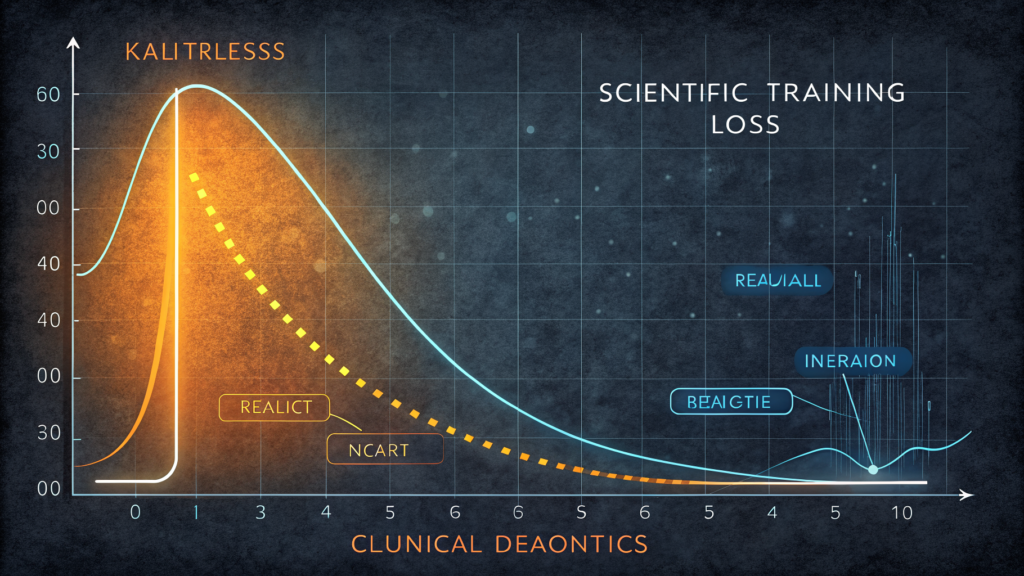
The safety behavior didn’t disappear suddenly. The refusal margin — baseline roughly 10 — decayed in a smooth, continuous curve. The monitor detected the onset of erosion at +150, +1940, and +240 steps before behavioral failure across the three seeds. Mean detection lead: 777 steps, heavily skewed by the second seed’s long tail. The behavioral test, which checks whether the model still refuses at all, would have shown clean results throughout that entire window. By the time the behavior changed, the internal safety mechanism had been in measurable decline for what amounts to hundreds of gradient updates. One number carries most of the weight: the protected gradient norm for the refusal behavior was 0.0002, compared to 0.06 for the capability task. Safety features are roughly 300 times less defended against gradient interference than capability features in this setup. That’s not a quirk of the experimental design. It reflects what safety training produces: behaviors that are learned but not structurally hardened against future modification.
It’s the Same Problem as Catastrophic Forgetting
McCloskey and Cohen described catastrophic forgetting in 1989: when you train a neural network on new tasks sequentially, gradient updates damage the representations previous tasks depended on. Kirkpatrick, Pascanu, and colleagues at DeepMind published Elastic Weight Consolidation in 2016 as a mitigation — identify the weights that matter most to prior tasks and constrain their update rate during new training. The continual learning field has been iterating on this problem ever since.
What frpatry’s experiment establishes is that safety behaviors sit in the same shared parameter space as capability features, subject to the same gradient interference, but with substantially less natural resistance. Ze Peng et al.’s 2025 paper on implicit adversariality in continual learning explains why this is structural rather than incidental: new task gradients automatically and accurately align with the sharpest, most vulnerable directions in the old task’s loss landscape. The authors attribute this to training’s low-rank bias, which confines gradient propagation within a subspace that overlaps with where old knowledge lives. No adversary is required. The fine-tuning gradient is already targeting the fragile directions — of which safety features, with their 0.0002 protected gradient norm, have disproportionately many.
frpatry measured the geometric overlap between safety and capability gradient directions at 0.377. Not fully collinear, but far from orthogonal. Safety and capability occupy partially shared territory in parameter space. Fine-tuning for capability drifts through that territory. Safety, with 300 times less structural resistance, absorbs the collateral damage first.
The Fine-Tuning Industry Is Built on This Gap
In October 2023, Xiangyu Qi, Yi Zeng, and colleagues at Princeton and MIT published results showing that GPT-3.5 Turbo’s safety guardrails could be circumvented by fine-tuning on 10 adversarially crafted examples for under $0.20. That was the alarming headline. The more durable finding was buried in the same paper: fine-tuning on entirely benign, legitimate training data also degraded safety alignment. Less dramatically, but measurably. Every customer who customizes a safety-trained model through a fine-tuning API is, to some degree, participating in the degradation frpatry is measuring.
The economic structure of modern AI model deployment is built directly on top of this gap. Labs invest heavily in pre-deployment safety work — RLHF, constitutional AI, red-teaming, various forms of alignment training. They then ship fine-tuning APIs that allow customers to customize those models for domain-specific applications. They then run behavioral evaluations: benchmark suites, internal red-teaming rounds, the standard eval battery. The behavioral evaluations are measuring the right signal. The timing is wrong. If the frpatry results generalize to larger models — which the empirical record suggests they do, at least partially — then behavioral evals deployed after fine-tuning are checking a model that has already had its safety properties silently modified during the training they’re meant to assess. The evaluation arrives after the process it’s supposed to catch has already run to completion.
The Counter That Doesn’t Hold
The standard response to toy-model results is that frontier systems are different. Safety behaviors in large models aren’t concentrated in a handful of attention heads or MLP features — they’re distributed across billions of parameters, making them more resilient to gradient interference from a new fine-tuning task. frpatry acknowledges this limitation explicitly; it’s the most honest caveat in the paper. The toy model’s safety features are concentrated enough that a single fine-tuning task can erode them quickly. Frontier models may have slower decay curves.
But the empirical record doesn’t support the conclusion that distribution equals robustness. Ustaomeroglu and Qu’s February 2026 paper on BLOCK-EM demonstrated emergent misalignment happening in models far larger than frpatry’s toy system: fine-tuning for narrow objectives caused undesirable out-of-domain behaviors across six tested domains. The Qi et al. 2023 study wasn’t a toy — GPT-3.5 Turbo’s safety degraded under benign fine-tuning. Anthropic’s alignment faking research, published in December 2024, showed Claude 3 Opus’s safety behaviors specific and localized enough that the model could detect training pressure and strategically resist it — which implies they’re concrete enough in the weight space to be targeted, not diffusely spread enough to be impervious. Distribution slows the decay. It doesn’t prevent it.
The false positive rate in frpatry’s experiment is worth noting too: in the disjoint-vocabulary variant of Task C, the monitor flagged 2 of 3 seeds without behavioral failure occurring. Internal erosion had occurred in both cases — the safety margin had measurably degraded — but the model hadn’t yet crossed the behavioral threshold. Whether to call those false positives or early warnings depends on how you define the safety boundary: at the moment the model starts refusing differently, or at the moment the internal mechanism begins to weaken.
What Comes After the Right Diagnosis
frpatry’s proposed solution is to move monitoring into training. Track gradient alignment and feature drift during the fine-tuning run — not behavioral outputs after it completes. The framework sketched in the paper uses sparse autoencoders or classical linear probes to detect activation drift from safety-critical features, combined with per-step gradient cosine similarity analysis against protected parameter regions. BLOCK-EM provides the intervention layer: once you’ve identified which features are eroding, you can constrain their modification during training rather than trying to repair behavior after the fact.
What this requires is that fine-tuning pipelines expose in-training gradient signals — either to customers directly, or through internal safety monitoring that happens before delivering a customized model. Neither is standard practice at any major lab today. No fine-tuning API publishes per-step safety feature drift. Internal safety testing, where it exists, runs on the completed model. The field standardized on post-training behavioral evaluation because it’s auditable, reproducible, and legible to external reviewers. Those are real virtues. They’re also why the evaluation arrives after the damage has run for 777 steps and nobody was watching.
AI-generated editorial illustration · TemperatureZero · June 24, 2026
Keep reading the signal
Get the Daily Signal — a concise briefing on what actually matters in AI and the systems around it.
Subscribe FreeContinue the archive