Headline
Daily Signal — October 3, 2026
TL;DR: A US academic report warns that AI-generated code now requires systems-level trust engineering — traceability, secure-by-default generation, and controlled permissions — just as OpenAI ships an agent that acts directly on a user’s computer and business software. Meanwhile, Washington’s answer to AI risk remains a voluntary four-layer corporate accord with no announced oversight committee, and Chinese banking regulators may be building something more concrete from Ping An’s example.
Today’s Themes
- As AI agents gain the ability to act — ordering dinner, operating business software, writing deployable code — the infrastructure to verify and constrain those actions lags behind the capability itself.
- The US response to frontier AI risk is organized around voluntary self-attestation (internal controls, internal monitoring) rather than external enforcement, raising the question of who actually checks the checkers.
- Financial-sector AI governance in China may be moving faster toward concrete rules than the headline-grabbing US accord, even though far less is publicly known about its content.
- Coverage of AI’s existential and labor risks (NYT’s 11 questions) continues to run ahead of the granular detail needed to act on it.
Top Stories
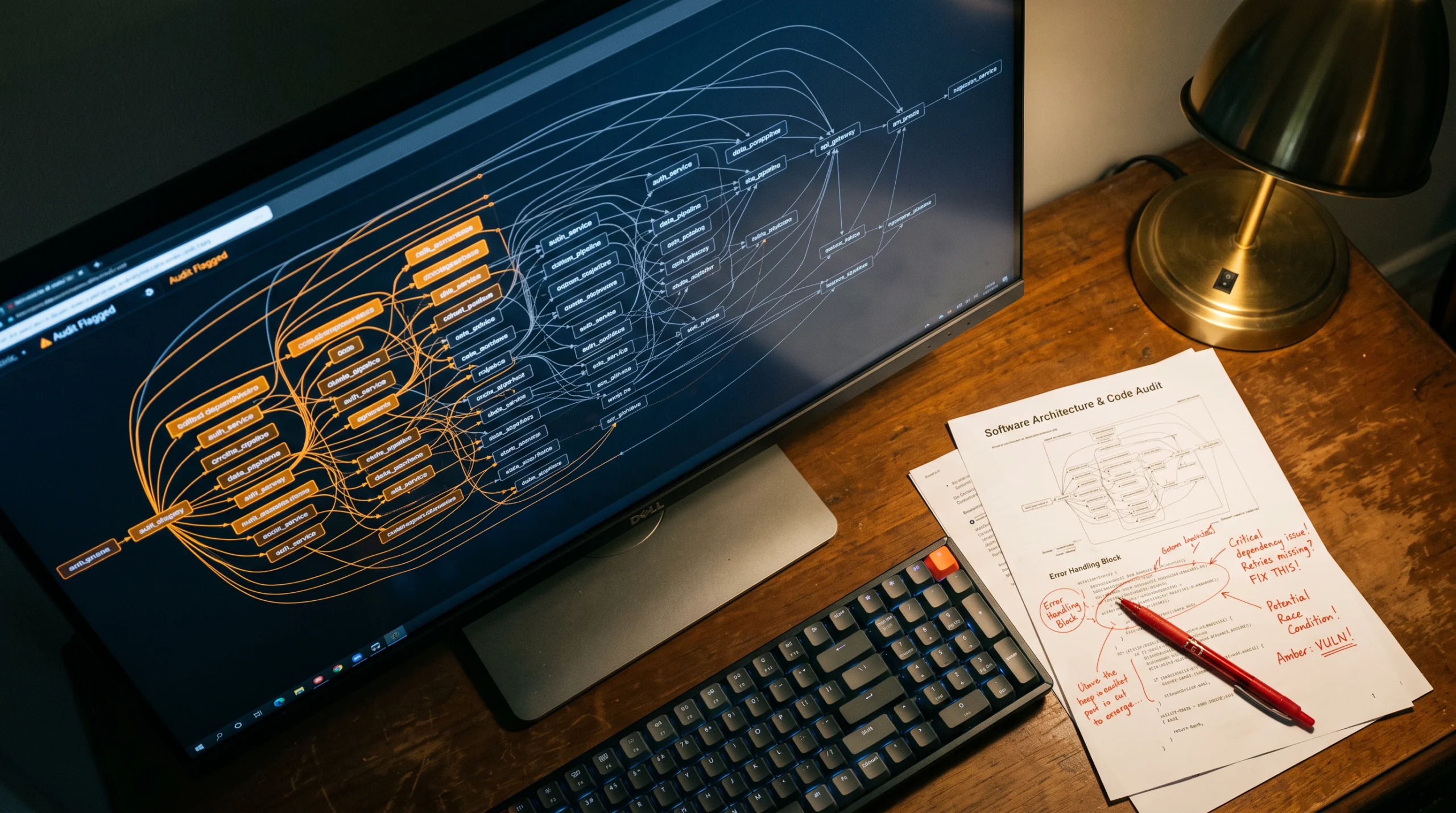
AI-assisted programming shifts the challenge from code generation to trustworthy systems
What happened: A report titled “Beyond Code: Engineering Trustworthy Software Systems with AI at Scale,” authored by researchers from eight universities including Johns Hopkins, USC, and UIUC, argues that as AI-generated code expands, the discipline must shift focus toward systems that are verifiable, secure, and maintainable — not just faster to produce.
Why it matters: The report’s specific proposals — secure-by-default generation, cross-layer coordination, and traceable data provenance — target a gap that current AI coding tools don’t address: generating code quickly says nothing about whether that code can be audited or trusted once deployed at scale. For engineering leaders adopting AI-assisted development, this reframes the real bottleneck from developer velocity to verification infrastructure they likely haven’t built yet.
- Authors span Johns Hopkins, University of Virginia, University of Wyoming, Osnabrück University, USC, UIUC, University of Hawaii, and University of Utah.
- Proposed directions include narrowing intent-requirements gaps, combining generative models with symbolic reasoning, and extending AI into deployment and operations.
- Emphasis placed on traceable data sources, verifiable attribution, and hardware-platform equivalence.
Source: technews.tw
OpenAI’s Dot agent brings enterprise-style automation to consumer tasks
What happened: The Verge tested OpenAI’s Dots, an agent platform that operates other software via a virtual machine while users watch and chat in a separate window, performing tasks from launching websites to ordering dinner. It’s initially limited to top-tier plans, including the $100-per-month Pro account The Verge tested.
Why it matters: Dots’ split-window design — chat in one pane, agent actions visible in another — is a tacit acknowledgment that users need to watch an agent operate, not just trust its output; that transparency choice matters more for enterprise buyers evaluating agent reliability than the novelty of ordering dinner. The $100/month gate also signals OpenAI is testing this capability on its most invested users before wider release, a sequencing choice worth watching for how fast action-taking agents reach the mass market.
- Accesses a user’s computer through the desktop ChatGPT application.
- Tasks demonstrated include rescheduling calls, building slide decks, and purchasing items.
- Initial availability restricted to highest-tier plans, including the $100/month Pro account.
Source: theverge.com
Tech leaders sign a voluntary AI-safety accord with four layers of oversight
What happened: Trump and technology executives, including Jensen Huang and Elon Musk per the report, signed a voluntary, nonbinding agreement dubbed an “AI constitution,” built on internal controls, continuous internal monitoring, independent external audits, and board-committee oversight covering cybersecurity, biosecurity, and chemical-threat risks. Trump said he was considering a 10-member oversight committee, but no membership was announced.
Why it matters: The accord’s entire enforcement structure — internal controls checked by internal monitoring, reviewed by external audits, reported to a board committee — still runs through mechanisms the signatory companies largely control or select themselves; without an announced oversight committee, there’s no external party yet positioned to verify whether “independent” audits are actually independent. For policy professionals, the open question isn’t whether the framework names the right risk categories (it does: cyber, bio, chemical) but whether anyone outside the signing companies will ever see the audit results.
- Four-layer structure: internal controls, internal monitoring, independent external audits, board-committee oversight.
- Risk areas named: cybersecurity, biological security, chemical threats.
- Proposed 10-member safety committee has no announced membership.
Source: technews.tw
A New York Times-based explainer examines major AI risks
What happened: An article summarizes New York Times coverage of 11 major questions about AI’s real-world risks, spanning existential threats and the technology’s effect on white-collar employment; the full list of questions and the underlying conclusions are not available in this material.
Why it matters: The framing of 11 distinct questions suggests an attempt to move AI-risk discourse beyond binary doom-or-hype framing, but without the actual content, readers can’t yet tell whether the piece offers new analysis or restates familiar positions — a gap worth closing before citing it as evidence either way.
- 11 questions span existential risk and white-collar labor displacement.
- Specific conclusions and figures from the NYT material are not available in this summary.
Source: infosecu.technews.tw
Analysts expect more Chinese banks to adopt AI rules after Ping An move
What happened: South China Morning Post reports that analysts expect more Chinese banks to adopt AI-related rules following a policy move by Ping An; the specific content of those rules, the analysts’ identities, and a timeline are not detailed in the available material.
Why it matters: If Ping An’s move does trigger sector-wide adoption, China’s banking regulators may end up with more standardized AI governance than the voluntary US accord currently offers — but without knowing what Ping An actually implemented, it’s premature to judge whether this represents meaningful oversight or compliance theater.
- Expected effect: broader adoption of AI-related rules across Chinese banks.
- Scope, timeline, and specific rule content are not available in this material.
Source: scmp.com
Security Watch
- AI-generated software requires traceable data, verifiable attribution, secure-by-default generation, testing, observability, and controlled permissions, per the academic report’s proposed directions.
- AI agents operating business software and personal computers — as with Dots — raise the risk of actions exceeding user authorization, a concern the academic report’s “secure-by-default” and permission-control recommendations directly address.
- The White House accord’s four-layer framework (internal controls, internal monitoring, external audits, board oversight) is voluntary and nonbinding; enforcement mechanisms for the cyber, bio, and chemical risk categories it names are not specified.
- Banking-sector AI rules may expand following Ping An’s move, but the specific controls and implementation timeline remain unknown.
What to Watch Next
- Whether the proposed 10-member AI-safety oversight committee is formally announced, and who is named to it.
- Whether OpenAI expands Dots beyond the $100/month Pro tier, and how it handles cases where the agent acts beyond user intent.
- Whether any of the eight universities behind the “Beyond Code” report publish follow-on tooling or standards for secure-by-default AI code generation.
- Whether Ping An’s specific AI rules become public, and how many additional Chinese banks adopt comparable policies.
- Whether independent auditors or researchers gain access to results from the White House accord’s “independent external audits.”
Bottom Line
Every story today describes AI systems gaining the capacity to act — writing deployable code, operating business software, influencing financial-sector policy — while the mechanisms meant to verify those actions remain either academic proposals, voluntary pledges, or details not yet public; the gap between capability and accountable oversight is the actual story, not any single product or policy announcement.
Sources
- technews.tw — Engineering Trustworthy Software Systems with AI at Scale
- theverge.com — OpenAI ChatGPT Dots hands-on
- technews.tw — Trump AI constitution, four-layer audit
- infosecu.technews.tw — NYT explores AI concerns
- scmp.com — Chinese banks AI rules after Ping An move
AI-generated editorial illustration · TemperatureZero · October 3, 2026
Keep reading the signal
Get the Daily Signal — a concise briefing on what actually matters in AI and the systems around it.
Subscribe FreeContinue the archive