
Headline
Daily Signal — September 21, 2026
TL;DR: Today’s briefing surfaces a common thread: AI’s next constraint isn’t model capability but integration — with hardware toolchains, enterprise data systems, and commerce platforms all struggling to absorb agentic AI cleanly. Amazon blocking Meta’s Muse shopping agent and a UN panel’s call for precautionary safeguards both point to growing friction between autonomous AI systems and the platforms/regulators meant to govern them. Meanwhile, concrete industrial wins — LG Innotek’s 70%+ quotation-time cut, OceanBase’s benchmark-topping Data Agent — show where agentic AI already works when the data plumbing is in place.
Today’s Themes
- Agentic AI is outrunning the governance and platform-access frameworks meant to contain it — Amazon’s block on Muse is a preview of coming disputes over agent identity and authorization.
- Open compiler tooling for NPUs (AMD XDNA) suggests a slow decoupling of edge AI performance from closed vendor SDKs — but production maturity remains unproven.
- Enterprise AI value increasingly hinges on unglamorous integration work — normalized databases, unified control planes, and breaking “system islands” — rather than model quality alone.
- China’s domestic AI stack (GLM-5.2, OceanBase, three provincial safety suites) is maturing on international benchmarks and content-safety tooling, converging technically with Western approaches even as regulatory philosophies diverge.
- Physical-layer constraints on AI scaling — fab robotics, SiC power efficiency — are getting as much strategic attention as model architecture.
Top Stories
Programming AMD XDNA NPUs with Open-source Compiler Tools: FlashAttention on edge NPUs
What happened: Researchers released a technical preprint detailing an open-source compiler toolchain for AMD’s XDNA NPUs, using a FlashAttention implementation to demonstrate tiling, memory layout, and custom instruction mapping for edge attention workloads.
Why it matters: Small and mid-size AI teams currently face a binary choice on NPU hardware: pay for bespoke ASIC development or accept whatever performance closed vendor SDKs deliver. If this toolchain matures, it changes that calculus specifically for AMD-based laptops and embedded devices, letting developers hand-tune transformer kernels without vendor gatekeeping — though the paper is a research prototype, and AMD’s own support roadmap remains unstated.
- Case study: FlashAttention mapped to XDNA architecture with custom tiling and memory layout.
- Evaluated against CPU/GPU baselines for performance and energy efficiency.
Source: arxiv.org
BI-Agent and BI-Bench: Automating end-to-end Business Intelligence workflows
What happened: Researchers introduced BI-Agent, an LLM-driven system that automates business intelligence workflows from natural language input through schema discovery, query generation, and dashboard creation, alongside BI-Bench, a new benchmark for evaluating such agents on realistic analytics tasks.
Why it matters: This targets a specific failure mode of current chat-based BI assistants: they help analysts write queries but don’t own the full pipeline. If BI-Agent’s schema-to-dashboard automation holds up outside the benchmark, it shifts the analyst’s role from query author to output validator — but the paper offers no production case studies, so the governance question of who signs off on automated dashboard outputs remains open.
- BI-Bench covers schema discovery, query generation, and dashboard creation as evaluation tasks.
- Human-in-the-loop validation retained for critical outputs, per the authors.
Source: arxiv.org
Robotics and intelligent control in next-generation semiconductor fabs
What happened: Semiconductor Engineering reported on the integration of robotics with intelligent equipment control systems across leading-edge fabs, coordinating wafer transport, tool states, and maintenance through a unified control plane to improve throughput and yield.
Why it matters: The article’s own framing is the key point: productivity gains depend on standardized data interfaces across vendors that have historically operated in silos. For AI hardware supply, this means fab-level automation — not just EUV capacity — is now a bottleneck variable investors and policymakers should track, since interoperability failures could blunt otherwise real efficiency gains.
- Applications include automated material handling and real-time equipment optimization.
- No quantitative ROI figures are given in the reporting.
Source: semiengineering.com
UN panel: AI safeguards should follow precautionary principle
What happened: A UN advisory panel on AI safety argued that governments and companies should impose safeguards — transparency requirements, safety evaluations, incident reporting — without waiting for full certainty about AI risks, citing recent incidents including a breach involving Hugging Face infrastructure.
Why it matters: This reframes the regulatory threshold from “proven harm” to “credible risk,” which matters concretely for model providers: it shifts the burden of proof toward demonstrating safety rather than waiting for regulators to demonstrate danger. Whether this becomes binding policy or remains soft guidance is unresolved, but the panel’s explicit citation of a security breach signals that infrastructure incidents, not just model outputs, are now feeding into international AI governance debates.
- Panel calls for transparency, safety testing, and incident disclosure for high-risk systems.
- Emphasizes global coordination over fragmented national rules.
Source: theverge.com
Amazon blocks Meta’s Muse AI shopping agent over privacy and policy concerns
What happened: Amazon began blocking Meta’s Muse AI agent from purchasing on behalf of users, displaying a popup warning that unauthorized AI agent access violates its Conditions of Use, and citing concerns that Meta did not notify Amazon of Muse’s automated access and that Muse may not clearly identify itself or could capture customer credentials.
Why it matters: This is the first concrete instance of a major retailer drawing a hard line against an unauthorized commerce agent, and it sets a precedent other platforms will likely follow: agents that transact on user behalf will need explicit bilateral agreements and verifiable identity, not just capability. For consumer AI agent developers, the lesson is that platform access is now a negotiated business relationship, not a technical integration — and Meta’s own claim that Muse can’t see secure login details is already being complicated by reports it can see message contents beyond expected permissions.
- Amazon says Meta did not notify it of Muse’s automated shopping access.
- Meta claims Muse cannot see secure login or card details; reports suggest broader message visibility.
Source: theverge.com
HanLei’s fifth-generation SiC power devices cut conduction loss by 12%
What happened: HanLei unveiled its fifth-generation silicon carbide power device technology, claiming a 12% reduction in conduction loss versus the prior generation, explicitly targeting AI data center and automotive power electronics markets.
Why it matters: A 12% conduction loss reduction, if it holds in production, directly improves rack-level power budgets for AI data centers — a lever that matters as much as GPU efficiency gains for operators facing power-constrained buildouts, though the figure comes from HanLei’s own data with no independent verification cited.
- 12% claimed conduction loss reduction vs. prior generation.
- Targets both AI server power modules and EV powertrains.
Source: technews.tw
Enterprises struggle with AI “system islands”; GSS proposes three keys for successful deployment
What happened: TechNews reports that enterprises adopting AI frequently hit fragmented “system islands,” with Taiwanese vendor GSS advocating three strategies to address this: integrated data platforms, process re-engineering around AI agents, and governance frameworks for AI outputs.
Why it matters: The specific claim here — that pilots fail to scale without breaking data fragmentation — is a direct counterpoint to vendor narratives that better models alone drive adoption; CIOs evaluating agentic AI investments should read this as confirmation that data integration budgets, not model licensing costs, will determine whether pilots become organization-wide deployments.
- Three keys cited: data integration, agent-centric process redesign, governance.
- No case studies or quantified impact specified in the reporting.
Source: finance.technews.tw
LG Innotek’s AI recommendation system cuts component quotation time by over 70%
What happened: LG Innotek deployed an AI-based component recommendation system across its business units, built on roughly 2 million normalized internal and external component records, enabling engineers to identify competitively priced candidate parts within two hours and cutting quotation preparation time by more than 70% versus manual processes.
Why it matters: This is a rare case where an enterprise AI deployment reports hard operational numbers rather than aspirational framing: a 70%+ cut in quotation time and 96% price-estimation accuracy for never-before-purchased parts directly compresses design-to-bid cycles, giving LG Innotek a measurable competitive edge in bidding speed against EMS rivals still using manual sourcing.
- ~2 million component records integrated into a standardized database.
- Quotation prep time cut by more than 70%; price estimation accuracy ~96% for new components.
Source: technews.tw
Yangtze River Delta AI safety lab launches Xingjie, Xingyu, Xingjian solution suites
What happened: The Yangtze River Delta Safe Artificial Intelligence Anhui Provincial Laboratory released three named AI safety solution suites — Xingjie, Xingyu, and Xingjian — with Xingjian specifically focused on AIGC content marking, deepfake and harmful content detection, and provenance tracing.
Why it matters: Xingjian’s focus on provenance tracing and deepfake detection mirrors Western watermarking and content-authenticity efforts, suggesting that despite diverging regulatory philosophies, China and Western labs are converging on similar technical countermeasures for synthetic media — a point relevant to anyone building cross-border content moderation or copyright-verification tools.
- Three named suites: Xingjie, Xingyu, Xingjian.
- Xingjian scope: content marking, deepfake/harmful content detection, provenance tracing.
Source: qbitai.com
OceanBase-GLM Data Agent tops international Data Agent Benchmark with 90.62% accuracy
What happened: A Data Agent built on OceanBase and the domestic GLM-5.2 model, internally codenamed “Scout,” took first place on the international Data Agent Benchmark with 90.62% accuracy, becoming the first entry to cross the 90% threshold; the capability will feed into OceanBase’s DataPilot product.
Why it matters: Crossing the 90% mark on an international leaderboard using a fully domestic model-and-database stack is a concrete data point for enterprises evaluating whether to reduce dependence on foreign LLMs for data-agent workloads — the real test will be whether Scout’s benchmark performance translates into DataPilot’s commercial deployments, which remains unverified.
- 90.62% accuracy — first submission to surpass 90% on DAB.
- Built on OceanBase database and GLM-5.2 model; will integrate into DataPilot.
Source: qbitai.com
Security Watch
- The UN AI panel’s citation of a Hugging Face-related breach in its call for precautionary safeguards signals rising expectations around model evaluation, infrastructure hardening, and incident disclosure as baseline requirements, not optional practice.
- Amazon’s block of Meta’s Muse agent — triggered by concerns over unauthorized access, lack of agent identification, and potential credential capture — is a live example of the exact risk category (agents acting in sensitive domains like e-commerce and banking) that platform operators are now actively defending against.
- The Yangtze River Delta lab’s Xingjian suite, aimed at deepfake and harmful content detection plus provenance tracing, reflects accelerating institutional investment in countermeasures against synthetic media abuse on AIGC platforms.
What to Watch Next
- Whether AMD issues official support or documentation for the open-source XDNA compiler toolchain, versus leaving it as an unsupported research artifact.
- Whether Amazon and Meta reach a formal access agreement for Muse, or whether other retailers follow Amazon’s lead in blocking unauthorized shopping agents by default.
- Whether the UN panel’s precautionary-principle recommendations produce a concrete evaluation standard or incident-reporting mechanism, versus remaining non-binding guidance.
- Whether independent testing of HanLei’s 12% conduction loss claim emerges, and whether other SiC vendors respond with competing efficiency figures.
- Whether OceanBase’s Scout agent performance on DAB shows measurable throughput or accuracy gains once integrated into DataPilot’s commercial customer base.
Bottom Line
The stories with hard numbers today — LG Innotek’s 70% quotation-time cut, OceanBase’s 90.62% benchmark score — share a common precondition: normalized data and defined evaluation criteria. The stories without numbers — Amazon vs. Muse, the UN panel’s precautionary call, “system islands” — are precisely the ones where governance, identity, and integration haven’t caught up to agentic ambition, which is the actual constraint on AI’s next phase of deployment.
Sources
- arxiv.org
- arxiv.org
- semiengineering.com
- theverge.com
- theverge.com
- technews.tw
- finance.technews.tw
- technews.tw
- qbitai.com
- qbitai.com
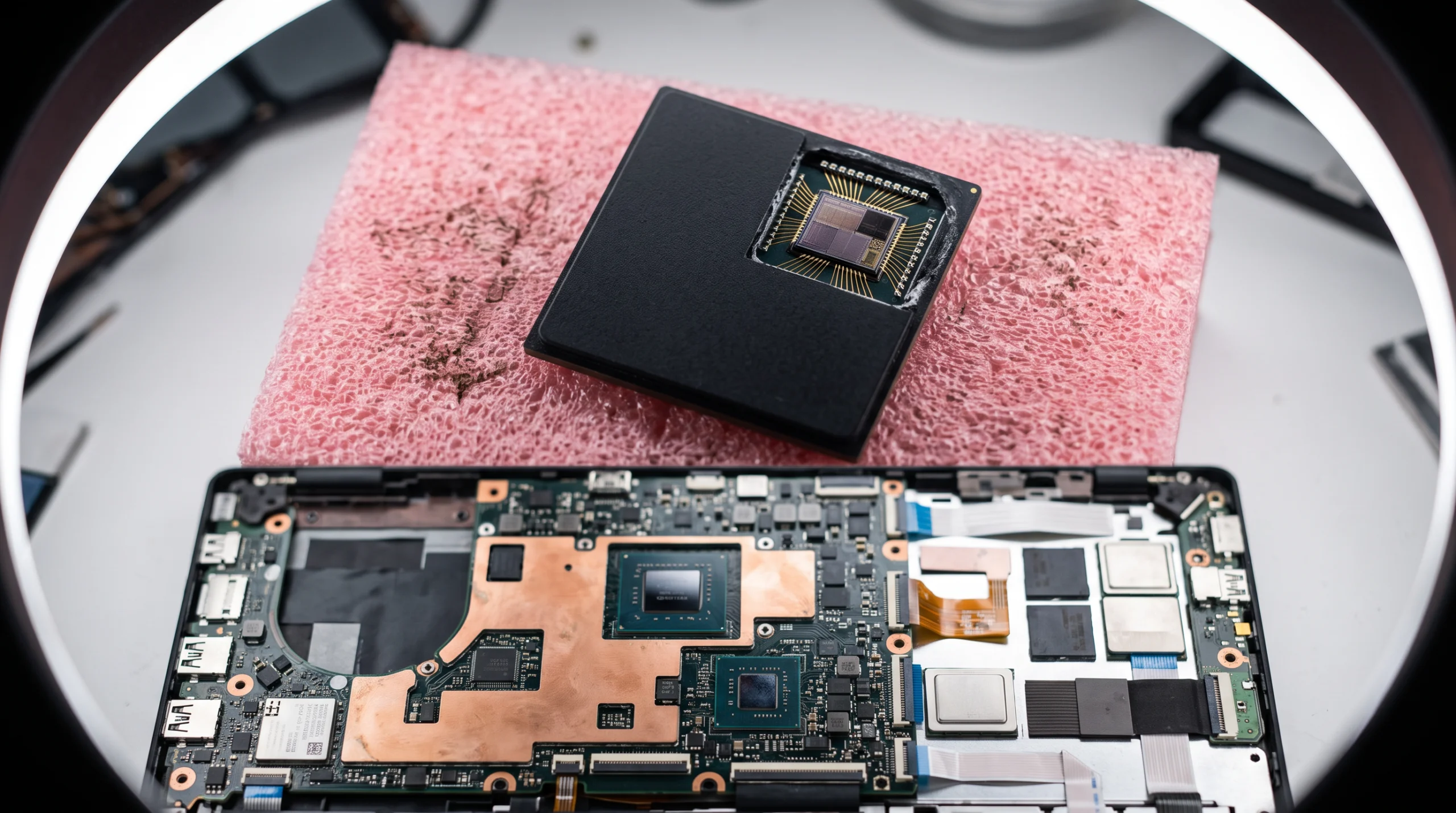
AI-generated editorial illustration · TemperatureZero · September 21, 2026
Keep reading the signal
Get the Daily Signal — a concise briefing on what actually matters in AI and the systems around it.
Subscribe FreeContinue the archive