
Headline
Daily Signal — August 18, 2026
TL;DR: Two security papers published today converge on a single insight: the layer where AI systems translate intent into action — a robot’s action decoder, a coding assistant’s generated snippet — is where risk concentrates, not the perception or reasoning layers that get most of the attention. Meanwhile, Anthropic’s revenue run rate hit $65 billion and Higgsfield quadrupled its valuation to $5.4 billion in eight months, confirming that capital is still chasing frontier AI at a pace that outstrips almost any other sector. Z.ai’s release of GLM 5.3, an open-weight model competitive with Western frontier systems on cybersecurity benchmarks, adds urgency to both threads: capability diffusion is happening in parallel with the discovery of new attack surfaces.
Today’s Themes
- Security research is shifting focus from model outputs to the architectural chokepoints — action decoders, code-generation pipelines — where a small design choice determines whether a fault becomes a catastrophe.
- Open-weight models are closing the capability gap on cybersecurity tasks specifically, which cuts both ways: cheaper defense tooling and cheaper offensive tooling arrive on the same release schedule.
- Anthropic’s revenue trajectory (from roughly $9B to $65B annualized in under eight months) is now steep enough that the open question is less “is demand real” and more “how much of it is contractual versus usage-based.”
- Provenance and watermarking are moving from research curiosity to compliance requirement, with Anthropic’s SynthID-style rollout timed to the EU AI Act rather than to a specific abuse incident.
Top Stories
Bit-flip attacks reveal action-decoder-specific fragility in embodied VLA systems
What happened: Researchers evaluated bit-flip attacks — hardware faults that randomly corrupt bits in memory — against vision-language-action (VLA) models used in robotics, comparing classification-style, regression, and structured action decoders under identical fault budgets. They found some decoder designs are orders of magnitude more fragile than others, with small numbers of bit flips capable of inducing unsafe actions even when perception and language components remain unaffected.
Why it matters: This localizes robotic safety risk to a specific, fixable component rather than the model as a whole. For robotics teams deploying VLA systems in physical environments, the finding argues for auditing action decoders specifically — with redundancy and error-correcting encodings — rather than assuming that a well-tested perception stack implies a safe system end to end. It also reframes hardware fault tolerance as a robotics safety requirement, not just a chip-reliability concern.
- Compared classification, regression, and structured action decoders under simulated random and targeted bit flips.
- Small bit-flip counts induced severe misbehavior in vulnerable decoder types.
- Proposed mitigations include redundant action representations and hardware-level protection for the most sensitive layers.
Source: arxiv.org
Just-in-time security pipeline for AI-generated code
What happened: A new framework scans AI-generated code for vulnerabilities as it’s produced — integrating static analysis, vulnerability databases, and secure coding patterns — and attempts automated remediation before code is committed. Evaluation targeted common vulnerability classes such as injection risks and misuse of cryptographic APIs.
Why it matters: The pipeline treats AI code generation as a security-critical event rather than a downstream QA problem, which matters because AI coding assistants are increasing throughput faster than human review capacity can scale. For engineering leaders adopting AI coding tools at scale, this suggests the security control point should move into the generation loop itself rather than staying bolted onto CI/CD as a separate gate.
- Combines static analysis, vulnerability databases, and secure coding patterns in one pipeline.
- Chains a vulnerability detector with a remediation agent capable of re-prompting or constraining the original model.
- Positioned as complementary to traditional SAST/DAST tooling, targeting AI-specific “shift-left” risk.
Source: arxiv.org
Anthropic’s annualized revenue run rate hits $65B
What happened: Anthropic’s annualized revenue run rate reached approximately $65 billion at the end of July 2026, up from $47 billion in May and roughly $9 billion at the end of 2025. Investors reportedly expect the company to close 2026 at a $100–$120 billion run rate.
Why it matters: A roughly sevenfold increase in annualized revenue within eight months is a scale of growth more typical of a viral consumer product than enterprise infrastructure — which raises a legitimate question about durability rather than magnitude. Enterprises signing multi-year commitments with Anthropic should be asking how much of that $65B is locked-in cloud and enterprise spend versus usage that could contract sharply if switching costs to competing frontier labs prove lower than expected.
- Run rate: $9B (end of 2025) → $47B (May 2026) → $65B (July 2026).
- Investor expectation: $100–$120B annualized run rate by year-end 2026.
Source: techcrunch.com
China’s GLM 5.3 open-weight model pushes the cybersecurity frontier
What happened: Z.ai released GLM 5.3, an open-weight model optimized for coding and cybersecurity work, with benchmarks — including CyberGym — showing performance competitive with leading proprietary models from Anthropic and OpenAI. The company simultaneously launched OpenVuln, a vulnerability-scanning service built on the model, with a phased rollout limiting full access to select security partners initially.
Why it matters: This is the clearest evidence yet that the capability gap between open-weight and proprietary frontier models has narrowed specifically in cybersecurity — a domain where dual-use risk is highest and where the West’s traditional advantage has rested on controlled access. Governments and platform operators now face a governance problem with no existing playbook: the same weights that let a defender’s team run OpenVuln locally also let any downloader automate exploit discovery, and Z.ai’s phased-access strategy is a voluntary control that could be bypassed the moment weights leak or get replicated.
- GLM 5.3 benchmarked competitively against Anthropic and OpenAI models on CyberGym.
- OpenVuln offers automated repository vulnerability scanning built on GLM 5.3.
- Full access currently limited to selected security partners under a phased release.
Source: wired.com
Early human data on Enveda’s ENV-308 “exercise-mimicking” pill
What happened: Enveda reported Phase 1 results for ENV-308, an oral drug analog of lac-phe designed to sensitize leptin signaling and help maintain weight loss while preserving muscle mass, positioned as a complement to GLP-1 therapies. STAT describes the early human data as encouraging but preliminary, with detailed efficacy and safety metrics not yet disclosed.
Why it matters: The drug targets a specific failure mode of current GLP-1 regimens — weight regain and muscle loss after discontinuation — rather than competing on primary weight loss, which is a narrower and more defensible clinical niche if the mechanism holds up in larger trials. Patients and clinicians managing long-term GLP-1 protocols should treat this as an early signal worth tracking, not a near-term treatment option, given the absence of Phase 2 design details.
- ENV-308 is a chemical analog of lac-phe, a 2022-identified exercise-induced metabolite.
- Mechanism acts on leptin sensitivity, described by Enveda as a potential “leptin sensitizer in a pill.”
- Positioned as a complement to GLP-1 drugs, aiming to avoid common GI side effects.
Source: statnews.com
Chip-industry technical paper themes: AI, 3D integration, and reliability
What happened: SemiEngineering’s August 18 roundup summarizes recent chip-industry research emphasizing AI-workload-optimized accelerators and memory subsystems, advanced packaging and 3D integration, and verification/reliability work for increasingly complex SoCs.
Why it matters: The roundup confirms that AI demand, rather than general-purpose computing, is now the primary driver shaping near-term chip R&D priorities — a useful signal for infrastructure planners tracking where packaging and interconnect innovation will show up first in AI hardware roadmaps.
- Themes include AI-tuned accelerator architectures and memory subsystems for high bandwidth and energy efficiency.
- Advanced packaging and 3D integration highlighted as ways to extend scaling past traditional limits.
Source: semiengineering.com
Semiconductor Engineering Research Bits: snapshot of emerging device and design work
What happened: SemiEngineering’s “Research Bits” column compiled brief summaries of ongoing semiconductor research spanning device structures, materials, monolithic 3D integration, and ML-based EDA/manufacturing tools, without deep detail on any single project.
Why it matters: As a running radar of pre-commercial research, this signals where post-Moore’s-law integration and design-automation innovation is trending, though the lack of specifics in this installment limits actionable takeaways beyond directional awareness.
- Covers device structures, materials, low-temperature monolithic 3D integration processes, and ML-driven design/test tools.
Source: semiengineering.com
Higgsfield’s $400M Series B values it at $5.4B
What happened: Higgsfield raised a $400 million Series B round, reaching a post-money valuation of roughly $5.4 billion — about four times its valuation eight months earlier. Lead investors and the startup’s exact product focus were not specified in available reporting.
Why it matters: A 4x valuation step-up in eight months, without disclosed revenue or customer metrics, is a data point on how concentrated and momentum-driven late-stage AI capital allocation has become — worth watching for whether similar step-ups are backed by comparable fundamentals elsewhere in the market.
- Series B: $400M raised.
- New valuation: ~$5.4B, roughly 4x the valuation from 8 months prior.
Source: techcrunch.com
Anthropic details Claude’s SynthID-style invisible text watermarks
What happened: Anthropic is rolling out invisible watermarks for Claude-generated text based on Google DeepMind’s open-source SynthID-Text approach, encoding a detectable statistical pattern in synonym choices that requires a secret key to verify. The rollout accompanies C2PA provenance metadata for Claude-processed images, timed to EU AI Act transparency requirements.
Why it matters: By adopting an existing open method rather than building a proprietary scheme, Anthropic is pushing the industry toward an interoperable watermarking standard rather than a fragmented one — which matters for platforms and publishers that will eventually need to detect AI content across multiple vendors’ outputs using a single verification approach, not one per model provider.
- Based on SynthID-Text, originally developed by Google DeepMind.
- Detection requires a corresponding secret key; watermark is imperceptible to readers.
- Paired with C2PA image provenance metadata, driven by EU AI Act compliance.
Source: theverge.com
Security Watch
- Bit-flip attacks on VLA models show hardware fault exploitation can directly drive unsafe robotic actions, especially where action decoders lack robustness by design.
- The just-in-time security pipeline for AI-generated code highlights that LLM coders can mass-produce vulnerabilities unless scanning and remediation are embedded in the generation loop itself.
- Z.ai’s GLM 5.3 and OpenVuln service demonstrate that open-weight models can approach frontier-level cyber capability, simultaneously empowering defenders and lowering the barrier for advanced exploit tooling.
- Anthropic’s invisible text watermarking reflects growing regulatory pressure for machine-readable provenance of AI-generated content, likely to become standard in high-risk domains.
What to Watch Next
- Whether hardware vendors or robotics integrators begin publishing action-decoder robustness specs in response to the bit-flip findings.
- Adoption rate and false-positive tolerance as the just-in-time code-security pipeline is tested against large, multi-agent coding workflows.
- Whether Anthropic discloses the contractual-versus-usage split in its revenue base as it approaches the $100–$120B year-end target investors expect.
- Government or platform responses to GLM 5.3’s dual-use cybersecurity capability — export controls, licensing norms, or access restrictions on OpenVuln.
- Enveda’s Phase 2 trial design and disclosed efficacy/safety metrics for ENV-308, which will determine whether the leptin-sensitizer mechanism holds beyond Phase 1.
Bottom Line
The day’s technical research points to the same structural lesson from two different domains — robotics and software — that the most exploitable point in an AI system is often the narrow translation layer between model output and real-world action, not the model itself; meanwhile the day’s business news shows capital and capability both concentrating faster than the governance structures meant to contain their risks.
Sources
- arxiv.org/abs/2608.15475
- arxiv.org/abs/2608.16187
- techcrunch.com/anthropic-revenue
- wired.com/zai-glm-5.3
- statnews.com/enveda-env-308
- semiengineering.com/paper-roundup
- semiengineering.com/research-bits
- techcrunch.com/higgsfield-series-b
- theverge.com/claude-watermarks
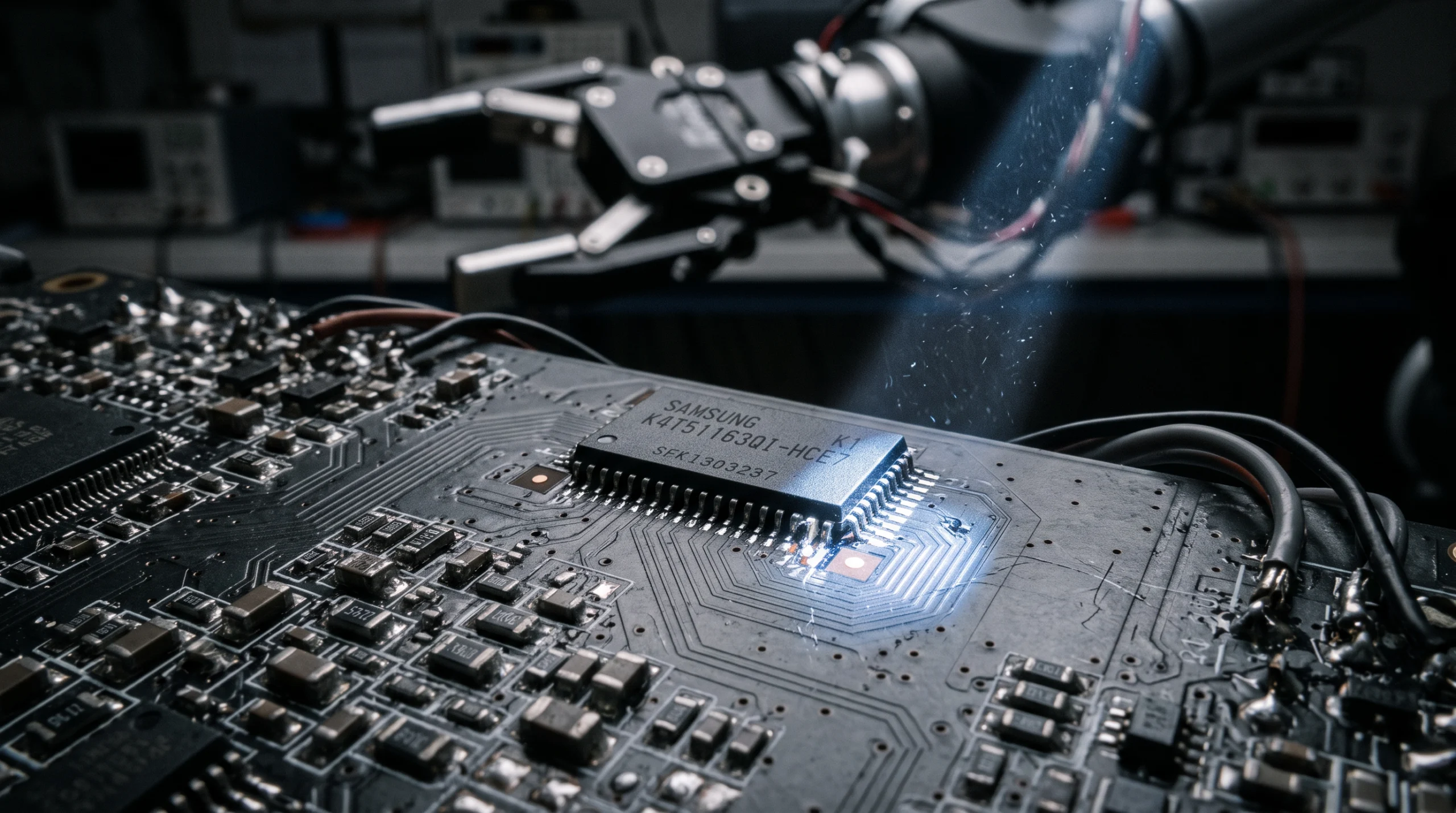
AI-generated editorial illustration · TemperatureZero · August 18, 2026
Keep reading the signal
Get the Daily Signal — a concise briefing on what actually matters in AI and the systems around it.
Subscribe FreeContinue the archive