
Daily Signal — July 4, 2026
TL;DR: Carnegie Mellon and UCLA researchers demonstrate multi-agent LLM pipelines refactoring C/C++ code for high-level synthesis hardware flows, marking a concrete expansion of AI automation into chip design. Simultaneously, TechCrunch’s 2026 AI glossary attempts to stabilize contested terminology — from AGI to hallucinations — at precisely the moment those terms are entering regulatory and product decisions. A separate NIST-led study on Schottky barrier height prediction reinforces a parallel trend: computational methods are progressively displacing experimental iteration in semiconductor engineering.
Today’s Themes
- AI automation is moving upstream into hardware design workflows, where errors compound differently than in software — functional bugs introduced by LLM refactoring can manifest as silicon defects or security vulnerabilities in deployed hardware.
- The gap between how AI terms are used in engineering, business, and policy contexts is wide enough to distort real decisions, and a single publication’s glossary is both a symptom of that problem and a partial remedy.
- Computational materials modeling is being positioned as a front-end design tool rather than a back-end validation check — a shift that changes who owns contact engineering in semiconductor workflows.
- Multi-agent orchestration is appearing not just in software and productivity applications but in structured engineering domains with hard correctness constraints, exposing the limits of current LLM reliability.
- Historical engineering knowledge is being centralized and made globally accessible at the same time that the pace of new engineering development makes institutional memory harder to maintain.
Top Stories
LLM Agents Used to Refactor Software for High-Level Synthesis Hardware Design Flows
What happened: Researchers at Carnegie Mellon University and UCLA developed a multi-agent LLM pipeline that analyzes C/C++ code and applies refactoring transformations — loop unrolling, function inlining, dataflow restructuring — to make it compatible with high-level synthesis tools that compile software into FPGA hardware. The system assigns different agents to code comprehension, performance-oriented transformation, and synthesis constraint validation. Benchmarking against representative HLS workloads showed the pipeline can accelerate code preparation and surface viable refactors, but the researchers also documented prompt sensitivity, occasional functional errors, and the continued need for human oversight.
Why it matters: HLS tool chains are notoriously unforgiving: code that violates their structural requirements yields hardware that is either unroutable or functionally incorrect, and the consequences are not a runtime error but a bad chip tape-out or a flawed accelerator deployed in production. Software engineers who use this pipeline without understanding that LLM-generated transformations can introduce subtle correctness failures — now documented by the authors themselves — may trust outputs that require expert validation they don’t know to apply. For teams building domain-specific accelerators or targeting FPGAs under time pressure, the practical question is not whether LLMs can help with HLS refactoring (they can, in constrained cases) but what verification layer sits between agent output and synthesis submission.
- Institutions: Carnegie Mellon University, UCLA
- Target hardware: FPGAs and reconfigurable logic via HLS compilation from C/C++
- Multi-agent roles: code understanding, performance transformation, synthesis constraint checking
- Documented limitations: prompt sensitivity, occasional functional errors, requirement for human oversight
- Published via: SemiEngineering
Source: semiengineering.com
“The Only AI Glossary You’ll Need This Year” Clarifies 2026 AI Jargon, from AGI to Hallucinations
What happened: TechCrunch published an extensive AI glossary intended as a living reference for 2026, covering foundational concepts (artificial intelligence, machine learning, deep learning, neural networks), operational terms (tokens, parameters, fine-tuning, context windows, prompting), and contested ecosystem concepts (AGI, hallucinations, AI safety, alignment, guardrails, red-teaming, agents, orchestration). On AGI specifically, the glossary surfaces the fact that OpenAI, Google DeepMind, and others use materially different definitions — framing the ambiguity itself as a finding rather than glossing over it.
Why it matters: Policymakers drafting AI regulation and enterprise buyers evaluating AI products are making consequential decisions using terms that lack stable, shared definitions — and the glossary’s decision to explicitly flag where definitions diverge across major labs (particularly on AGI) is more useful than false consensus would be. For practitioners, the more immediate value is in the operational vocabulary: imprecise use of terms like “context window,” “fine-tuning,” and “hallucination” leads to misspecified requirements, misaligned vendor contracts, and safety gaps that aren’t caught until deployment. A regularly updated public reference anchors those conversations in something more durable than individual blog posts.
- Publisher: TechCrunch, released July 3, 2026
- Scope: foundational, operational, and ecosystem AI terminology
- Notable: explicitly documents divergent AGI definitions from OpenAI, Google DeepMind, and others
- Framing: intended as a “living guide” updated as terminology evolves through 2026
- Coverage includes: hallucinations, AI agents, tool use, orchestration, guardrails, red-teaming
Source: techcrunch.com
Computational Strategies for Predicting Schottky Barrier Heights for Advanced Semiconductor Contacts
What happened: SemiEngineering published a technical summary of work by researchers from NIST, the University of Maryland, and Johns Hopkins surveying and evaluating computational methods for predicting Schottky barrier heights (SBH) at metal-semiconductor interfaces. The piece compares density functional theory-based approaches, more approximate methods, and empirically corrected models, assessing accuracy and practical usability for engineering workflows. Key physical challenges examined include interface dipoles, Fermi-level pinning, and work-function alignment — all mechanisms through which naive models diverge from experimental measurements. The authors argue for integrating SBH prediction into computational materials design and device simulation earlier in the design cycle.
Why it matters: As device nodes shrink and wide-bandgap and 2D-material systems enter production, contact resistance is no longer a second-order correction — it is a primary performance and yield variable. Device engineers currently relying on empirical iteration to characterize contacts face time and cost penalties that computational prediction could reduce, but only if the methods are robust enough to handle the interface chemistry of real devices rather than idealized models. The NIST involvement is significant: it signals that metrology standards bodies are treating SBH computation as mature enough to warrant systematic validation, which is a prerequisite for these methods to enter mainstream TCAD tool chains.
- Institutions: NIST, University of Maryland, Johns Hopkins
- Physical parameter: Schottky barrier height (SBH) at metal-semiconductor interfaces
- Methods surveyed: density functional theory, approximate atomistic models, empirically corrected approaches
- Key failure modes documented: Fermi-level pinning, interface dipoles, work-function misalignment in naive models
- Target applications: advanced CMOS, power electronics, 2D-material and wide-bandgap devices
Source: semiengineering.com
IEEE Launches a Global Museum to Bring Engineering History to a Worldwide Audience
What happened: IEEE Spectrum reports on the launch of IEEE’s Global Museum, a digital platform aggregating historical artifacts, documents, photographs, and narratives from IEEE’s archives and partner institutions. The museum covers electrical, electronic, computing, and communications engineering milestones, and is explicitly designed for remote access by students, educators, engineers, and the public. The initiative also aims to surface contributions from underrepresented regions and communities, framing the platform as both a preservation tool and a discovery engine.
Why it matters: For educators and STEM outreach professionals, a centrally curated, globally accessible archive changes the practical cost of incorporating engineering history into curricula — primary sources that previously required institutional access or archival travel are now available at zero marginal cost. The harder test will be whether the museum’s curation methodology for underrepresented contributors is systematic or anecdotal; that distinction determines whether it becomes a genuine research resource for historians of technology or primarily a public engagement platform.
- Publisher highlight: IEEE Spectrum
- Format: digital museum, remote access, curated narratives with social and cultural context
- Scope: electrical, electronic, computing, and communications engineering history
- Stated goals: preservation, discovery, education, and surfacing underrepresented regional contributions
Source: spectrum.ieee.org
Security Watch
- LLM hallucinations in hardware design loops: The Carnegie Mellon/UCLA research explicitly documents that LLM-driven HLS refactoring can produce functional errors — in a hardware context, these are not recoverable at runtime. Teams deploying such pipelines without rigorous synthesis-level validation are introducing an unquantified correctness risk into physical design flows.
- Hallucinations as a systemic reliability threat: TechCrunch’s glossary identifies hallucinations as a central safety and reliability problem for generative AI in decision-support and code-generation contexts. The framing matters: “hallucination” is sometimes treated as an edge case, but in structured engineering tasks — including the HLS refactoring described above — confident fabrication of incorrect transformations is a design-critical failure mode, not a conversational nuisance.
- Computational SBH model overconfidence: The NIST-led survey notes that naive SBH prediction models fail to match experimental values due to interface physics they don’t capture. If overconfident computational predictions are integrated into automated design flows without uncertainty quantification, systematic errors could propagate into contact specifications across large semiconductor production runs before experimental discrepancies surface.
What to Watch Next
- Whether the Carnegie Mellon/UCLA LLM-HLS pipeline publishes quantitative benchmarks — LUT utilization, timing closure rates, power — that allow direct comparison to manually refactored baselines; without those numbers, the practical ceiling of this approach remains undefined.
- Whether NIST moves to incorporate the surveyed SBH computational methods into formal metrology standards or TCAD tool integration guidelines, which would be the concrete signal that this work is transitioning from academic survey to engineering practice.
- How TechCrunch’s stated commitment to maintaining the glossary as a “living guide” holds up as new agent architectures, safety frameworks, and regulatory vocabulary emerge — the update cadence will determine whether it remains a reliable reference or becomes a dated snapshot.
- Whether IEEE’s Global Museum publishes its curation criteria and data access policies for historians of technology, which would clarify whether the platform has research utility beyond public engagement.
- As multi-agent LLM orchestration appears in hardware design (HLS refactoring), semiconductor physics (computational design), and AI governance (glossary standardization) within a single news cycle, watch for whether any major EDA vendor announces formal integration of LLM agents into their tool chains — that would convert today’s research demonstrations into production deployment decisions.
Bottom Line
The day’s most structurally significant story is not the glossary or the museum — it is the demonstration that multi-agent LLMs are now being applied to engineering tasks with hard correctness constraints and physical consequences, while the field simultaneously lacks stable shared language for the reliability properties those agents are supposed to have. The tension between “LLMs can accelerate HLS refactoring” and “LLMs introduce functional errors that require expert validation” is not a solvable problem through better prompting alone; it is the central unresolved question about deploying generative AI in any domain where errors don’t surface until after production.
Sources
- techcrunch.com — AI Glossary 2026
- semiengineering.com — Schottky Barrier Heights Prediction
- semiengineering.com — LLM Agents for HLS Refactoring
- spectrum.ieee.org — IEEE Global Museum
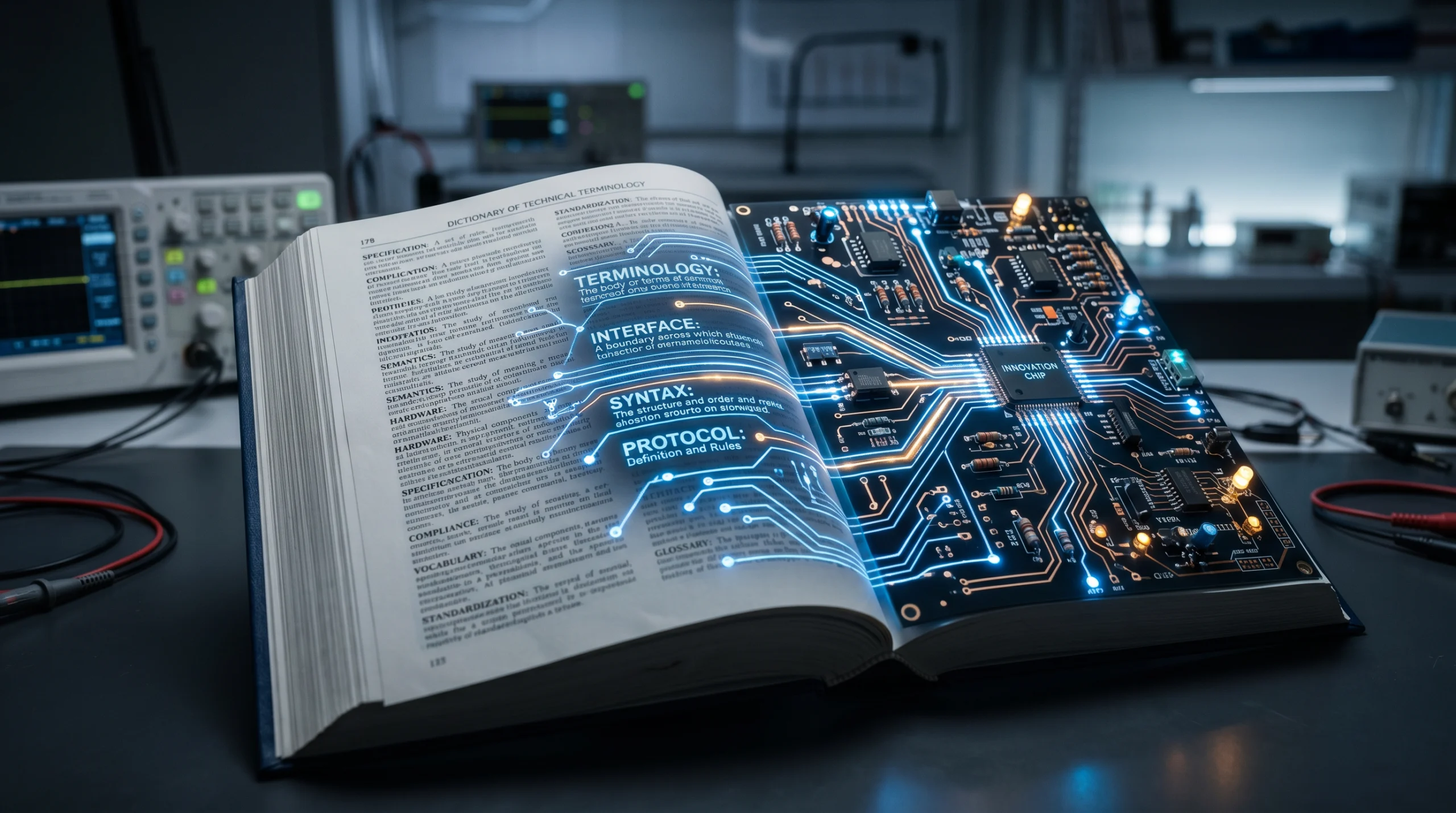
AI-generated editorial illustration · TemperatureZero · July 4, 2026
Keep reading the signal
Get the Daily Signal — a concise briefing on what actually matters in AI and the systems around it.
Subscribe FreeContinue the archive