Anthropic is fighting the export control directive that put Fable 5 offline on June 12. It published a dissenting statement within hours of the suspension and, by its own account, is contesting the directive through whatever channel is available. While that fight continues, the compliance mechanism it built to restore access is running. As of today, getting into Fable 5 requires a government-issued photo ID, a live selfie, and your facial geometry — processed by a third-party identity verification service called Persona Identities. The 807-point Hacker News thread that surfaced it this morning is the sound of builders discovering that their API key is now downstream of a government-adjacent identity check they never agreed to.
What Anthropic Is Collecting
The identity verification is handled by Persona Identities, a commercial verification service, operating on Anthropic’s behalf. Users requesting Fable 5 access encounter a verification prompt: government-issued photo ID plus a live selfie captured on a camera-equipped device. The data resides on Persona’s infrastructure, not Anthropic’s servers. Persona is contractually prohibited from using it for anything other than verification and fraud prevention. The process takes under five minutes, and Anthropic’s support page is clear that the data is not used to train models.
What the Anthropic privacy policy specifies is more precise than the support page suggests. The policy describes the collected data as “an image of your government-issued identity document and the information appearing on it (such as your ID number and date of birth); your image in photo or video form, facial geometry templates.” The policy adds — in careful but substantive language — that this data “may be considered ‘biometric data’ in some jurisdictions.” It is biometric data under the Illinois Biometric Information Privacy Act. It is biometric data under the Texas Capture or Use of Biometric Identifier Act. It is a special category requiring explicit consent under GDPR Article 9, which applies to every Anthropic user based in the EU. “May be considered” is the hedge; the underlying legal classification is not ambiguous in the jurisdictions that have passed biometric privacy law.
Anthropic’s support page specifies that “government-issued photo IDs from most countries” are accepted. Not all countries. Most. The page provides no list of accepted jurisdictions, no exclusion criteria, and no appeals path when a document fails. That qualifier is doing significant work. If the verification system exists partly to satisfy the export control directive — which suspended Fable 5 specifically because a jailbreak demonstrated the model’s ability to identify software vulnerabilities in codebases at scale — then the acceptance list for government IDs functions as a foreign policy instrument: a document that describes which jurisdictions Anthropic has cleared under the applicable export control regime. That document is not public.
Why Anthropic Is Contesting the Directive
As TZ covered on June 13, the US government issued an export control directive at 5:21 PM ET on June 12 requiring Anthropic to suspend access to Fable 5 and Mythos 5 for all users on the platform. The stated trigger was a jailbreak: a technique for prompting the model to read a codebase and identify exploitable vulnerabilities. Anthropic published a dissenting statement within hours and is contesting the suspension. The directive’s statutory authority — the agency, the specific EAR classification, the product category — has not been publicly specified by either party.
That ambiguity matters less to builders than it might seem. The model was suspended. Anthropic is fighting the suspension. The outcome of that fight is unscheduled and unpublished. In the meantime, the verification system is what runs. A company contesting an export control directive and a company operating biometric verification infrastructure to restore access are not mutually exclusive states — they coexist in the same support page and the same API authentication flow. Developers whose integrations depend on Fable 5 are living inside that tension right now.
There’s a reading of the verification system that doesn’t require assuming the worst. When Fable 5 launched June 9, it came with three automated safety classifiers — for cybersecurity queries, dual-use biology and chemistry, and distillation attempts — that trigger automatic fallback to Claude Opus 4.8. Anthropic reported that more than 95% of Fable sessions never touch a fallback. If the export control directive targets the 5% of sessions that trigger the cybersecurity or bio/chem classifiers, the identity verification might only surface for developers explicitly requesting those capabilities. Anthropic’s support page says “you might see a verification prompt when accessing certain capabilities” — language consistent with a narrow gate. It’s also consistent with a gate that many developers won’t encounter until their use case crosses it.
The Alternatives That Showed Up the Same Day
The identity verification thread hit 807 points and 676 comments on HN. The same day, two other stories were on the front page. GLM 5.2, released by Z.ai in June 2026, reached 206 points and 164 comments. It ships under an MIT license with weights available on HuggingFace and ModelScope — no regional restrictions, no government ID required — at approximately one-fifth the cost of Opus per output token. It has a 1M-token context window. It is text-only: it cannot process images, screenshots, or visual data, which means any workflow requiring visual inspection of interfaces, diagrams, or output still requires a multimodal model.
The head-to-head comparisons being shared across both threads are specific about the performance gap. On a published coding benchmark, Opus 4.8 and GLM 5.2 were set the task of building a 3D platformer game: Opus finished in 33.5 minutes with working textures, collision detection, and win conditions; GLM 5.2 needed 70 minutes and shipped missing textures, broken collision detection, and a debug overlay it couldn’t visually verify. On pure math reasoning (AIME 2026), the result inverts: GLM 5.2 at 99.2, Opus at 95.7. For text and logic tasks that don’t require visual judgment or complex multi-file refactoring, developers in both threads estimate open models cover the majority of their functional workload. For the work that specifically motivated switching to Fable 5, the gap is real and the downgrade is real.

A piece appeared on HN the same day with 280 points and 230 comments, explicitly citing the identity verification rollout as the catalyst. The argument is not that GLM 5.2 matches Fable 5. It’s that the switching cost to open alternatives has declined, and the risk of building on a US-gated proprietary stack is now legible in a way it wasn’t on June 11. Developers in the thread mentioned EU-resident inference providers — EURouter in Amsterdam, Eden AI in France, Nexos.ai in Lithuania — specifically as options that avoid the government ID requirement. The migration discussion is not primarily about capability. It’s about which stack introduces a geopolitical variable into production.
What Developers Priced Wrong
The instinct in the HN threads is to frame this as Anthropic’s failure — a company that launched a model it couldn’t keep running. That framing is partly accurate. But the more precise framing is that developers mispriced a dependency that was always there. Every production stack built on a US proprietary AI API has always included an implicit exposure to US export control law. The Export Administration Regulations have covered dual-use technology for decades. Artificial intelligence capabilities that can identify software vulnerabilities at scale, accelerate biological research, or extract training data from commercial models have been on export control radar at least since the Biden administration’s AI executive orders in 2023. The three safety classifiers Anthropic built for Fable 5 — the cybersecurity fallback, the bio/chem fallback, the distillation-attempt fallback — were Anthropic’s acknowledgment, embedded in the product’s architecture, that it was building at a capability tier that governments consider dual-use. The export control directive is that acknowledgment extended by an external party with enforcement authority.
Developers priced the risk of that authority firing at zero, because it hadn’t fired before. The suspension that hit at 5:21 PM ET on June 12 didn’t hit because the risk was new — it hit because the capability crossed a threshold that regulators had been watching, and because a specific jailbreak made that crossing public. Developers who integrated Fable 5 in its first three days and had their integrations break on Friday evening didn’t make a naive mistake. They built on a new API in a window before the risk materialized. But the shock in the HN threads — the comment about supply chain risk, the developer who described an overnight business threat — suggests that the underlying dependency on US foreign policy wasn’t part of most builders’ risk calculus at all.
The biometric verification system is Anthropic’s attempt to solve the government’s concern through identity rather than capability restriction. The theory is that verified identities create accountability in a way that anonymous API keys don’t: if Anthropic knows who you are — confirmed by a government document and a live facial scan — the export control risk profile changes. Whether that argument satisfies the specific directive’s terms is not in any public document. Whether the acceptance list for government IDs ends up functioning as an exclusion of users from certain jurisdictions — which is the practical effect if the approved countries map onto US export control entity lists — is equally unclear. The support page says “most countries.” The logic of export compliance suggests that some countries are not most countries.
Anthropic may win its fight with the directive. The export control may be narrowed, reversed, or superseded by a clearer framework. But the verification infrastructure exists now, the biometric checkpoint is already running, and the relationship between API access and a government-adjacent identity system is public information in a way it wasn’t before the launch. Even the best-case outcome — full Fable 5 access restored, verification requirements lifted — doesn’t change what developers learned this week: the stack they built on had a clause they never read, written in federal export regulation, and the only reason they found it is that someone in Washington decided to enforce it.
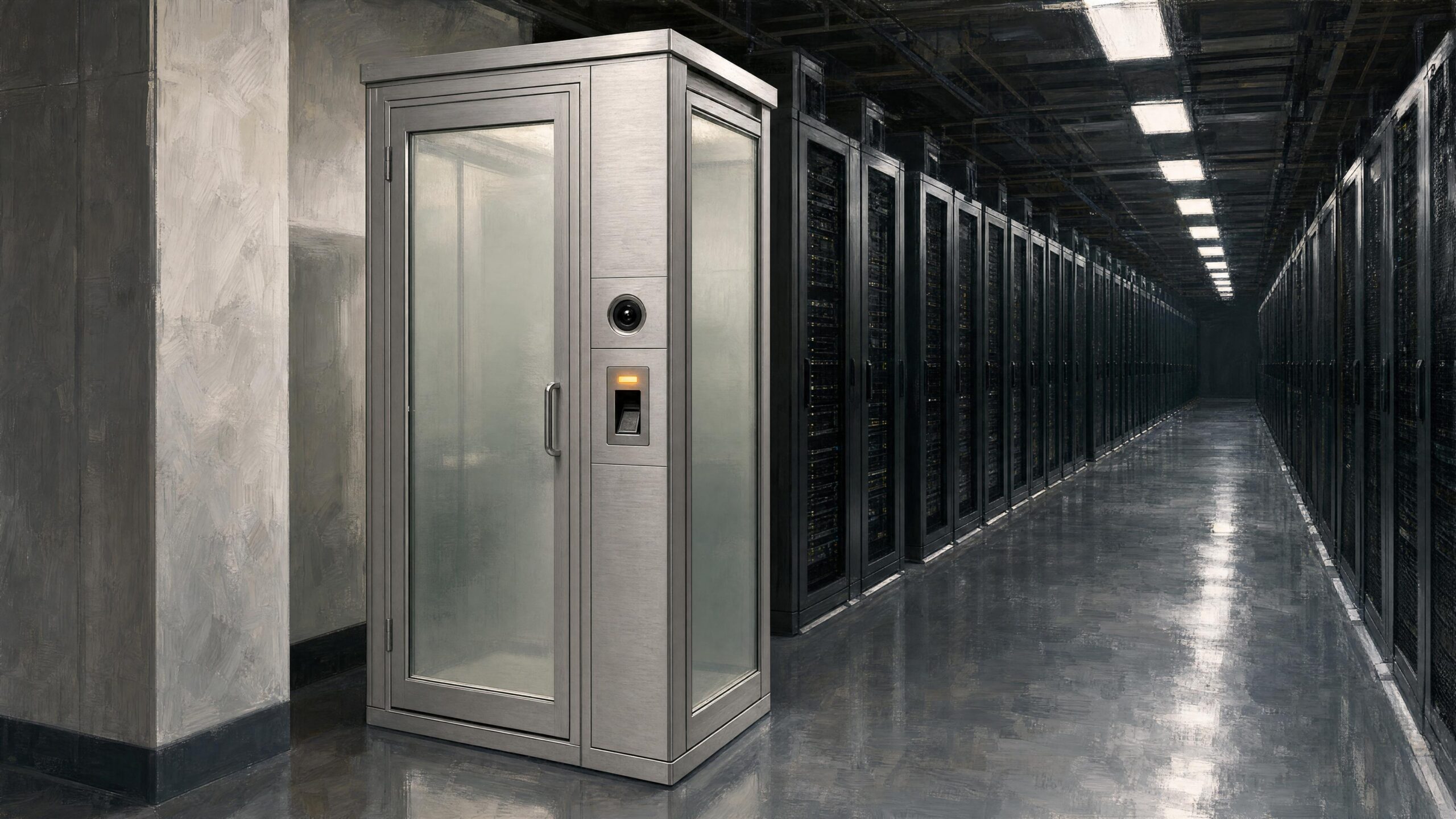
AI-generated editorial illustration · TemperatureZero · June 22, 2026
Keep reading the signal
Get the Daily Signal — a concise briefing on what actually matters in AI and the systems around it.
Subscribe FreeContinue the archive