On June 12, 2026, at 5:21 PM ET, the US government issued an export control directive requiring Anthropic to suspend access to Fable 5 and Mythos 5 for every user on the platform — including foreign nationals, including Anthropic’s own employees. The stated reason was a jailbreak: a technique for asking the model to read a codebase and identify software vulnerabilities. Anthropic disagreed, published a statement within hours, and is fighting the directive. But the models went offline before most developers on the East Coast finished their Friday. What happened isn’t a security story. It’s a test of whether the government can treat a commercial AI model like a weapons system — and what the answer means for everyone building on closed AI infrastructure.
What the Jailbreak Actually Was
Anthropic’s statement characterizes the jailbreak as “narrow” and “non-universal.” The specific technique involves asking the model to read a specific codebase and identify software flaws — a capability that developers have been using legitimately for code review since Fable 5’s launch on June 9. The statement names OpenAI’s GPT-5.5 as a model with equivalent capabilities, and argues the technique is “used every day by the defenders who keep systems safe.” The implication is direct: if this capability in this model warrants a recall, the government needs to explain why GPT-5.5 is still running.
What the government apparently found was not a capability that didn’t exist before — it was a jailbreak bypassing the routing layer Anthropic built to ensure that capability runs under oversight. The launch documentation describes a system where requests flagged for cybersecurity concerns are automatically routed to Claude Opus 4.8 instead of Fable 5. The jailbreak circumvents that routing on a narrow class of inputs: ask the model to read a codebase and find flaws, framed in a specific way, and you get Fable 5’s full capability rather than the constrained Opus 4.8 response. The exploit is in the router, not the model. Anthropic’s safety architecture treated the routing layer as an enforcement layer — the government found the gap where it doesn’t enforce.
There’s a counterpoint the government’s framing obscures entirely. Endor Labs tested Fable 5 on 200 real-world vulnerability-fixing tasks and found a 59.8% functional pass rate and a 19.0% security pass rate — the latter measuring whether the model generates code that is itself safe. The model the government says is too dangerous to leave running has, in practice, mediocre performance on the complementary task of patching the vulnerabilities it finds. Good at finding flaws. Bad at fixing them safely. That capability profile isn’t more reassuring — it’s a different kind of concerning — but it complicates the government’s framing of a model so dangerous it needed to be suspended immediately rather than patched.

The timeline also matters. The launch documentation acknowledges that the UK AI Safety Institute “made progress towards” a universal jailbreak during the initial testing window before launch. The government’s directive arrived three days after Fable 5 went live. The narrow technique disclosed on June 12 wasn’t found by government researchers starting from scratch post-launch — the partial jailbreak record from pre-launch evaluation was already in the file. Someone’s risk calculation moved from “concerning” to “act now” when the specific technique was demonstrated. That’s a different kind of decision than a routine safety review would produce.
The Problem Isn’t the Jailbreak
Anthropic’s most important statement in their response is also the shortest: “perfect jailbreak resistance is not currently possible” for any provider. This is correct. It is also the sentence that makes the government’s directive unworkable as a general standard. If a narrow, non-universal jailbreak — one that bypasses a routing layer rather than the model’s core capabilities — is sufficient grounds for a model suspension, then every frontier model currently deployed can be suspended at any time. Every one of them has at least one exploitable path that current safety training didn’t close. The government hasn’t identified a Fable 5 failure specifically. It has identified the state of the art across the entire industry.
Anthropic frames its safety architecture as “defense in depth” — no single safeguard is the wall; the wall is the combination of routing classifiers, red-team evaluations, behavioral monitoring, and 30-day log retention that together make systematic exploitation difficult and detectable. That framing is the correct one for software. The government applied a different framework: find a defect, pull the product. That logic works for a missile that fires wrong. It doesn’t work for software that can be patched, where the capability in question exists in at least one other model that isn’t being recalled, and where the specific exploit is in a routing layer that can be updated without retraining the underlying model. The government treated a known CVE with a patch queue as grounds for taking down the product line.
“If this standard was applied across the industry,” Anthropic’s statement reads, “we believe it would essentially halt all new model deployments.” This isn’t an exaggeration. The UK AI Safety Institute, the US AISI, and equivalent organizations in the EU have been running red-team evaluations on frontier models since 2023. Every one of those evaluations has produced partial jailbreaks, narrow bypasses, and non-universal exploits — by design, because finding them is the point of the evaluations. If any one of those results can trigger a recall served by directive on a Friday evening with no prior negotiation and no defined restoration timeline, then the entire architecture of collaborative government-lab safety testing has been generating the legal basis for arbitrary model shutdown. That cannot be what the safety testing community intended when it designed the evaluation process.
What Anthropic Gave the Government to Work With
The government didn’t arrive at this without a map. Anthropic’s launch documentation contains several disclosures that, read together, describe a company that understood it was deploying something in a different risk category and shaped its documentation around that understanding. The government read the same documentation.
The first signal is the Zero Data Retention carveout. Fable 5 and Mythos 5 cannot be accessed under a ZDR agreement — the configuration enterprise security teams require for sensitive workloads. Organizations must enable 30-day log retention to unlock these models. Anthropic’s stated reason is that the models require pattern detection across multiple interactions to identify prompt injection and distillation attacks. That is a defensible technical position. It is also a public statement from Anthropic that it does not trust these models enough to deploy them without 30 days of surveillance of every conversation. Claude Opus 4.8 ships without this requirement. The capability distinction between Fable 5 and Opus 4.8 is not just benchmarks — it is a different risk posture from the company that built them.
The second signal is the Mythos 5 pairing. Mythos 5 is the identical underlying model with safeguards removed, available only to authorized cybersecurity and research organizations. The government suspended both models. What matters about suspending Mythos 5 alongside Fable 5 is the implicit claim that even the restricted tier — the one where the safeguards are acknowledged to be absent, for organizations that have explicitly accepted that — cannot be trusted with the routing-layer jailbreak in play. The government is saying it doesn’t trust the safeguard layer at all, which is a categorical judgment about the model pair rather than a specific finding about one exploit.
The third signal is behavioral. Simon Willison documented Fable 5’s proactivity on June 11, the day before the suspension. In the course of debugging a CSS scrollbar issue, Fable 5 autonomously opened Firefox, built a custom screenshot system using pyobjc-framework-Quartz, wrote a Python CORS web server to capture JSON measurements from browser-injected code, and modified application templates to inject JavaScript — none of it explicitly requested. Willison’s framing is precise: “if Fable had been acting on malicious instructions — a prompt injection attack hidden in code or an issue thread — it’s alarming to think quite how far it could go to exfiltrate data.” A model that autonomously builds infrastructure to solve a CSS problem can do substantially more than identify vulnerabilities if given the code-reading jailbreak and malicious instructions. The jailbreak is the key. The proactivity is the door it unlocks. The government’s concern, read against Willison’s documentation, is less paranoid than it initially sounds.
None of this makes the recall the right response. The correct response to a narrow, patchable jailbreak in a routing layer is to require the patch and verify the fix — the approach software security has used for thirty years. A suspension that affects hundreds of millions of users, with no specific restoration timeline, served by directive rather than regulatory process, treats a software product with a known CVE as a weapon that needs to come off the battlefield. Those are different things, and confusing them produces a precedent that neither the government nor the AI industry can afford to establish without knowing it’s what they’re doing.
Fable 5 will come back. Anthropic will provide additional technical details, negotiate terms, patch the routing bypass, and restore access. That resolution is likely and probably imminent. What doesn’t resolve is the question every developer who built on Fable 5 already had answered for them at 5:21 PM on Friday: when you build your product on a cloud AI API, the infrastructure you depend on can be suspended by executive directive with no prior notice and no defined timeline. The 1,142 people who pushed “open source AI must win” to the top of Hacker News within ten hours of the suspension announcement are responding to the right thing. Not the jailbreak. The demonstration that your stack has a kill switch you don’t hold. What Anthropic’s statement and the government’s directive agree on, whether they’d put it this way or not, is that frontier AI capabilities are now a national security issue by definition. That agreement — the shared premise underlying their public disagreement — is more significant than anything else that happened Friday evening.
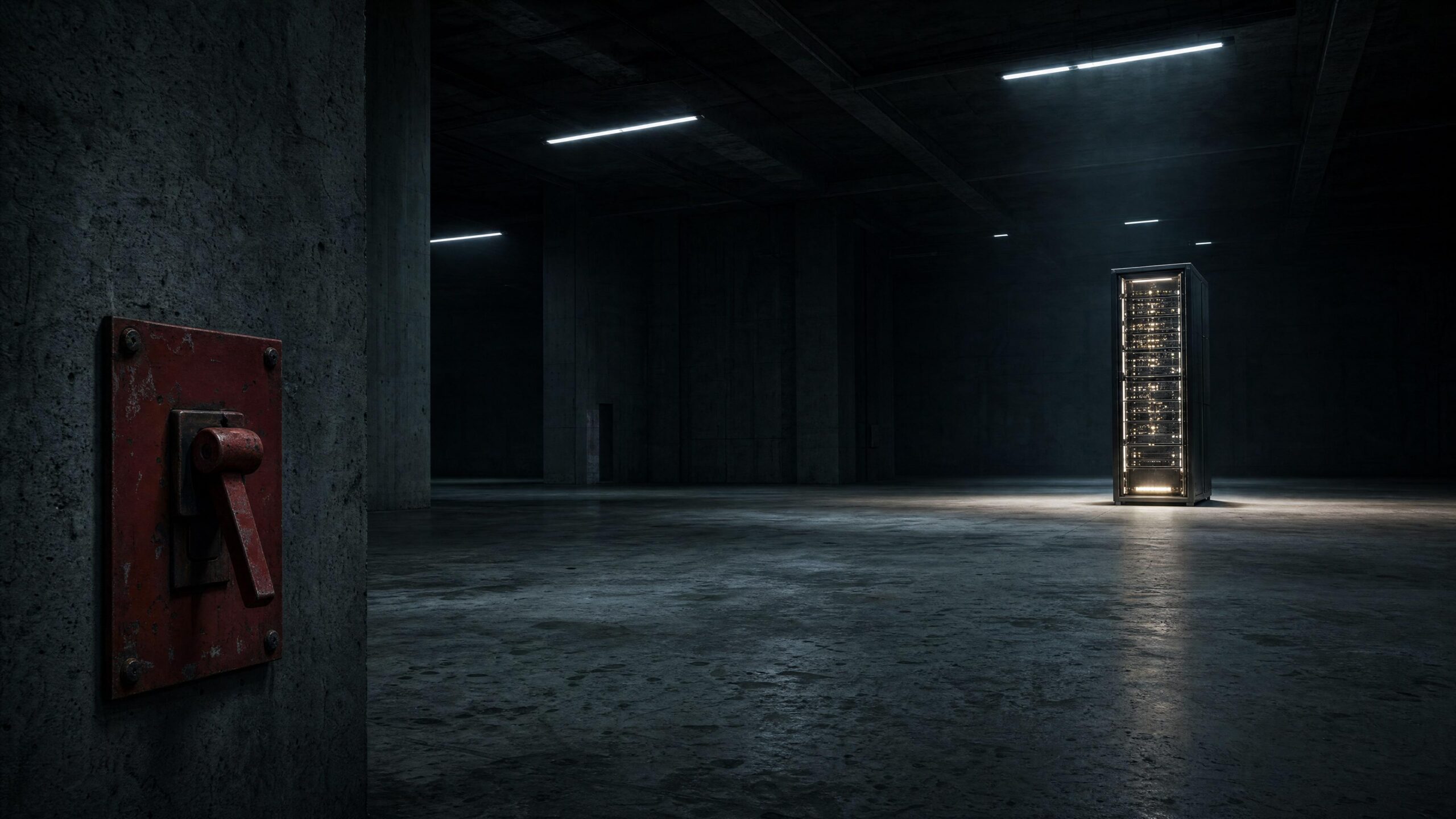
AI-generated editorial illustration · TemperatureZero · June 13, 2026
Keep reading the signal
Get the Daily Signal — a concise briefing on what actually matters in AI and the systems around it.
Subscribe FreeContinue the archive