Nobody has to learn AI.
I know that’s not what you’ve been told. You’ve been told the opposite, loudly, by people with a course to sell — that there’s a train, it’s leaving, and your seat costs four payments of $97. “Learn AI or get left behind” is one of the great sales pitches of the decade, precisely because it’s built to be unfalsifiable. It dresses a forecast in the clothes of a threat, and the threat does the selling.
But strip the urgency out and look at the actual claim, and it falls apart in two directions at once. So let me say the unpopular thing to both crowds in the same breath: the boosters and the haters are watching the same screen, and it’s the wrong one.
The two cartoons
Ask most people what AI is right now and you’ll get one of two cartoons.
The first is the horror: a slop machine flooding the internet with fake images, a phishing-email firehose, a fleet of broken apps shipped to skim a few dollars before anyone notices, comment sections drowning in half-articulate spam. A thing that steals work and burns power and makes everything a little worse. The second is the rapture: a productivity miracle that will 10x your output, replace your team, and — if you act now — let you out-hustle everyone who didn’t buy the course.
Here’s what’s strange. These two camps think they’re at war. They’re not. They’re describing the same thing — the loud, low-effort, gold-rush layer that sits on top of the technology — and then disagreeing only about whether it’s good news or bad. The doomer and the hustler are looking at the same screen. They’ve just labeled it differently.
And it’s the wrong screen.

The slop is real. It’s also the part that’s already dying.
I’m not going to pretend the ugly layer isn’t there. It is. The spam is real, the scams are real, the environmental cost is a real conversation we should be having with numbers instead of vibes. None of that is invented.
But here’s the bet I’ll put my name on: most of the use cases people hate right now fade faster than anyone expects. Not because anyone cleans them up out of virtue — because they’re the cheapest possible thing to do with a powerful tool, and cheap-and-everywhere is always the first phase of a new technology, never the lasting one. The early web was a wasteland of pop-ups and link farms. The early app stores were ten thousand flashlight apps and fart-noise buttons. The junk didn’t define the medium. It was just what rushed in first, before anyone had figured out what the thing was actually for.
The slop is not AI’s destiny. It’s AI’s adolescence.
The screen nobody’s looking at
So what’s on the other screen — the one neither the hype guys nor the haters spend any time on?
The real utility of this technology is connective. It’s the ability to find deep, non-obvious relationships across enormous bodies of information faster than any divided team of specialists ever could. It’s translation in the broadest sense — not just between languages, but between concepts and methods, so that the architect’s instinct can reach an engineering problem, the doctor’s pattern-recognition can reach a sociological one, the artist’s eye can reach a mathematical one. The walls between disciplines were never about the problems being unrelated. They were about no single human having the time to become fluent in two fields at once. That wall is what’s coming down.
It’s the disenfranchised founder whose only missing piece was never the idea — it was the team they could never assemble or afford. It’s intelligence and leverage landing in the hands of people whose biggest opportunity used to be capped by the accident of where they were born. If you’ve ever watched talent go nowhere because it was in the wrong zip code, you already understand the stakes better than the people arguing about deepfakes.
This is, if you want the grand version of it, the next step on the same track that gave information a voice — the line that runs from the printing press through the telephone through the open internet. I’ll say that once and then put it down, because the grand version is exactly the kind of thing that gets oversold. But it’s true, and it’s worth saying plainly: the consequential part of AI is the part that connects what couldn’t connect before. And almost nobody is fighting about it, because there’s no course to sell and no outrage to farm.

“Left behind” is a sales pitch. The real risk is worse.
Now, the part that should annoy everyone equally.
To the people insisting you must learn AI or perish: being early helps. It genuinely does — early fluency compounds, and I’d rather you be curious than not. But early adoption does not buy you a seat at any table. The future where this technology bifurcates society into a class that owns the systems and a class that’s owned by them — that’s a real risk, and it is not a risk you can opt out of by finishing an online module. A permanent underclass is not avoided one prompt-engineering certificate at a time. Selling it that way isn’t just dishonest; it points people at the wrong threat entirely. It reframes a structural problem as a personal failing you can buy your way out of, which is the most profitable lie available and the least true.
To the people who refuse to touch any of it: you don’t have to. You can decline to generate a single image, write a single prompt, or open a single chatbot, and you are allowed to. But you don’t get to decline the consequences. You will watch this technology reshape your industry, your information, and your institutions whether or not you ever use it, the same way you live in a world built by the internet whether or not you have opinions about TCP/IP. The one thing the refusers actually have to accept is the boring one: it’s here, and it isn’t leaving. Disliking it and pretending it’s temporary are two different things, and only one of them is a strategy.
What’s actually left to decide
Strip away both cartoons and you’re left with the only question that was ever interesting: not whether, but what for.
The harms arriving in the short term are real, but notice that almost none of them are new. Concentration of capital, environmental recklessness, institutions too old and slow to govern what they’ve built, power flowing toward power because that’s what power does — those were already in motion. AI is an accelerant on fires that were already lit. That’s an argument for grabbing the controls, not for staring at the flames and narrating.
Because the bifurcated future — the permanent underclass, the systems owned by a few and rented to everyone else — is not written. It’s preventable. Preventing it is the actual work, and it’s collective work: it lives in how these systems are built, who they’re accountable to, what we decide they’re for. That conversation is the entire game. And right now it’s being drowned out on both sides — by people too angry at the slop to look past it, and by people too busy selling shovels to admit the gold-rush layer is the least important thing about the mine.
The tech is here. It is not going anywhere. The only question still open is what we point it at — and that question is far too important to leave to the people selling courses.
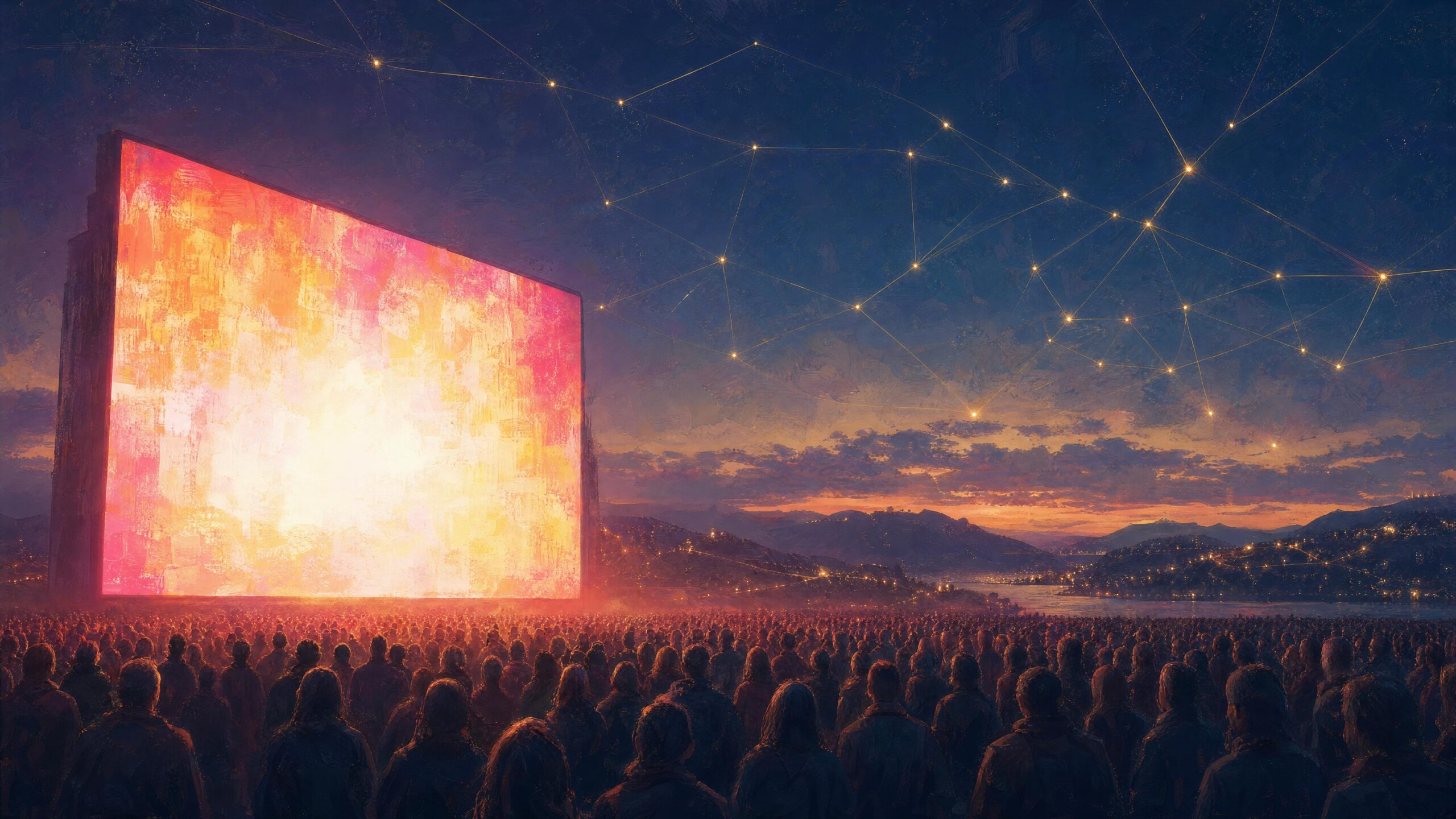
AI-generated editorial illustration · TemperatureZero · May 31, 2026
Keep reading the signal
Get the Daily Signal — a concise briefing on what actually matters in AI and the systems around it.
Subscribe FreeContinue the archive