On May 16, Silvio Schembri, Malta’s Minister for Economy, Enterprise and Strategic Projects, and George Osborne, Managing Director and Head of OpenAI for Countries, stood up a partnership that gives every Maltese resident with an EU eID account a year of ChatGPT Plus once they complete an online course developed by the University of Malta. Euronews reported the announcement at 12:31 GMT+2; Engadget put the eligible population at about 574,250 and the per-person notional value at $240 for the year. Both outlets ran the same boosterish frame: an EU country, empowering its citizens, with the most advanced AI tool available.
That frame is wrong, or at least incomplete. What Malta announced is not an AI literacy program. It is the first EU member state to let OpenAI’s sovereign-relations team test the consumer flank of its global expansion strategy inside the union, one full year of habit formation, on roughly 574,000 new accounts that the Maltese government just helped acquire. It is happening exactly when EU industrial policy is supposed to be pivoting in the other direction, and exactly eleven days after Mistral signed an open letter demanding Brussels protect European tech from “subsidised rivals with very strong market penetration in the EU.” The literacy framing is the part you tell the press. The lock-in funnel is the part that’s actually new.
The mechanics, not the slogan
The shape of the program is worth being specific about, because the specifics are what give it teeth. Schembri’s office and the Malta Digital Innovation Authority will distribute access. The University of Malta has built the prerequisite course; it teaches, per Euronews, “what AI is, what it can and cannot do, and how to use it responsibly at home and at work.” Engadget’s Jackson Chen reported that the eligibility check runs through Malta’s EU eID system, and that Maltese citizens abroad qualify if they complete the course. The first phase launches in May.
The dollar amounts on either side are revealing. ChatGPT Plus retails at $20 per month in the United States; over a year, that is roughly $240 per person. Multiply that against the eligible population and you arrive at a notional figure of about $137 million in subscription value. Neither government has disclosed what, if anything, changes hands between Malta and OpenAI. That blank is the most important number in the deal: the public statements imply OpenAI is giving the access away. Companies do not give away $137 million in subscriptions to demonstrate civic virtue. They give it away to acquire a country’s worth of users at a price per acquisition that no consumer marketing budget could match, with the friction of the eID gate doing the targeting and the Maltese government doing the distribution.
Read the program as a customer-acquisition mechanism and the design clicks into place. The course is a qualification filter, not a curriculum: it confirms each new user is a Maltese resident with the technical literacy to operate a Plus subscription. The one-year term is exactly long enough to convert a curious citizen into a habituated one. The Malta Digital Innovation Authority handles the part that would otherwise be a CAC line item. At month thirteen, the renewal prompt arrives. Some percentage of those 574,000 accounts will keep paying out of pocket. Even a single-digit conversion rate prices in cleanly.

Osborne’s brief, in practice
The personnel are worth being specific about too. OpenAI hired George Osborne — the former UK Chancellor of the Exchequer — as Managing Director and Head of OpenAI for Countries in December 2025, with TechRadar’s Craig Hale reporting that his remit covered Stargate data-center expansion outside the United States, government partnerships, and “public service use cases.” A syndicated TokenRing brief published New Year’s Day put the working scope at roughly 50 nations, with pilot programs already advancing in Nigeria, the UAE, Argentina, and Indonesia, and Stargate itself valued at $500 billion across its full buildout.
Read in January, that list looked Global South–weighted: countries with limited domestic AI ecosystems and political appetite for foreign infrastructure investment. Five months later, the same brief has crossed the EU’s external border. Osborne’s public line on Malta — “Malta is leading the way by showing how countries can empower their citizens to benefit from the transformative potential of AI” — is diplomatic boilerplate. The substantive move is that the OpenAI for Countries program has demonstrated it can operate the same playbook inside the European Union: pair a credentialed local institution (here, the University of Malta) with a public-sector distribution authority (the MDIA) and route a foreign LLM into national infrastructure under the banner of literacy.
It is the kind of move that is only available to a company with the political-capital surface area OpenAI has built. Hiring a former G7 finance minister is not symbolic. Schembri’s office did not call Anthropic. It called the person whose ten years running the UK Treasury made him a known quantity to every European minister of finance. The Malta deal is the proof point that the OpenAI for Countries org chart works as advertised.
Mistral signed a letter eleven days earlier
The counter-narrative is unusually clean, because it is documented in public, and it is recent. On 5 May 2026, ASML’s Christophe Fouquet, along with executives from Airbus, Ericsson, Mistral AI, Nokia, SAP, and Siemens, published a joint letter in Handelsblatt and Corriere della Sera asking the European Commission to streamline the AI Act, invest more in industrial policy, and “protect European companies from subsidised rivals with very strong market penetration in the EU.” The letter went directly to Ursula von der Leyen. Its frustration was explicit: “More than three years after the ‘ChatGPT moment,’ Europe is still debating regulation, while others have long shifted focus to scaling AI in physical systems and robotics.”
Mistral signed that letter knowing it had material to point to. Sovereign Magazine reported in January that France’s Ministry of the Armed Forces had awarded Mistral a framework agreement covering all branches of the military through 2030, running on French-controlled infrastructure, and that France and Germany had separately signed a Mistral framework for public-administration AI in the same month. Mistral’s CEO Arthur Mensch told the magazine that “European governments are coming to us because they want to build the technology and they want to serve their citizens.” That sentence reads differently on May 17 than it did on January 18. France and Germany came to Mistral. Malta did not.
The reflexive response to this point is that Malta is a 574,000-person country and the EU’s two largest economies are not, so the comparison is unfair. The reverse is true. Malta is exactly the kind of country where the question of which AI provider becomes default citizen infrastructure resolves first, because the rollout is administratively tractable and the EU’s institutional resistance is thinnest at the periphery. The Mistral playbook published by Kelly Kirsch on ESG.ai in April identified “sovereign infrastructure” as one of the four pillars Europe would need to defend. The Maltese government, watching that same debate, chose not to participate in defending it.

What “literacy” actually means here
The honest steelman for Schembri is that capability matters and OpenAI has it. ChatGPT, on the consumer-facing product side, is meaningfully more capable than Le Chat right now on the tasks most ordinary users will throw at a chatbot. If the goal is to put the best available tool in the hands of a small country’s citizens, OpenAI is a defensible call. Schembri’s own framing — “we refuse to let our citizens stay behind in the digital age” — has teeth if you accept the capability gap as decisive.
What the framing cannot survive is the substitution test. “AI literacy” in 2026 is being defined, in this program, as exposure to one specific US lab’s specific product behind one specific eID gate for one specific year. That is not literacy. Literacy is the ability to evaluate multiple tools, recognize where each fails, and route work intelligently across them. A program that gates 574,000 citizens through a single vendor’s product for twelve months does not teach that skill. It establishes a baseline assumption — that ChatGPT is what AI is — and then exits the building at the moment the assumption hardens. The University of Malta course can teach the principles of responsible use. It cannot, by design, teach the comparative judgment that real literacy requires, because the entire post-course experience is monocultural.
Malta could have built a program that gave citizens a sandboxed allowance to use Le Chat, Claude, Gemini, and ChatGPT side-by-side, with the same curriculum and the same eID gate. That program would have cost the Maltese government something, because no vendor would have subsidized it. OpenAI’s offer was free. The decision to take the free option is the decision to define “the digital age” as the product of one vendor.
The Maltese program is the first European data point in what is going to be a multi-year sovereignty contest, and the early geometry is already legible. France will continue to route through Mistral. The European Commission will continue to talk about the AI Act, and a subset of CEOs will continue to write letters about being subsidized to death. Smaller member states — those without a domestic frontier-AI champion to defend — will be the contested terrain, and Osborne’s team will work it country by country, with offers structured exactly like the Malta one: credentialed local partner, public-sector distributor, free year, no disclosed money changing hands. Brussels does not get to be surprised by this. The mechanism by which the EU loses sovereign-AI ground is not a treaty violation; it is a series of bilateral announcements like the one Schembri made on Friday, each individually defensible, each contributing to a state where European citizens experience AI primarily through American products subsidized by American capital and distributed by their own governments. Mistral asked Brussels for cover on May 5. On May 16, an EU member state showed why.
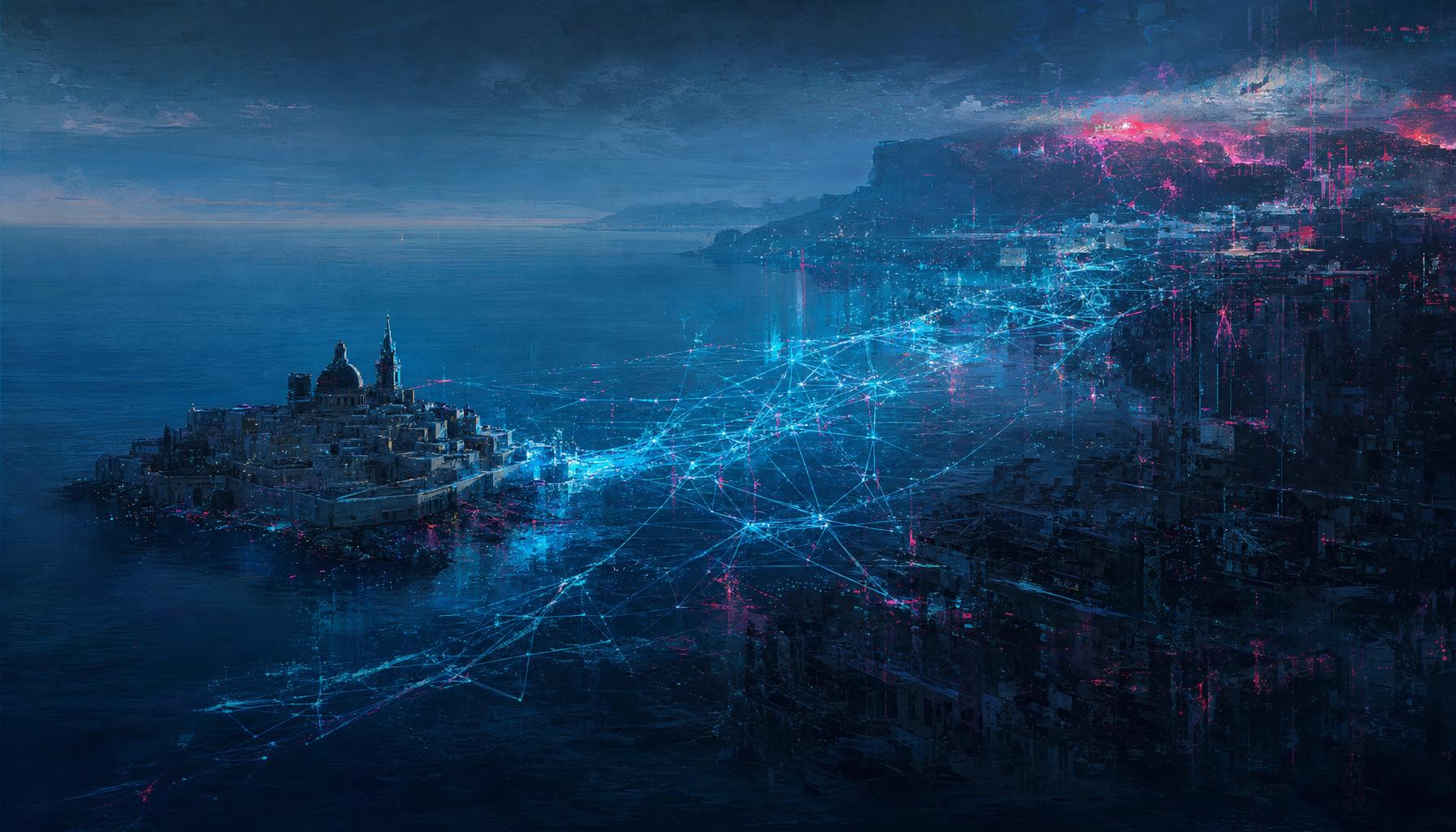
AI-generated editorial illustration · TemperatureZero · May 16, 2026
Keep reading the signal
Get the Daily Signal — a concise briefing on what actually matters in AI and the systems around it.
Subscribe FreeContinue the archive