
Daily Signal — February 22, 2026
TL;DR: China’s brain-computer interface industry is moving from research to commercial scale, backed by state strategy, clinical momentum, and a cohort of well-funded startups that are beginning to challenge Neuralink and Synchron on their own terms. Elsewhere, new research quantifies atmospheric damage from rocket reentries for the first time, Apple drops the traditional keynote format ahead of a major product week, and the creator economy grapples with what AI-generated content floods mean for the humans trying to build audiences inside it.
Today’s Themes
- China’s coordinated BCI push: State roadmaps, provincial insurance integration, and a 120 billion yuan market projection by 2040 signal this is industrial policy, not just startup activity.
- The atmospheric cost of commercial spaceflight: The first real-time measurement of pollution from a specific rocket reentry makes it harder to treat the upper atmosphere as a free dumping ground.
- Apple rethinks the launch format: No keynote stream, no Steve Jobs Theater — just press releases, hands-on demos, and at least five products across three days in three cities.
- AI and the creator economy: ByteDance’s Seedance 2.0 and MrBeast’s fintech acquisition frame a broader question about whether the next generation of creators can survive a content environment that never sleeps.
- Quantum capital persistence: Quantonation’s doubled second fund is a data point worth noting as the sector tests institutional patience.
Top Stories
China’s Brain-Computer Interface Industry Is Racing Ahead
What happened: A new wave of Chinese BCI startups — led by NeuroXess, BrainCo, Gestala, StairMed, Neuracle, and several others — is transitioning from research programs to commercial deployment, backed by an explicit national strategy. In August 2025, China’s industry ministry and six other agencies issued a roadmap targeting key technical milestones by 2027 and a full domestic supply chain by 2030. Provinces including Sichuan, Hubei, and Zhejiang have already established medical service pricing for BCI treatments, accelerating their pathway into the national health insurance system. BrainCo has quietly filed for a Hong Kong IPO after raising 2 billion yuan ($287 million) earlier this year. The country has completed its first fully implanted, wireless BCI trial — the second globally after Neuralink — and logged more than 50 flexible implantable BCI clinical trials by mid-2025.
Why it matters: What’s happening in China’s BCI sector is not a single company story — it’s an industrial policy story. The combination of state roadmaps with hard milestone targets, provincial-level insurance infrastructure, mature manufacturing supply chains, and surging private capital creates conditions that are structurally different from how U.S. neurotech has developed. Phoenix Peng, co-founder of NeuroXess and founder of ultrasound BCI startup Gestala, frames the long-term vision explicitly: neuroscience and AI are “two sides of the same coin” destined for deep integration. Whether or not that framing proves prescient, the capital and clinical infrastructure being built now will shape who controls neurotech’s commercial layer when the technology matures.
The technical diversity is also worth noting. Chinese firms are not simply racing Neuralink on invasive implants. Gestala’s ultrasound approach — targeting chronic pain, stroke, and depression without requiring surgery — represents a potentially larger addressable market. Early clinical results cited by the company show pain score reductions of 50% from a single session, with effects lasting one to two weeks. HongShan Capital (formerly Sequoia China) has backed Zhiran Medical, which is working on flexible, high-throughput electrodes specifically designed to reduce the inflammation and signal degradation that limit long-term implant performance.
- BCI market valued at 3.2 billion yuan (~$446M) in 2024; projected at 120 billion yuan by 2040
- National roadmap targets key milestones by 2027, full supply chain by 2030
- BrainCo filed for Hong Kong IPO after raising $287M; StairMed raised $48M Series B in early 2025
- 50+ flexible implantable BCI clinical trials completed by mid-2025
- Gestala’s first-generation product — a clinic-based ultrasound device — expected by Q3 2026
Source: Kate Park, TechCrunch
Study Shows How Rocket Launches Pollute the Atmosphere
What happened: New research published in Communications Earth & Environment (a Nature-family journal) presents the first real-time measurement of upper-atmosphere pollution from a specific spacecraft disintegration. German researchers tracked the reentry of a SpaceX Falcon 9 upper stage that made an uncontrolled reentry on February 19, 2025, detecting lithium concentrations roughly ten times higher than normal in the 80–110 kilometer altitude band that sits just above the stratosphere. The study used a suite of remote sensing instruments and atmospheric models to trace a plume from a single identifiable event to a specific location above Germany — a methodological first in this field.
Why it matters: Until recently, the upper atmosphere was treated as largely unchanged by human activity. That assumption is no longer defensible. Researchers estimate that the mass of human-made material entering the upper atmosphere via reentries has doubled to nearly a kiloton per year over the past five years. For some metals like lithium, human-produced concentrations already exceed those from natural meteor ablation. As commercial launch cadence grows — with projections of up to 60,000 satellites in orbit by 2040 and reentries potentially happening every one to two days — the cumulative effect on atmospheric chemistry, ozone processes, and high-altitude climate dynamics is genuinely uncertain.
The regulatory picture is thin. The Outer Space Treaty and Liability Convention establish principles around preventing harmful contamination, but practical enforcement mechanisms for atmospheric pollution from space activities are essentially nonexistent. Leonard Schulz of the Technical University Braunschweig has warned that introducing large quantities of catalytic metals into the atmosphere approaches inadvertent geoengineering territory — happening without any deliberate governance framework. Under a high-growth scenario reaching roughly 2,000 launches per year, modeling suggests potential ozone loss on the order of 3 percent, comparable to the atmospheric effects of a severe wildfire season.
- First real-time tracking of upper atmosphere pollution from a single identified spacecraft reentry
- Lithium concentrations 10x above normal detected 20 hours after an uncontrolled Falcon 9 reentry
- Human-produced reentry material now estimated at nearly a kiloton per year, doubled in five years
- Up to 10,000 metric tons of aluminum oxide particles annually projected by 2040 under high-growth scenarios
Source: Bob Berwyn, Ars Technica / Inside Climate News
Apple Might Take a New Approach to Announcing Its Next Products
What happened: Apple has invited press to a “special Apple Experience” on March 4, held simultaneously in New York, London, and Shanghai, but without a traditional live-streamed keynote. Bloomberg’s Mark Gurman reports that Apple plans to roll out at least five products across three days — March 2 through March 4 — through press releases and pre-recorded videos, with March 4 serving as the hands-on demo day. Products expected include the iPhone 17e, a low-cost MacBook (~$599 with an A18 Pro chip), updated MacBook Air and Pro models with M5-series chips, new iPads including an M4 iPad Air, and potentially a Mac Studio refresh.
Why it matters: The format shift is worth noting for what it signals about Apple’s communication strategy, not just its product cadence. The traditional keynote is a tool for managing attention and narrative at scale. Replacing it with a multi-city, multi-day press release cadence followed by hands-on demos suggests Apple is either confident enough in its product lineup that it doesn’t need the theatrical container, or is deliberately experimenting with a format that extends media coverage across multiple news cycles rather than concentrating it in a single event. Either interpretation suggests Apple is thinking carefully about how attention works in a media environment where single-day coverage spikes are increasingly fragile.
The product slate itself spans entry-level to professional, multiple form factors, and at least two chip families. Whether the format change enhances or diminishes launch impact will be visible in the coverage and sales data that follows.
- No traditional livestreamed keynote; announcements via press releases and pre-recorded videos March 2–4
- March 4 “experiences” in New York, London, and Shanghai provide hands-on media time
- At least five products expected; iPhone 17e and low-cost MacBook most confirmed
- MacBook Pro with M5 Pro/M5 Max, M4 iPad Air, and updated standard iPad also expected
Source: Anthony Ha, TechCrunch
Can the Creator Economy Stay Afloat in a Flood of AI Slop?
What happened: Two adjacent news items triggered a broader industry conversation this week. MrBeast’s company announced the acquisition of fintech startup Step, and Hollywood studios — including Netflix — sent cease-and-desist letters to ByteDance over its new video generation model Seedance 2.0, which was enabling users to generate videos featuring real actors without authorization. The TechCrunch Equity podcast took up the question directly: what happens to the creator economy when the content environment is flooded with AI-generated material, and is there a sustainable path for the next generation of creators to build audiences within it?
Why it matters: The structural question is real. The economic model for most creators is already under stress — ad revenue has plateaued as a standalone revenue source, which is why the most successful YouTubers are aggressively diversifying into e-commerce, product lines, and now fintech acquisitions. AI-generated content adds a new layer of pressure: it’s not just that more content is being produced, but that algorithmic discovery systems now face the prospect of being gamed by AI operations running 24/7 with no production resource constraints.
The counterargument — that AI-generated content’s primary effect may be to make authentic human presence more scarce and therefore more valuable — has some data behind it. OpenAI’s Sora, which launched with significant attention, has reportedly struggled to retain users, in part because consuming content without a sense of authentic human agency produces a specific kind of emptiness. That’s an interesting signal, though too early to generalize. What’s more certain is that the economics of the creator economy are being restructured in real time, and the current moment — before the full effects of AI video become visible in platform analytics — is when the business models that survive will be built or abandoned.
- MrBeast company acquires fintech startup Step, reflecting creator diversification beyond ad revenue
- Hollywood studios send C&D letters to ByteDance over Seedance 2.0 actor likeness usage
- New creators face algorithmic competition from AI content operations with no production resource constraints
- Authenticity premium emerging as counterweight; OpenAI’s Sora struggling to retain users as a data point
Source: Anthony Ha, TechCrunch
Bill Gurley: Playing It Safe Is the Worst Career Move Right Now
What happened: Venture capitalist Bill Gurley argued publicly that the current moment in technology — marked by rapid AI capability advancement and significant market uncertainty — makes risk aversion in career decisions particularly costly. The core argument: when the landscape is shifting fast, staying in a safe position optimizes for a world that may not exist in two years.
Why it matters: Gurley’s comments are directionally consistent with a broader pattern visible in talent flows. Senior engineers and product leaders are leaving large tech companies for AI-native startups at a rate that hasn’t been seen since the early mobile era. The reasoning isn’t purely financial — it’s that the skills and judgment developed at the frontier of an AI-native organization may be worth more in five years than any amount of vesting at a company whose core product is temporarily insulated from AI disruption. Whether or not the framing is correct, the talent allocation decisions being made right now will shape which organizations have the capability to compete when AI capabilities mature into production systems.
Source: Connie Loizos, TechCrunch
Samsung Adds Perplexity to Galaxy AI
What happened: Samsung announced it is integrating Perplexity into its Galaxy AI feature set, giving Galaxy device users access to Perplexity’s AI-powered search and answer capabilities directly within the Samsung ecosystem.
Why it matters: This is the latest move in a quiet but significant competitive dynamic: the race to be the default AI layer on Android devices. Google has historically owned this space through its default search integration, but device manufacturers are increasingly signing agreements with AI-native companies to offer alternatives. For Perplexity, Samsung integration represents meaningful distribution at scale. For Samsung, it’s a signal that the company is not content to simply pass Google’s default AI through to users. The implications for Google’s default search revenue on Android are worth watching over the coming quarters.
Source: The Verge
Quantonation’s Double-Sized Second Fund Shows Quantum Still Has Believers
What happened: Quantonation, a Paris-based venture fund focused on quantum technologies, closed its second fund at double the size of its first, signaling continued institutional appetite for quantum investment despite the sector’s extended timeline to commercial viability.
Why it matters: Quantum computing has been perpetually five to ten years from commercial relevance for long enough that investor patience has become a genuine test. Quantonation’s doubled fund suggests that sophisticated institutional LPs have not abandoned the thesis — they’ve repriced it for a longer horizon. The firms that maintain committed quantum portfolios through this period will have preferential access to the companies that emerge on the other side of the hardware maturity curve. What that curve looks like for error correction, qubit coherence times, and practical algorithmic advantage over classical systems remains the central open question. The capital is expressing a bet on the timeline, not on any specific technical answer.
Source: Anna Heim, TechCrunch
Security Watch
The BCI story carries embedded security dimensions that are easy to overlook when coverage focuses on clinical progress and market projections. Neural interface systems capture and process neural data — a category of information with no established international governance framework, no agreed standards for data sovereignty, and no precedent for what constitutes a breach. China’s rapid clinical progress means real neural data from real patients is being collected and analyzed at scale, within a regulatory environment that provides minimal transparency to external observers. The questions of who owns that data, how it is stored, and whether it could inform other applications are not being asked loudly enough in coverage of this sector. Organizations working at the intersection of neuroscience, healthcare, and AI should be tracking this proactively rather than waiting for a governance framework to appear.
What to Watch Next
- China BCI regulatory frameworks: Whether Chinese BCI governance evolves to address data privacy and neural data sovereignty, or whether competitive pressure to move fast pushes those questions aside indefinitely.
- Apple’s March 4 week in practice: Whether the multi-day, multi-city format extends media attention or fragments it — and what the iPhone 17e sales trajectory signals about Apple’s mid-tier pricing strategy.
- Rocket pollution governance: Whether this study catalyzes regulatory attention at the FAA, ESA, or international treaty level, or gets absorbed into the background as one more externality of the commercial space boom.
- Creator platform responses: How YouTube, TikTok, and Instagram adjust discovery algorithms as AI-generated content volume increases — specifically whether authenticity signals become rankable features or remain unverifiable.
- Quantum fund deployment: Which specific companies and technical approaches Quantonation’s second fund backs will indicate whether the consensus quantum thesis is shifting toward near-term applications or staying patient on foundational hardware.
Sources
- TechCrunch — China’s BCI industry (Kate Park)
- Ars Technica — Rocket launch atmospheric pollution (Bob Berwyn / Inside Climate News)
- TechCrunch — Apple announcement format (Anthony Ha)
- TechCrunch — Creator economy and AI slop (Anthony Ha)
- TechCrunch — Bill Gurley on career risk (Connie Loizos)
- The Verge — Samsung adds Perplexity to Galaxy AI
- TechCrunch — Quantonation second fund (Anna Heim)
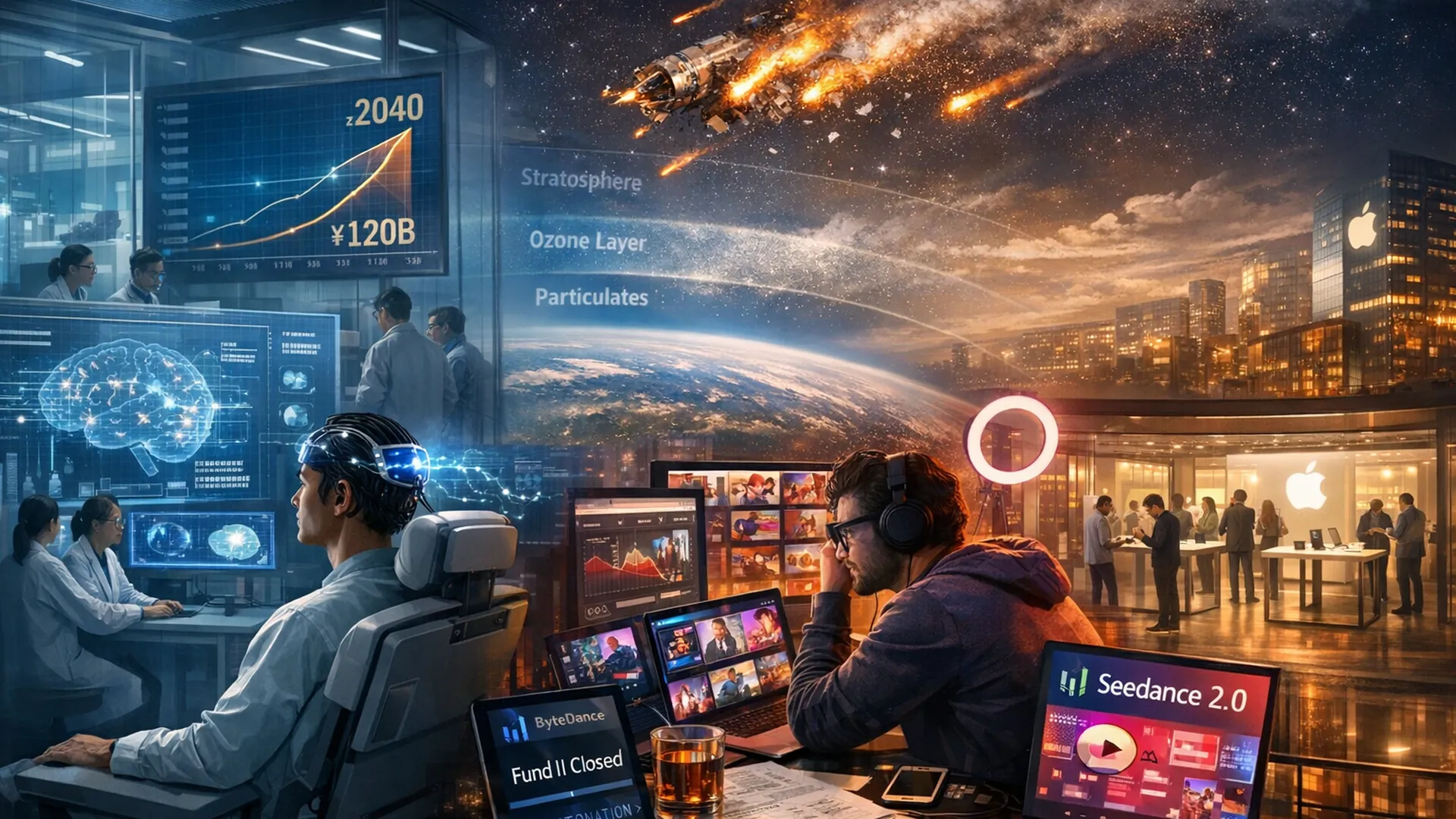
AI-generated editorial illustration · TemperatureZero · February 22, 2026
Keep reading the signal
Get the Daily Signal — a concise briefing on what actually matters in AI and the systems around it.
Subscribe FreeContinue the archive